Hybrid heat pumps: how they work and when they make sense
How a heat pump and a boiler share the heating under one controller, why hybrids get no grant in England, Wales or Scotland, what they cost to run in our example home, and when a hybrid or a standalone heat pump is the better choice.
A hybrid heat pump is an air source heat pump and a boiler, usually gas, run by one controller: the heat pump heats your home in milder weather, and the boiler takes over when it is colder or when gas makes heat more cheaply. Hybrids get no Boiler Upgrade Scheme grant in England and Wales and no Home Energy Scotland funding in Scotland, so it is worth setting a hybrid quote against a standalone heat pump: a median £12,826 installed before the grant, as reported by MCS installers under the Boiler Upgrade Scheme in England and Wales (July to September 2026), or £5,326 after the £7,500 grant in England and Wales, if the home qualifies. In the government-funded Electrification of Heat trial, the heat pump in a hybrid supplied a median 40.4% of the space heating.
At a glance
- How it works. One controller switches between heat pump and boiler by outdoor temperature, energy prices or both; MCS requires the heat pump to cover at least 55% of your home's heat loss.
- Grant. No Boiler Upgrade Scheme grant in England and Wales and no Home Energy Scotland funding in Scotland; Northern Ireland has no heat-pump grant open to all homeowners.
- Price. No official median exists for hybrids. Compare quotes with a standalone heat pump: a median £12,826 installed before the grant, as reported by MCS installers under the Boiler Upgrade Scheme in England and Wales (July to September 2026), or £5,326 after the £7,500 grant in England and Wales, if the home qualifies.
- Running costs. In our example home, heat from the heat pump beats the existing gas boiler only above an efficiency of 2.81, and a new boiler above 3.07 (Ofgem price cap, 1 October to 31 December 2026); the gas standing charge stays.
- Best fit. Homes that would still need radiator water above 55 °C after radiator and insulation changes, or owners keeping a newer boiler without a grant.
How a hybrid heat pump works
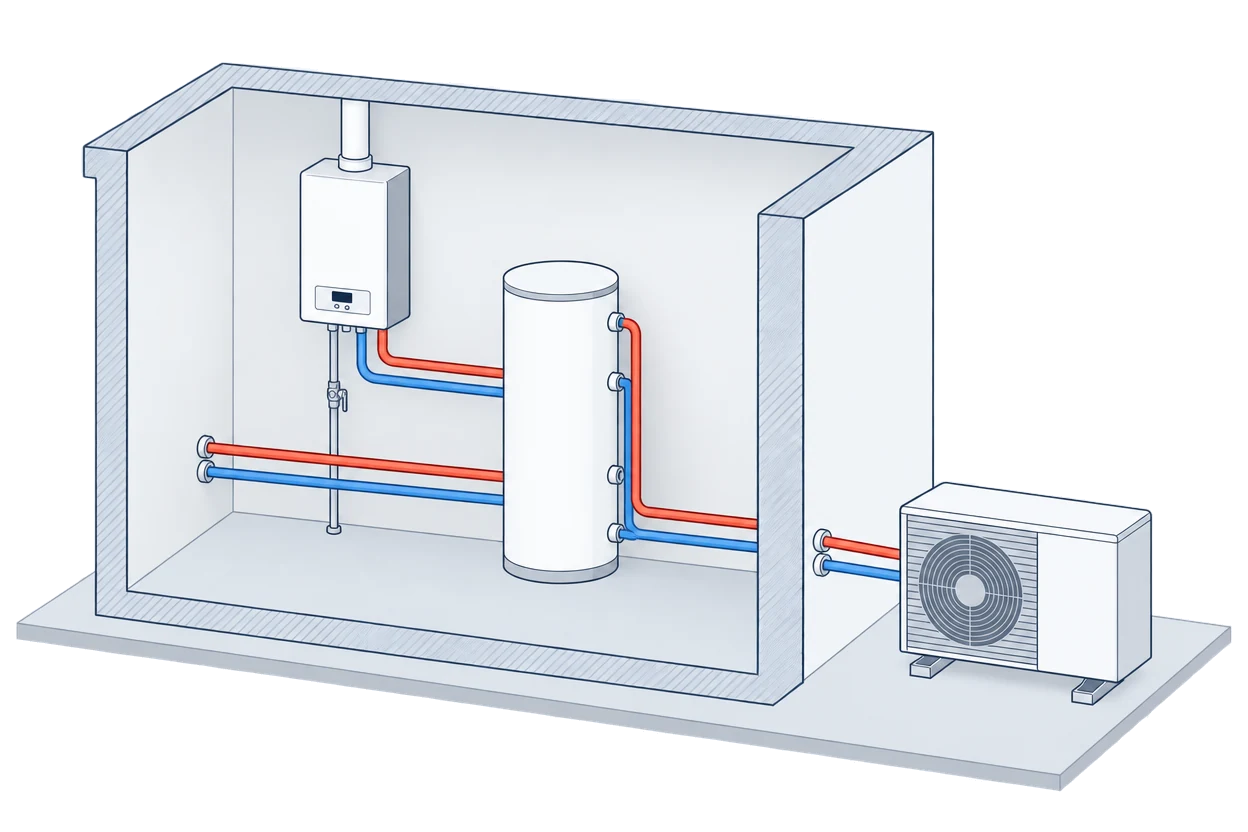
MCS, the certification scheme for heat pump installers and products, defines a hybrid as one or more heat pumps combined with a supplementary heat source, most commonly a fossil-fuel boiler, all run by a single master controller. An air-to-air heat pump can't be part of one.
The heat pump is an ordinary air-to-water unit feeding the same radiators as the boiler, so either can heat the house. The Electrification of Heat trial installed 155 hybrids in two layouts: integrated units with both in one package, and a separate outdoor heat pump alongside a boiler sized for the whole heating load (usually a new boiler, sometimes the existing one).
How the controller chooses
A heat pump's COP (coefficient of performance) is the heat it delivers per unit of electricity at a given moment; it falls as the air gets colder and your radiators need hotter water. The seasonal average is the SCOP. Controllers use one of three approaches, or a mix:
| Switch-over | How it decides |
|---|---|
| By temperature | below a set outdoor temperature, the switch-over pointInstallers may call it the bivalent point, the boiler joins in or takes over |
| By price | compares the cost of a unit of heat from each, using your energy prices and the heat pump's efficiency at the time |
| Heat pump first | runs the heat pump whenever it can meet the demand; the boiler covers the rest |
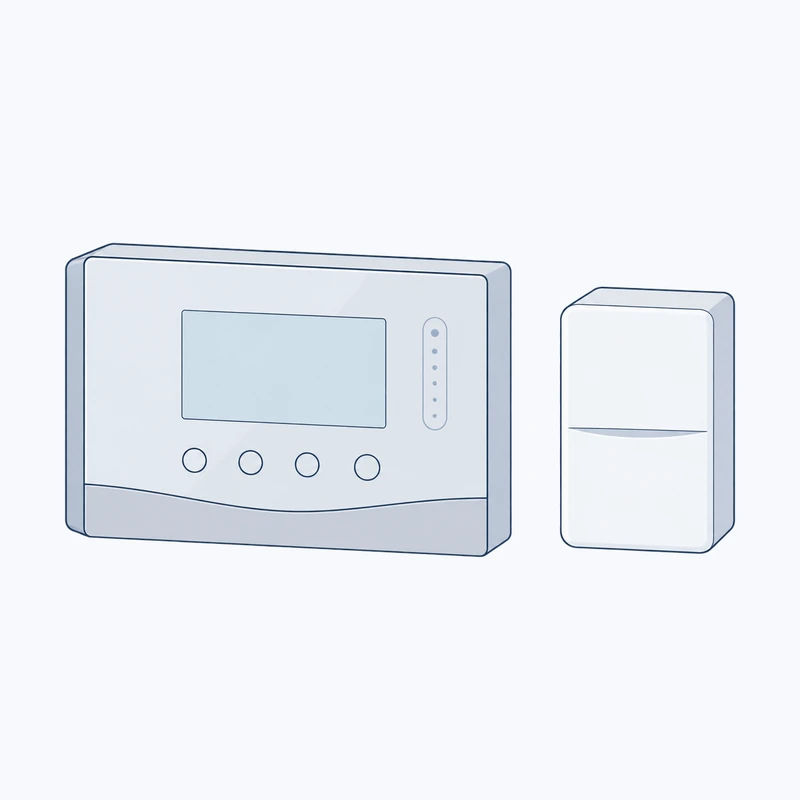
Viessmann says the boiler in its hybrid switches on only at particularly low temperatures; Daikin says its hybrid picks the most economical mode from outdoor temperature, energy prices and heat demand. MCS requires the control to be capable of prioritising the heat pump, set up as agreed with you. The trial's hybrids were generally commissioned to run at the lowest cost, so the boiler took over when it was cold enough to need hotter radiators.
How MCS sizes a hybrid
A standalone heat pump must cover at least 100% of your home's calculated heat loss without an electric backup heater. A hybrid may use a smaller one: under MCS's design standard, MIS 3005-D Issue 3.0, the heat pump must provide at least 55% of the heat loss, rated at a 55 °C flow temperature (the temperature of the water sent to the radiators) at your location's design outdoor temperature, and heat pump and boiler together at least 100%. For illustration, a home with an 8 kW heat loss needs a heat pump giving at least 8 × 0.55 = 4.4 kW at 55 °C flow on a design-temperature day.
The contract must state what share of your space heating, and of your hot water, the heat pump is designed to provide. Real use can sit well below a design figure: across the trial's 94 hybrids with a full year of data, the heat pump supplied a median 40.4% of the space heating, and between 29.7% and 55.5% in half of the homes. Where the heat pump did a smaller share it also ran less efficiently; the report suggests stop-start running may be the reason.
Hot water in a hybrid
Which part heats your hot water depends on the design, and MCS makes the installer put it in writing: the contract states the share of hot water the heat pump is designed to provide, and MCS's pre-sale performance estimate shows it as its own line. The trial didn't meter hot water in its hybrids, so its 40.4% covers space heating only.
If you have a combi boiler, ask whether the hybrid needs a hot-water cylinder, where it would go and which part heats it. Leaving hot water to the boiler means burning more gas; having the heat pump heat a cylinder means finding room for one. See heat pump hot water cylinders.
Hybrid heat pump grants by nation
In England and Wales, GOV.UK states that you cannot get a Boiler Upgrade Scheme grant for a hybrid heat pump system, such as a gas boiler with an air source heat pump. Ofgem's guidance adds that existing fossil-fuel heating, such as a gas or oil boiler, must be fully replaced, not kept alongside a funded heat pump. The regulations allow a supplementary appliance only if it isn't fuelled by fossil fuel, and the heat pump must meet the full space-heating demand on its own.
| Nation | Hybrid heat pump | Standalone heat pump |
|---|---|---|
| England and Wales | no Boiler Upgrade Scheme grant | £7,500 off the price if your home qualifies; your installer applies, ideally before work starts |
| Scotland | no Home Energy Scotland funding | grant and optional interest-free loan if the heat pump provides all your heating and hot water; you apply and wait for a written offer |
| Northern Ireland | no grant open to all homeowners | no grant open to all homeowners; income-tested schemes fund some air source heat pumps |
Home Energy Scotland says hybrid heat pumps are not eligible for funding; only heat pumps providing 100% of a home's heating and hot water qualify. The full rules, including Scotland and Northern Ireland, are in heat pump grants.
VAT differs between the two parts: a heat pump supplied and installed in your home carries 0% VAT until 31 March 2027, then 5%, while HMRC normally treats installing an energy-efficient boiler as standard-rated. A quote with a new boiler should show it as its own line.
What a hybrid heat pump costs
There is no official median price for a hybrid: the installed prices published for England and Wales come from Boiler Upgrade Scheme grants, which hybrids can't get. Set a hybrid quote against the figures that do exist:
| What | Price | Basis |
|---|---|---|
| Standalone air source heat pump | £12,826 | median reported by MCS installers under the Boiler Upgrade Scheme, England and Wales, July to September 2026, VAT included, before the grant |
| The same after the grant | £5,326 | in England and Wales, if the home qualifies for the £7,500 Boiler Upgrade Scheme grant |
| Replacement gas boiler | about £3,500 | government (DESNZ) estimate, VAT included |
| Hybrid | no official figure | no grant in England, Wales or Scotland: you pay the whole price |
In England and Wales, if your home qualifies for the grant, a standalone heat pump at the median price leaves you £5,326 to pay and replaces your boiler. A hybrid gets nothing off, so compare its quote with that £5,326, not £12,826; you also keep a boiler to maintain and a gas supply to pay for. Prices by size and type are in heat pump cost.
Running costs in our example home
Our example home is a 1970s gas-heated semi in England: 97 m², 9,500 kWh of gas a year and an existing combi boiler at 85% efficiency (our assumption), so 9,500 × 0.85 = 8,075 kWh of useful heat. Prices are the Ofgem price cap for 1 October to 31 December 2026, GB average, direct debit: electricity 26.32p/kWh with no VAT in Great Britain until 31 March 2027, gas 7.97p/kWh plus 29.68p a day standing charge.
A hybrid's controller is asking which machine makes the next unit of heat more cheaply. A kWh of heat costs the unit rate divided by the efficiency:
- Gas through the existing boiler: 7.97p ÷ 0.85 = 9.38p
- Gas through a new boiler at 93%: 7.97p ÷ 0.93 = 8.57p
- Heat pump at a COP of 2.5: 26.32p ÷ 2.5 = 10.53p; at 2.8: 9.40p; at 3.1: 8.49p
Pence per kWh of heat, our example home
| Source of heat | Gas boiler | Heat pump |
|---|---|---|
| Existing gas boiler (85%) | 9.38 | |
| New gas boiler (93%) | 8.57 | |
| Heat pump, COP 2.5 | 10.53 | |
| Heat pump, COP 2.8 | 9.40 | |
| Heat pump, COP 3.1 | 8.49 |
So the heat pump makes cheaper heat only when its efficiency beats 0.85 × 26.32 ÷ 7.97 = 2.81 against the existing boiler, or 0.93 × 26.32 ÷ 7.97 = 3.07 against a new one. The heat pump part of the trial's hybrids reached a median of 2.50 over a year, or 26.32 ÷ 2.50 = 10.53p per kWh of heat at these prices. At these prices, a controller set to run at the lowest cost would use the heat pump mainly in mild weather, when its efficiency is highest, and leave colder days to the boiler.
The standing charge is where the two part company. A standalone heat pump lets you end the gas supply: at a SCOP of 2.8 its electricity costs 8,075 ÷ 2.8 = 2,884 kWh × 26.32p = £759 a year (£850 at 2.5, £686 at 3.1), against £757 of gas plus £108 standing charge, £865 in all, and the break-even falls to 2.46. A hybrid keeps the gas connection, so the £108.33 a year stays and only cheaper units of heat can save money.
These figures move with each price-cap period. To estimate your own year, use MCS's method for hybrid performance estimates:
- gas = heat × boiler share ÷ boiler efficiency (MCS uses 0.93 for a new boiler, 0.82 to 0.92 for an existing one by age)
- electricity = heat × heat pump share ÷ heat pump efficiency
- cost = gas × gas rate + electricity × electricity rate + 365 × gas standing charge
Ask your installer for the shares and efficiency behind the estimate. Payback against a boiler is in heat pump vs gas boiler.
Hybrid heat pump vs air source heat pump: which fits?
| What differs | Standalone heat pump | Hybrid |
|---|---|---|
| Grant, England and Wales | £7,500 if your home qualifies | none |
| Gas supply | can end, saving the standing charge (£108.33 a year at the October to December 2026 cap) | stays, with its standing charge |
| Heat pump size (MCS) | at least 100% of the heat loss | at least 55%, rated at 55 °C flow |
| Coldest days | the heat pump alone | the boiler joins in |
| In writing | room heat losses, design flow temperature, SCOP | also the heat pump's share of heating and hot water |
| Appliances to service | one | two |
A hybrid can make sense when:
- Rooms would still need water above 55 °C after larger radiators and insulation, for example where radiators can't change. MCS tells installers to avoid high-temperature heat pumps unless more than 55 °C is needed, and to offer a 55 °C alternative with the efficiency difference explained; a hybrid is the other route. Check each room first with heat pump radiators.
- Your boiler is fairly new and you would rather add a heat pump than replace it, paying the full price with no grant in England, Wales or Scotland.
- You live in Northern Ireland, where most homeowners get no grant for either, so it comes down to each quote and running costs at your own prices (the GB price cap doesn't apply there).
A standalone heat pump is usually the better choice when the survey shows your home can be heated at 55 °C or lower, your home qualifies for the grant in England and Wales or Home Energy Scotland funding, or you want to end the gas supply, which lowers the break-even in our example from 2.81 to 2.46.
There is no ban on keeping or repairing a gas boiler in an existing home: the government's Heat and Buildings Strategy says no-one will be forced to remove their existing boiler. Other types are compared in air source heat pumps.
Before you sign a quote for a hybrid heat pump
- Design shares. The heat pump's share of space heating and of hot water, in the contract.
- Heat pump output. At 55 °C flow and your design outdoor temperature, against the calculated heat loss.
- Control settings. Switch-over point, price settings or heat-pump-first rule, agreed with you, and how to change them.
- Performance estimate. The combined kWh of electricity and gas a year, to price at your own tariff.
- Separate lines. Heat pump, any new boiler, controls, cylinder and radiators, each with its VAT.
- Existing boiler. If it stays, how it joins the single controller and who answers if the two don't work together.
- A standalone heat pump quote. From the same survey, with the grant as its own line if your home qualifies (England and Wales).
Figures that change
| What | Value | Applies |
|---|---|---|
| Boiler Upgrade Scheme, hybrid heat pump | no grant | England and Wales |
| Boiler Upgrade Scheme, air-to-water heat pump | £7,500 | England and Wales, if the home qualifies |
| Air-to-water median installed price | £12,826, VAT included, before the grant | England and Wales, July to September 2026 |
| VAT on a heat pump supplied and installed | 0%, then 5% | until 31 March 2027; 5% from 1 April 2027 |
| Electricity unit rate | 26.32p/kWh, no VAT in Great Britain until 31 March 2027 | Ofgem price cap, GB average, direct debit, 1 October to 31 December 2026 |
| Gas unit rate and standing charge | 7.97p/kWh and 29.68p a day, 5% VAT included | Ofgem price cap, GB average, direct debit, 1 October to 31 December 2026 |
How we worked this out
Our example home and its 85% boiler efficiency are our assumptions; a new boiler is at 93%, as in MCS estimates. Rates are the Ofgem price cap for 1 October to 31 December 2026, held flat, without the electricity standing charge, which you pay either way, or any cost of ending the gas supply. No hybrid price or annual hybrid cost is shown, as no official figure exists. More in our editorial method.
Frequently asked questions
Can I get a grant for a hybrid heat pump?
No. In England and Wales the Boiler Upgrade Scheme excludes hybrid systems and requires your gas, oil or LPG heating to be fully replaced, and in Scotland Home Energy Scotland doesn't fund hybrids either. Northern Ireland has no heat-pump grant open to all homeowners. A standalone heat pump may qualify for £7,500 in England and Wales if your home meets the scheme's conditions.
Hybrid heat pump vs air source: which is better?
It depends on your home. A standalone air source heat pump may qualify for a grant in England and Wales and lets you end the gas supply and its standing charge, while a hybrid suits homes that would still need radiator water above 55 °C on cold days or owners keeping a newer boiler. Get both quoted from the same survey and compare the price you pay and the running-cost estimate.
Do hybrid heat pumps heat hot water?
They can, but it depends on the design: the heat pump may heat a cylinder, or the boiler may provide the hot water. Under MCS rules the contract must state what share of your hot water the heat pump is designed to provide, so ask before you sign.
Can I add a heat pump to my existing boiler?
Yes, as a hybrid: an MCS installer can design a heat pump to work with your existing boiler, provided both run from one master controller and the heat pump covers at least 55% of the heat loss. You pay the full price, because no grant in England, Wales or Scotland funds a heat pump kept alongside a gas boiler.
Is a hybrid heat pump worth it?
At the October to December 2026 price cap, in our example home, the heat pump in a hybrid makes cheaper heat than the existing gas boiler only above an efficiency of 2.81, and the gas standing charge stays. Whether that pays back depends on the quote, how much of the heating the heat pump does and your tariff, so ask for the performance estimate and price it yourself.
Read next
Reading time: 14 min
Air source heat pumps
The UK guide to air source heat pumps: how they work, monobloc or split, the types compared, installed prices and support by nation, running costs in an example home, suitability, planning and the pros and cons.
Read moreAir source heat pumps
Reading time: 16 min
Heat pump grants
The Boiler Upgrade Scheme in full: amounts in England and Wales, the £9,000 for oil or LPG homes to 31 March 2027, who qualifies, the six steps from quote to voucher, Scotland and Northern Ireland, loans and 0% VAT to 31 March 2027.
Read moreHeat pump grants
Reading time: 16 min
Heat pump cost
Installed heat pump prices from the government's Boiler Upgrade Scheme statistics: the median and its range, prices by size and type, extras in older and combi homes, the grant by nation, 0% VAT to 31 March 2027 and a worked example.
Read moreHeat pump cost
Reading time: 15 min
Heat pump vs gas boiler
Heat pump vs gas boiler in our example 1970s semi: running costs at the October to December 2026 price cap against the current boiler and a new one, break-even SCOPs, the extra cost after the £7,500 grant in England and Wales if your home qualifies, payback, 20-year totals and when it isn't worth it.
Read moreHeat pump vs gas boiler
Reading time: 15 min
Heat pump radiators
Radiator output at heat-pump temperatures with Stelrad's ΔT factors, MCS room-by-room sizing, two rooms of our example semi worked through, flow temperature and England's 55 °C design rule, weather compensation, balancing and a checklist.
Read moreHeat pump radiators
Reading time: 14 min
Heat pump hot water cylinder
Hot water cylinders for heat pumps: MCS sizing (45 litres a day per person), cylinder sizes by bedrooms and heat pump size, space and weight, unvented G3 rules by nation, legionella and the immersion heater, a worked example and standalone hot water heat pumps.
Read moreHeat pump hot water cylinder