Ground source heat pumps: boreholes, trenches and what they cost
How a ground source heat pump works, how boreholes, trenches and open loops differ, how much ground each needs, how its efficiency compares with air source, what it costs and which rules apply before anyone digs.
A ground source heat pump takes its heat from pipes buried in your garden, in boreholes or in shallow trenches, and the heat pump itself sits indoors. Jobs reported by MCS installers under the Boiler Upgrade Scheme in England and Wales cost a median £34,630 in July to September 2026, VAT included and before the grant, against £12,826 for air source, though the median ground source system was larger (15 kW against 8 kW). MCS's pre-sale estimates give ground source a seasonal performance factor 0.3 higher than air source (3.1 against 2.8 at a 51–55 °C flow temperature), worth about £117 a year in our oil-heated example home at the GB price cap for October to December 2026: real, but small next to the cost of the ground loop.
At a glance
- Two ways in. Boreholes need little land; horizontal trenches or slinky coils need a large patch of garden.
- Price. £34,630 median for a ground source heat pump in England and Wales, middle half £22,348–£53,345 (July to September 2026, before the grant).
- Grant. £7,500 off the price in England and Wales if your home qualifies, the same as air source; in Scotland, Home Energy Scotland offers a grant and loan, and you wait for its written offer before any work.
- Efficiency. 0.3 higher than air source in MCS's estimates; in our oil-heated example home at 51–55 °C that is £117 a year at the GB price cap for October to December 2026.
- Permissions. Permitted development in all four nations (with limits in Northern Ireland); water and drilling rules apply on top.
How a ground source heat pump works
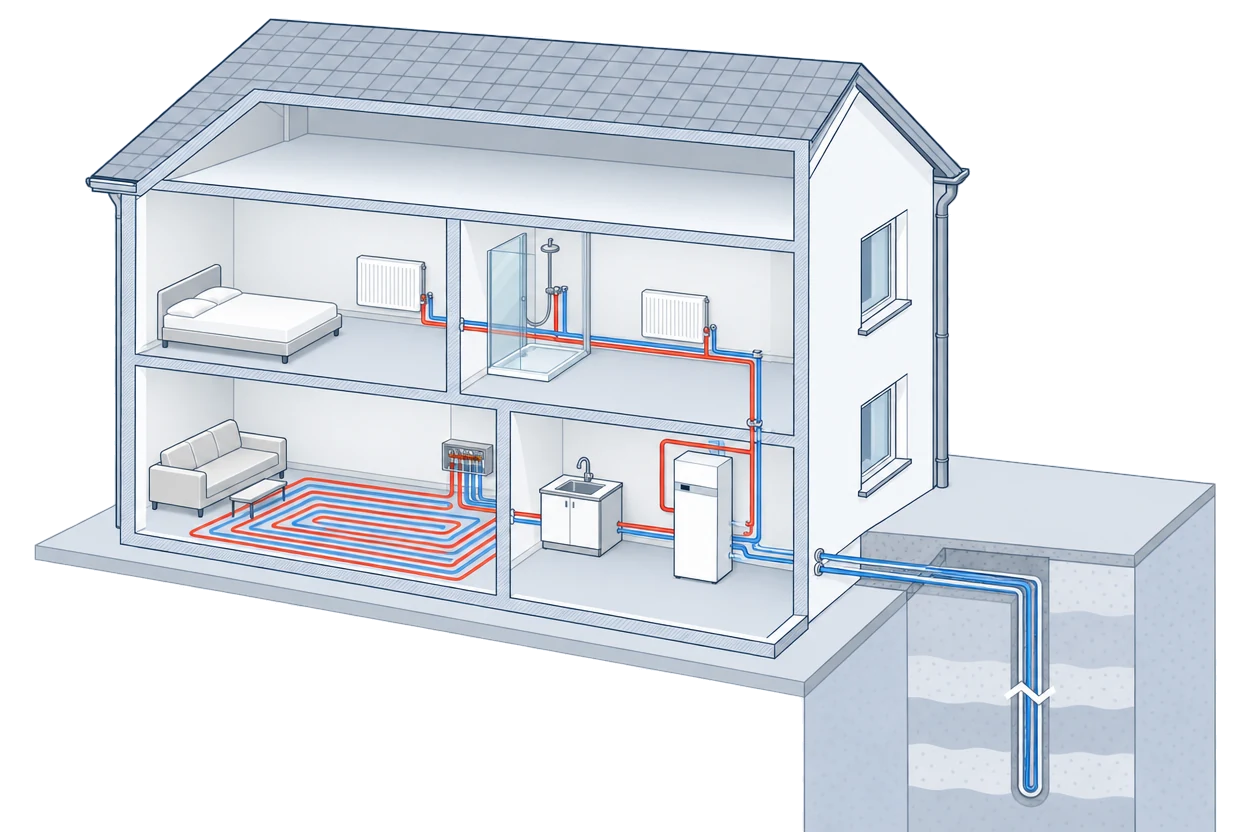
A ground source heat pump works like any heat pump: it collects low-temperature heat, raises it with a compressor and passes it to your radiators and hot-water cylinder. Only the source differs: instead of a fan drawing in outdoor air, a sealed loop of buried pipe carries water mixed with antifreeze, which picks up the ground's warmth. Our air source heat pump guide explains the other route.
The ground is steadier than the air. For design, MCS takes the local yearly average air temperature as the ground temperature, from 8.5 °C in north-east Scotland to 11.3 °C in the Thames Valley, while the air drops below freezing on cold nights. In the government-funded Electrification of Heat trial, ground source efficiency held up better at −5 °C than air source, though only 23 ground source systems were measured.
The heat pump is an indoor unit, with no outdoor unit or fan.
Borehole vs trench: which ground loop?
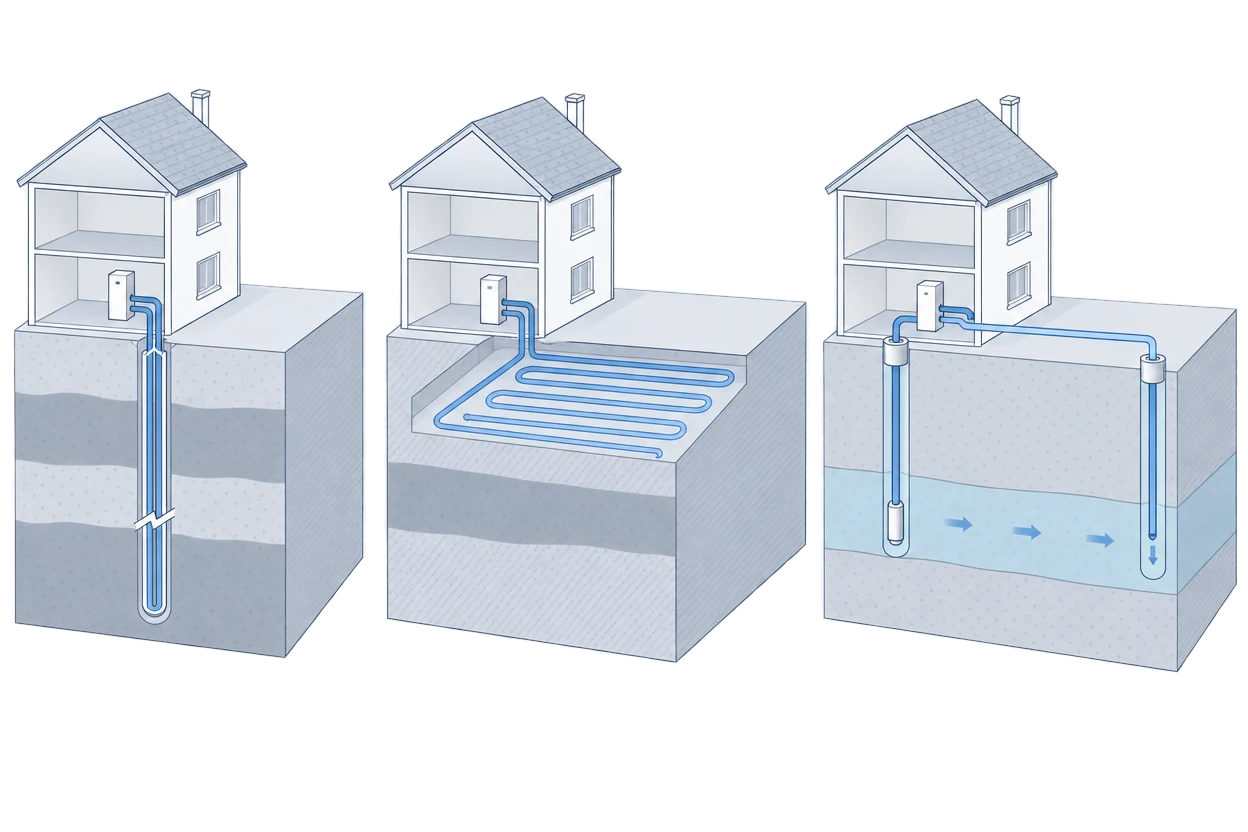
Which of the three fits depends on your space, the ground and, for an open loop, the water rules.
| Borehole | Trench or slinky | Open loop | |
|---|---|---|---|
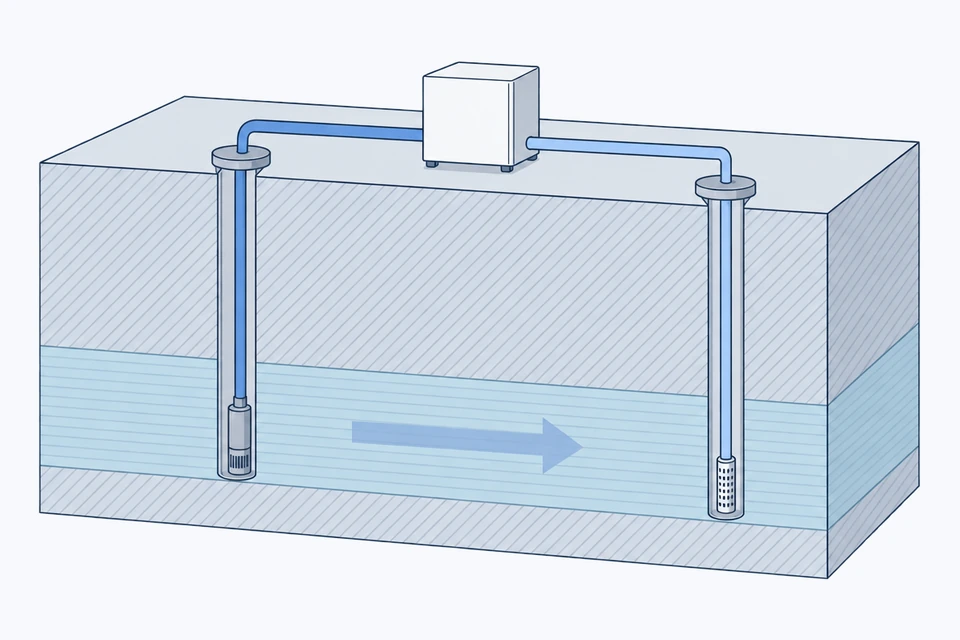
| What goes in | a vertical hole with a U-shaped pipe loop | pipes or coils laid 0.8–1.2 m deep | two boreholes: one draws groundwater, one returns it |
| Garden needed | little: boreholes at least 6 m apart | a large area, pipes at least 0.75 m apart | room for two boreholes |
| Heat per metreMCS look-up tables (MGD 007) at 1,800 full-load hours and 10 °C mean ground temperature; boreholes in ground conducting 1.5–2.5 W/mK, trenches 0.8–2.0 W/mK | 29–39 W | 9.4–19 W | depends on the water |
Boreholes: little land, a drilling rig
A rig bores a vertical hole, a U-shaped pipe goes in and heat-conducting grout fills the gap. With boreholes at least 6 m apart, a few fit where a trench field would not. What the ground gives depends on the rock. Its conductivity, in W/mK (watts per metre per degree), measures how well it passes heat: the higher, the more heat each metre of loop collects. MCS recommends 0.4 W/mK for dry sand, 2.3 for sandstone and 3.4 for granite. Your installer works this out from British Geological Survey records, a geological assessment or, on larger jobs, a thermal response test.
Trenches and slinkies: more land, no drilling
Horizontal loops lie in trenches 0.8 to 1.2 m deep; a slinky, pipe laid in overlapping coils, packs more pipe into a shorter trench. Damp ground passes heat far better than dry: MCS's recommended values are 1.7 W/mK for water-saturated clay or silt and 0.5 for dry clay or silt. The whole area is dug up during installation, so plan the garden around it.
Open loop: groundwater in, groundwater out
An open loop pumps groundwater from one borehole through the heat pump and returns it through a second. It needs a suitable water-bearing layer under your land and brings the most paperwork, set out in the rules below.
How much ground you need
MCS sets out the arithmetic in its design standard, MIS 3005-D. The ground supplies the share of the heat that doesn't come from the electricity the heat pump uses:
heat from the ground = heat pump output × (1 − 1 ÷ SCOP)
SCOP, the seasonal coefficient of performance, is heat delivered per unit of electricity over a year. At SCOP 3.1, each kilowatt of output draws 1 × (1 − 1 ÷ 3.1) = 0.677 kW, about 677 W, from the ground. Divide by what each metre of loop can give in MCS's look-up tables:
- Borehole, good ground (2.5 W/mK, 39 W per metre): 677 ÷ 39 = about 17 m of borehole per kW.
- Borehole, poorer ground (1.5 W/mK, 29 W per metre): 677 ÷ 29 = about 23 m per kW.
- Trench, damp clay (the 1.6 W/mK row, nearest to MCS's 1.7 for water-saturated clay; 16 W per metre): 677 ÷ 16 = about 42 m of pipe per kW; with pipes 0.75 m apart, 42 × 0.75 = about 32 m² per kW.
- Trench, drier ground (the 0.8 W/mK row; 9.4 W per metre): 677 ÷ 9.4 = about 72 m of pipe, or 54 m², per kW; dry clay or sand (0.4–0.5 W/mK) needs more still.
Multiply by the heat pump's size in kW for a feel for your garden. The figures assume 10 °C ground and 1,800 full-load hours (yearly heat demand divided by the heat pump's output); a heat pump that runs longer gets less per metre (35 W instead of 39 W at 2,400 hours). They are rules of thumb, not a design.
The real design starts from the room-by-room heat-loss survey. MIS 3005-D requires a loop big enough that the fluid returning to the heat pump stays above 0 °C, with the ground fully recovering each year; an undersized loop chills the ground and efficiency falls. Before work starts you receive a site plan showing every borehole or trench, its depth and its distances.
Ground source vs air source heat pump: efficiency
MCS's pre-sale estimate gives ground source a higher seasonal performance factor (SPF, the same idea as SCOP: yearly heat delivered divided by electricity used) than air source at every flow temperature:
| Flow temperature | Ground source SPF | Air source SPF |
|---|---|---|
| up to 35 °C | 4.3 | 4.0 |
| 41–45 °C | 3.7 | 3.4 |
| 51–55 °C | 3.1 | 2.8 |
| 56–60 °C | 2.8 | 2.5 |
The gap is a steady 0.3, worth fewer pounds the more efficient both systems are. Flow temperature, the temperature of the water sent to your radiators, matters more than the source: an air source heat pump at 41–45 °C beats a ground source one at 51–55 °C. Both types need a SCOP of at least 2.8 for the Boiler Upgrade Scheme. These are design estimates, not measurements; how real systems perform is in heat pump efficiency.
Ground source heat pump cost in the UK
The Boiler Upgrade Scheme statistics record costs self-reported by MCS installers for each finished job in England and Wales, covering equipment, labour and VAT. For ground source in July to September 2026 the median was £34,630 before the grant, for a median 15 kW system, against £12,826 for an 8 kW air source one; the middle half of ground source jobs ran from £22,348 to £53,345. One quarter's median is not a trend, and prices for every type are in heat pump cost.
The grant. In England and Wales the Boiler Upgrade Scheme takes £7,500 off a ground source heat pump if your home qualifies, the same as for air source, leaving £27,130 at the median. An off-gas-grid home replacing oil or LPG may get £9,000 instead for applications properly made from 21 July 2026 to 31 March 2027 (not self-builds). Your installer applies and deducts the grant, and a ground source voucher allows six months to finish the work, against three for air source. In Scotland, Home Energy Scotland has its own grant and loan, and you start no work before its written offer; Northern Ireland has no grant open to all homeowners. The conditions for each nation are in heat pump grants.
VAT on a ground source heat pump supplied and installed in your home is 0% until 31 March 2027, then 5%, and the relief covers the groundworks needed to install it.
Worked example: does the extra cost pay back?
Our example home is a detached, off-gas-grid house in England heated by oil: 149 m², the average for a detached home in the English Housing Survey, burning 1,480 litres of heating oil a year (15,200 kWh). With 85% boiler efficiency, our assumption, that is 12,920 kWh of heat. Electricity is 26.32p/kWh, the GB average price cap for direct debit from 1 October to 31 December 2026, with no VAT on electricity in Great Britain until 31 March 2027; standing charges are left out. Each type gets MCS's space-heating efficiency estimate at the same flow temperature, applied to all the heat including hot water (our simplification; MCS's hot-water estimates, 1.9 for air source and 2.2 for ground source, would raise both costs and widen the gap):
- Air source at 51–55 °C (2.8): 12,920 kWh ÷ 2.8 = 4,614 kWh × 26.32p = £1,214 a year.
- Ground source at 51–55 °C (3.1): 12,920 kWh ÷ 3.1 = 4,168 kWh × 26.32p = £1,097 a year.
- Difference: 4,614 − 4,168 = 446 kWh × 26.32p = £117 a year.
- Both at 41–45 °C (3.4 and 3.7): 3,800 kWh (£1,000) against 3,492 kWh (£919), a difference of £81 a year.
Electricity cost a year
| System | Air source | Ground source |
|---|---|---|
| Air source, 51–55 °C | £1,214 | |
| Ground source, 51–55 °C | £1,097 | |
| Air source, 41–45 °C | £1,000 | |
| Ground source, 41–45 °C | £919 |
The medians compare different sizes (15 kW against 8 kW), so we compare one size: from April 2025 to March 2026 the median 8–10 kW ground source job in England and Wales cost £21,541 (60 jobs, a small sample that swings from year to year) and the median 8–10 kW air source job £12,688, a gap of £8,853. The grant doesn't narrow it, because both types get the same amount.
Years to recover the gap = price gap ÷ saving a year = £8,853 ÷ £117 = about 76 years, at flat prices, without interest or servicing: in this home the electricity saving alone doesn't pay for the ground loop. How a heat pump compares with keeping the oil boiler is in replacing an oil boiler with a heat pump.
It can look different when:
- Your two quotes are close. At £117 a year, a ground source quote no more than £2,340 above an air source quote for the same home pays back in about 20 years (£117 × 20). Compare real quotes, not medians.
- Electricity prices change. Each 1p/kWh moves this home's saving by about £4.46 a year (446 kWh × 1p).
- There is no room for an outdoor unit, or neighbours are close. Nothing with a fan stands outside, so there is no noise test for neighbours.
- You join a shared ground loop. Several homes share one loop, each with its own heat pump and, in England and Wales, its own Boiler Upgrade Scheme voucher; compare your share of the loop cost with an air source quote.
Planning and water rules before you dig
A domestic ground source heat pump is permitted development in each nation, so it normally needs no planning application:
| Nation | Rule | Limits |
|---|---|---|
| England | permitted development (General Permitted Development Order 2015, Part 14, Class C) | no extra conditions |
| Wales | permitted development within the grounds (curtilage) of a house | no extra conditions |
| Scotland | permitted development (Class 6D of the 1992 Order) | no extra conditions |
| Northern Ireland | permitted development (Part 2, Class F of the 2015 Order) | not if any part is both within 3 m of the boundary and over 4 m high; not in an Area of Special Scientific Interest or a site of archaeological interest |
Permitted development rights can be removed locally, and listed buildings and conservation areas raise their own questions, so check with your local planning authority. The rules for every kind of heat pump by nation are in heat pump planning permission.
Water and drilling rules matter more:
- Closed loops in England. No environmental permit is needed if the system meets the Environment Agency's exemption conditions, among them: fully sealed, outside groundwater Source Protection Zone 1, not within 50 m of a well, spring or borehole used for domestic or food-production water, and at least 20 m from protected sites and ancient woodland for a home system up to 45 kW. Otherwise it must meet regulatory position statement RPS 307 or have a permit.
- Open loops in England. A groundwater investigation consent before drilling, an abstraction licence above 20 cubic metres a day, and a permit or registered exemption for the discharge.
- Water boreholes in England and Wales. Under section 198 of the Water Resources Act 1991, a well or borehole over 50 feet (about 15 m) deep, sunk to find or take water, must be notified before drilling, through the British Geological Survey, with the records sent afterwards.
- Wales, Scotland and Northern Ireland have their own environmental guidance; ask your installer which applies.
Before anyone digs or drills
These points decide whether the loop works and what it costs.
- Grant first. England and Wales: the voucher should be issued before work starts, and its six-month window should fit the drilling date. Scotland: wait for Home Energy Scotland's written offer.
- Ground data. Ask what the loop design rests on: British Geological Survey records, a soil assessment or a thermal response test.
- Design documents. Before work starts: the site plan, the loop design table and the SCOP at the design flow temperature.
- The loop as its own line. Number and depth of boreholes, or trench length and area, plus reinstating the garden and removing spoil.
- Site checks. Who checks Source Protection Zone 1, nearby wells and springs, septic tanks and buried services, and who handles any permit or licence.
- Warranty. Who drills, who stands behind the loop and who stands behind the heat pump, and any deadline for registering the manufacturer's warranty.
Figures that change
| What | Value | Applies |
|---|---|---|
| Median ground source price (before the grant) | £34,630; middle half £22,348–£53,345; median size 15 kW | England and Wales, July–September 2026 |
| Median price at 8–10 kW, ground source / air source | £21,541 / £12,688 | England and Wales, April 2025–March 2026 |
| Boiler Upgrade Scheme, ground source | £7,500; £9,000 for some off-gas homes replacing oil or LPG (not self-builds) | England and Wales; uplift for applications properly made 21 July 2026–31 March 2027 |
| VAT on installed heat pumps | 0% until 31 March 2027, then 5% | UK |
| Electricity unit rate | 26.32p/kWh, no VAT on electricity in Great Britain until 31 March 2027 | GB average, direct debit, 1 October–31 December 2026 |
How we worked this out
Our example home, its 85% boiler efficiency and the like-for-like 8–10 kW comparison are our assumptions; efficiencies are MCS's pre-sale space-heating estimates, applied to hot water too, prices are Boiler Upgrade Scheme medians before the grant, and standing charges, servicing and interest are left out. More in our editorial method.
Frequently asked questions
How much does a ground source heat pump cost in the UK?
Jobs reported under the Boiler Upgrade Scheme in England and Wales cost a median £34,630 in July to September 2026, before the grant, with the middle half between £22,348 and £53,345. The median system was 15 kW, larger than a typical air source one. The ground loop is the part a median can't show, so ask for it as its own line.
Is a ground source heat pump better than air source?
It is more efficient by MCS's estimates, 0.3 higher at every flow temperature, and has no outdoor fan. It also costs far more: in our oil-heated example home, both at 51–55 °C and 26.32p/kWh (GB price cap, October to December 2026), the £117 yearly saving would take about 76 years to cover the median 8–10 kW price gap, at flat prices. Ground source makes most sense with plenty of land, no good spot for an outdoor unit or quotes close to air source.
Borehole or trench: which is better?
MCS designs both to the same rule, with the fluid returning to the heat pump above 0 °C, and its efficiency estimates don't separate them; the choice is about space and cost. A borehole needs little land but a drilling rig; trenches or slinkies avoid drilling but need a large area of garden. In MCS's tables a borehole in good ground gives about 39 W per metre and a trench in damp clay about 16 W per metre of pipe.
How much land do I need for a ground source heat pump?
For trenches, roughly 32 m² of damp clay per kilowatt of heat pump at SCOP 3.1, and more in dry ground, from MCS's look-up tables at 1,800 full-load hours. A borehole needs room for a drilling rig and about 17–23 m of depth per kilowatt, depending on the rock. Your installer's design sets the real figure.
Do I need planning permission for a ground source heat pump?
Usually not: a domestic ground source heat pump is permitted development in England, Wales and Scotland, and in Northern Ireland with limits on height near the boundary and on protected sites. Water and drilling rules are separate, and listed buildings and conservation areas raise their own questions, so check with your local planning authority and ask your installer who handles any permit or licence.
Read next
Reading time: 16 min
Heat pump cost
Installed heat pump prices from the government's Boiler Upgrade Scheme statistics: the median and its range, prices by size and type, extras in older and combi homes, the grant by nation, 0% VAT to 31 March 2027 and a worked example.
Read moreHeat pump cost
Reading time: 16 min
Heat pump grants
The Boiler Upgrade Scheme in full: amounts in England and Wales, the £9,000 for oil or LPG homes to 31 March 2027, who qualifies, the six steps from quote to voucher, Scotland and Northern Ireland, loans and 0% VAT to 31 March 2027.
Read moreHeat pump grants
Reading time: 15 min
Heat pump planning permission
When an air source heat pump on a house needs planning permission in England, Wales, Scotland and Northern Ireland: a nation-by-nation table, the MCS 020(a) noise condition, one house checked against each nation's rules, listed buildings and conservation areas, Building Regulations and whether gas boilers are being banned.
Read moreHeat pump planning permission
Reading time: 14 min
Air source heat pumps
The UK guide to air source heat pumps: how they work, monobloc or split, the types compared, installed prices and support by nation, running costs in an example home, suitability, planning and the pros and cons.
Read moreAir source heat pumps
Reading time: 14 min
Heat pump efficiency
COP, SCOP and SPF explained with a UK datasheet, the Electrification of Heat field results (median 2.78 across 428 homes), the Boiler Upgrade Scheme's SCOP 2.8 minimum (England and Wales) and a meter-reading example.
Read moreHeat pump efficiency
Reading time: 15 min
Replacing an oil boiler with a heat pump
Replacing an oil or LPG boiler with a heat pump: the £9,000 grant for off-gas homes in England and Wales replacing oil or LPG (applications properly made 21 July 2026 to 31 March 2027), if your home qualifies, running costs against three oil prices, LPG as a formula, the oil tank and eight steps.
Read moreReplacing an oil boiler with a heat pump