Air-to-air heat pumps: how they differ, what they cost and the grant
How an air-to-air heat pump differs from the air-to-water kind, which homes it suits, what the £2,500 grant in England and Wales requires, and how to cover hot water.
An air-to-air heat pump takes heat from the outside air and blows it into your rooms through indoor units, so it heats no radiators, and most models heat no hot water either; a reversible unit can also cool in summer. In England and Wales the Boiler Upgrade Scheme takes £2,500 off an air-to-air heat pump if your home qualifies (applications properly made from 28 April 2026); Home Energy Scotland doesn't fund them. No official price statistic exists for air-to-air, and most homes still need a separate source of hot water.
At a glance
- Difference. An air-to-water heat pump heats water for radiators and taps; an air-to-air heat pump heats the air in each room that has an indoor unit, and a reversible one can cool.
- Grant. £2,500 in England and Wales if your home qualifies, against £7,500 for an air-to-water heat pump; your installer applies and takes it off the quote.
- Price. The Boiler Upgrade Scheme statistics contain no air-to-air price: no air-to-air voucher had been redeemed by the end of September 2026.
- Hot water. Most air-to-air systems make none; a few multi-split ranges add a hot-water tank. With the grant, the gas boiler can't stay to do it, so the quote needs a hot-water plan.
- Running costs. In our example home, heat from a heat pump costs less than heat from the existing gas boiler above a seasonal efficiency of 2.81, at the Ofgem price cap for 1 October to 31 December 2026.
Air-to-air or air-to-water: what's the difference?
Both kinds use an outdoor unit that pulls heat out of the outside air. The difference is where that heat goes.
An air-to-water heat pump, which the government's grant pages also call an air source heat pump, heats water for your radiators or underfloor heating and for a hot-water cylinder. An air-to-air heat pump has no radiator circuit: MCS, the certification scheme for heat pumps and their installers, defines it as a heat pump connected to indoor units, such as wall units or cassettes, by refrigerant pipes. Each indoor unit blows warm air into its room.
If that sounds like air conditioning, it is the same technology: a split air conditioner with a heating mode is an air-to-air heat pump.
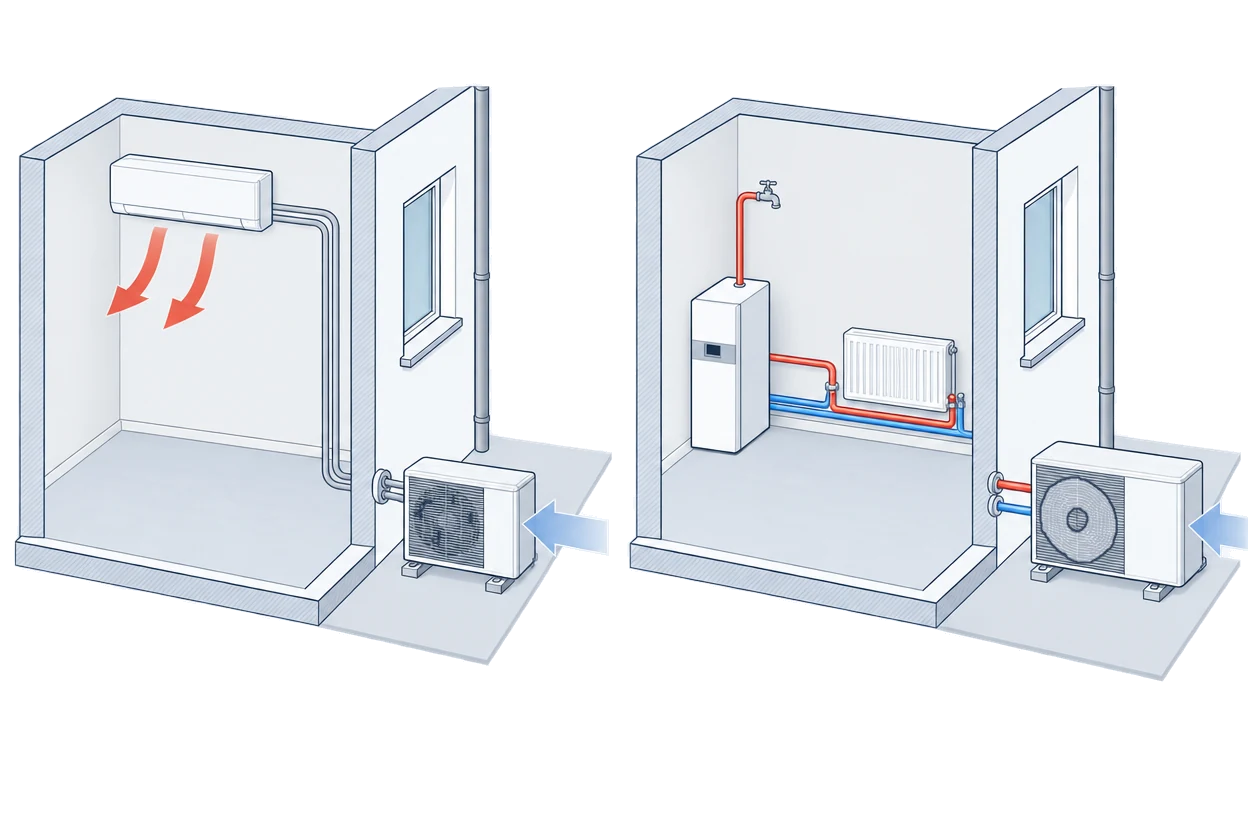
| Point | Air-to-air | Air-to-water |
|---|---|---|
| Heat reaches rooms | as warm air from indoor units | as hot water through radiators or underfloor heating |
| Hot water | usually not; most need a separate source | yes, through a cylinder |
| Cooling | yes on reversible units | depends on the model |
| Rooms heated | each room with an indoor unit | every room on the radiator circuit |
| Pipes indoors | refrigerant pipes to every indoor unit | heating-water pipes |
| BUS grantBoiler Upgrade Scheme, England and Wales only, if your home qualifies; the installer applies and deducts the grant | £2,500 | £7,500; £9,000 off the gas grid replacing oil or LPG, applications properly made 21 July 2026 to 31 March 2027 |
| Scottish grant | none | Home Energy Scotland grant and loan |
| Price statisticMedian installed price reported by MCS installers under the Boiler Upgrade Scheme, England and Wales, VAT included, before the grant | none published | £12,826 median, July to September 2026 |
In short, an air-to-water heat pump takes over heating and hot water through your existing pipes; an air-to-air heat pump serves the rooms with indoor units and usually leaves hot water to something else. The air-to-water kind is explained in our guide to air source heat pumps.
What gets installed: split systems and indoor units
An air-to-air system has an outdoor unit, one or more indoor units and the refrigerant pipes that link them. MCS names two layouts. A single split heats one room from one outdoor unit. A multi-split connects one outdoor unit to several indoor units to heat two or more rooms.
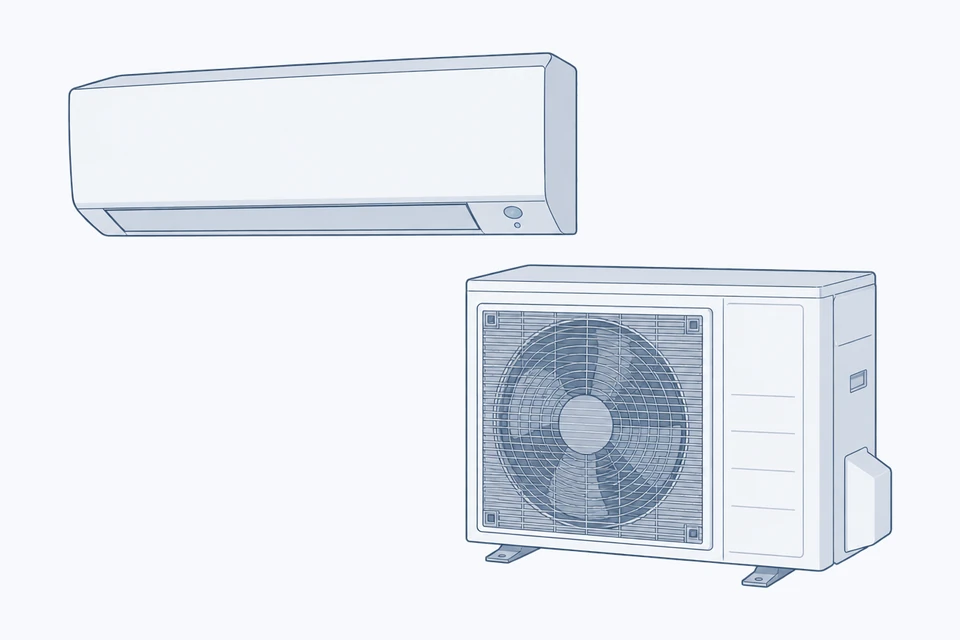
MCS's design standard (MIS 3005-D, Issue 3.0) sets the rules. Your installer calculates the heat loss room by room, and the outdoor unit must cover at least 100% of the building's heat loss at the local design temperature. Every habitable room, meaning bedrooms and living rooms but not bathrooms, kitchens used only for cooking or hallways, gets its own indoor unit sized for at least 100% of that room's heat loss. Before you sign, the installer must tell you in writing how many indoor units it proposes. In an older house an air-to-air system avoids replacing undersized radiators or old pipework; the trade-off is an indoor unit on the wall of every habitable room.
Whoever installs, services or leak-checks the refrigerant circuit needs their own F-gas qualification (F gas is fluorinated refrigerant); Category 2 covers systems under 3 kg, and MCS requires split-system installers to be qualified to handle refrigerant. Since 2025, new single splits under 3 kg can't be sold in Great Britain with an F gas whose global warming potential is above 750; R32, listed at 675 in Mitsubishi Electric's UK documents, is under that line.
Who an air-to-air heat pump suits
It depends on what heats your home today:
| Your home | Fit | Why |
|---|---|---|
| Electric storage or panel heaters, no radiators | good | nothing to adapt; in England and Wales the grant also covers replacing electric heating |
| Gas or oil boiler, radiators in good order | compare both | an air-to-water heat pump reuses the radiators, heats your water and carries a £7,500 grant in England and Wales |
| You also want summer cooling | possible | reversible units cool, but planning rules and the grant are about heating |
| You want to keep the boiler as well | no grant | the Boiler Upgrade Scheme needs fossil-fuel heating fully replaced |
| Home in Scotland | no grant | Home Energy Scotland excludes air-to-air heat pumps |
| A room with no wall space for a unit | check first | MCS design puts an indoor unit in every habitable room |
Weigh comfort and looks too: heat arrives as moving warm air from a fan, and the indoor units are visible and audible in the rooms you use. Ask for each indoor unit's sound level from the datasheet.
How much does an air-to-air heat pump cost?
No official price statistic exists for air-to-air heat pumps. The government's Boiler Upgrade Scheme statistics count 157 applications for air-to-air vouchers up to the end of September 2026, with no voucher issued or redeemed, so their price table has no air-to-air figure. We have analysed no quotes ourselves, so we give no range.
The price follows from the design rules above: the number of indoor units (one per habitable room, each with its own pipe run and wiring), the outdoor unit's size, the pipe routes and electrical work, and the cylinder and heat source for your hot water.
For comparison only, not as a price for air-to-air: an air-to-water heat pump cost a median £12,826 installed in England and Wales between July and September 2026, as reported by MCS installers, VAT included and before the grant. Price ranges by size and type are in heat pump cost.
A heat pump supplied and installed in your home carries 0% VAT until 31 March 2027 and 5% from 1 April 2027. HMRC treats most fixed air-conditioning units as air source heat pumps, but only permanently fixed units qualify: a portable air conditioner doesn't, and a unit you buy without installation is charged at the standard rate.
The Boiler Upgrade Scheme grant for air-to-air
In England and Wales, the Boiler Upgrade Scheme has taken £2,500 off an air-to-air heat pump for applications properly made since 28 April 2026, if your home qualifies: it must be a residential building, the heat pump must replace your existing gas, oil, LPG or electric heating (not an existing heat pump), and an MCS-certified installer that belongs to an approved consumer code such as RECC or HIES applies to Ofgem and deducts the grant from your quote.
Two conditions bite harder for air-to-air than for other heat pumps:
- Capacity and hot water. The heat pump must have the capacity to meet your home's full space-heating demand on its own, so electric heaters can't make up for an undersized unit, and the system must meet the full space-heating and hot-water demand, alone or with supplementary appliances that don't burn fossil fuel. Ofgem's guidance says you can't keep a fossil-fuel heating system alongside, so a combi boiler can't stay just for hot water.
- Timing. Once the voucher is issued, the installer has 3 months to fit, commission and redeem it.
Home Energy Scotland excludes air-to-air heat pumps from its funding, and Northern Ireland has no Boiler Upgrade Scheme. Who qualifies, the voucher steps and the other grant amounts are in heat pump grants.
Hot water: most homes still need a source
In a combi home your hot water comes from the boiler; with a grant-funded air-to-air system that boiler goes, and something else has to heat a stored supply of water.
Without fossil fuel the options are a cylinder heated by its own heat pump, a cylinder with an electric immersion heater or, on a few multi-split ranges, a tank heated by the same outdoor unit. Each means finding room for a cylinder or tank, which a combi home doesn't have. MCS's design standard requires the contract to state what share of your hot water the air-to-air heat pump is designed to provide, and warns that supplementary heaters can add running costs.
Cylinder sizes, space and the legionella question are covered in heat pump hot-water cylinders.
Running costs: a worked example
Whether heat from a heat pump costs less than heat from your existing boiler comes down to its seasonal efficiency: the heat it delivers over a year per kWh of electricity, called SCOP when rated in a test and SPF when estimated or measured for a real system.
Our example home is a 1970s semi-detached house in England with 97 m² of floor space, radiators and a gas combi boiler. It uses 9,500 kWh of gas a year, Ofgem's typical medium use, and we assume the boiler turns 85% of that into 8,075 kWh of heat. Prices are the Ofgem price cap, GB average, direct debit, 1 October to 31 December 2026: electricity 26.32p/kWh with no VAT in Great Britain until 31 March 2027, gas 7.97p/kWh including 5% VAT.
- Heat pump: 8,075 kWh ÷ SCOP 2.5 / 2.8 / 3.1 × 26.32p = £850 / £759 / £686 a year.
- Gas boiler: 9,500 kWh × 7.97p = £757 a year, so the break-even SCOP on unit rates is 0.85 × 26.32 ÷ 7.97 = 2.81.
Standing charges are left out, and the result depends on the house, the installation and the tariff; the full arithmetic is in heat pump running costs. The 2.8 is an air-to-water figure: the median measured across 428 air source heat pumps in the government-funded Electrification of Heat trial was 2.78, and the trial included no air-to-air units.
For air-to-air, MCS's pre-sale estimate uses fixed factors: 3.42 for space heating, taken from the minimum efficiency in the EU ecodesign rules for air conditioners, and 1.9 for hot water. Its own worked example is an existing house in rural Wales with 15,500 kWh a year of space heating and 2,900 kWh of hot water:
- Space heating: 15,500 kWh ÷ 3.42 = 4,532 kWh of electricity.
- Hot water: 2,900 kWh ÷ 1.9 = 1,526 kWh.
- Weekly pasteurising of a 200-litre cylinder by immersion heater: 121 kWh.
- Total: 4,532 + 1,526 + 121 = 6,179 kWh, shown to the customer as 5,561–6,796 kWh (±10%).
MCS says its estimate is guidance, not a guarantee. Set against our break-even, its fixed 3.42 factor for heating rooms is above 2.81 and its fixed 1.9 factor for hot water is below it. These are pre-sale assumptions, and the 3.42 is a product benchmark rather than a measurement in homes, but they suggest hot water is the part that could cost more than the existing gas boiler in our example home. Electricity used for cooling comes on top of the estimate.
What the SCOP on the energy label tells you
In Great Britain, air conditioners rated up to 12 kW carry an energy label with a heating class based on SCOP over a standard "average" heating season:
| Heating class | SCOP on the label |
|---|---|
| A+++ | 5.10 or more |
| A++ | 4.60 to under 5.10 |
| A+ | 4.00 to under 4.60 |
| A | 3.40 to under 4.00 |
A label SCOP is useful for comparing units side by side, but it is a rated value from a standard test, not a measurement in your home.
Noise and planning
Indoor units add fan noise inside your rooms, so ask for each one's sound level. The outdoor unit must pass the MCS 020(a) noise calculation (37 dB(A) just outside a neighbour's habitable-room window or door) to count as permitted development in England and Wales.
Permitted development doesn't cover a unit used solely for cooling in England or one designed for cooling only in Wales, never applies to a listed building, and works differently in Scotland and Northern Ireland. See planning permission for heat pumps and check with your local planning authority.
Before you sign a quote for an air-to-air heat pump
- Room-by-room heat loss. Ask for the calculation and the capacity of each indoor unit against its room's heat loss.
- Every habitable room covered. Check the quote names the number of indoor units and how any room without one is heated.
- Hot-water plan. Get in writing what heats your water, where the cylinder goes and what share the heat pump provides.
- Grant lines and voucher. In England and Wales, check the quote shows the price before the grant, the £2,500 and the balance, and agree a start date once the voucher is issued.
- Installer credentials. For the grant, an MCS-certified installer in an approved consumer code such as RECC or HIES; for the refrigerant work, an F-gas qualification.
- Datasheets. Ask for the outdoor and indoor units' datasheets: SCOP, energy label, sound levels, the lowest outdoor temperature each unit heats at and its heating output at your area's design temperature.
- Outdoor unit position. Ask for the MCS 020(a) noise calculation for the chosen spot.
Figures that change
| What | Value | Applies |
|---|---|---|
| Boiler Upgrade Scheme, air-to-air heat pump | £2,500 | England and Wales, homes only, applications properly made from 28 April 2026 |
| Boiler Upgrade Scheme, air-to-water heat pump | £7,500 | England and Wales |
| Air-to-air vouchers in the BUS statistics | 157 applications, none issued or redeemed | England and Wales, May 2022 to September 2026 |
| Air-to-water median installed price | £12,826, VAT included, before the grant | England and Wales, July to September 2026 |
| VAT on a heat pump supplied and installed | 0%, then 5% | until 31 March 2027; 5% from 1 April 2027 |
| Electricity unit rate | 26.32p/kWh, no VAT in Great Britain until 31 March 2027 | Ofgem price cap, GB average, direct debit, 1 October to 31 December 2026 |
| Gas unit rate | 7.97p/kWh, 5% VAT included | Ofgem price cap, GB average, direct debit, 1 October to 31 December 2026 |
How we worked this out
Our example home and its 85% boiler efficiency are our assumptions; rates are the Ofgem price cap for 1 October to 31 December 2026 without standing charges, and no air-to-air price or measured efficiency is shown, because the government statistics and the Electrification of Heat trial contain none. More in our editorial method.
Frequently asked questions
Is there a grant for air-to-air heat pumps?
Yes, in England and Wales: the Boiler Upgrade Scheme takes £2,500 off an air-to-air heat pump in a home, for applications properly made since 28 April 2026, if your home qualifies. Your MCS-certified installer applies, and gas or oil heating must be fully replaced. Home Energy Scotland doesn't fund air-to-air heat pumps.
How much does an air-to-air heat pump cost?
There is no official median price: the scheme's statistics contain no redeemed air-to-air vouchers up to the end of September 2026. The price mainly depends on how many indoor units you need, the pipe routes and how your hot water will be heated, so compare itemised quotes.
Can an air-to-air heat pump heat a whole house?
It can if every habitable room gets an indoor unit sized for that room and the outdoor unit covers the whole building's heat loss, which is how MCS designs a whole-home system. Hallways and bathrooms may need another heat source, and hot water usually does.
Do air-to-air heat pumps heat water?
Most don't: a typical split heats room air only, so hot water needs a cylinder with its own heat pump or an immersion heater. A few multi-split ranges add a hot-water tank to the same outdoor unit. With a Boiler Upgrade Scheme grant, an existing gas or oil boiler can't stay on just for hot water.
Can an air-to-air heat pump cool a house in summer?
Yes, if the unit is reversible: it can switch from heating to cooling. The grant and the planning rules are about heating, though: a unit used solely for cooling isn't permitted development in England, and cooling electricity isn't part of MCS's heating estimate.
Do I need planning permission for an air-to-air heat pump?
Often not in England and Wales: the outdoor unit can count as permitted development if it meets the conditions, including the MCS 020(a) noise calculation (37 dB(A) just outside a neighbour's habitable-room window or door). It can't if it is used solely for cooling (England) or designed for cooling only (Wales), and permitted development never applies to a listed building. Scotland and Northern Ireland have their own rules, so check with your local planning authority.
Read next
Reading time: 14 min
Air source heat pumps
The UK guide to air source heat pumps: how they work, monobloc or split, the types compared, installed prices and support by nation, running costs in an example home, suitability, planning and the pros and cons.
Read moreAir source heat pumps
Reading time: 16 min
Heat pump cost
Installed heat pump prices from the government's Boiler Upgrade Scheme statistics: the median and its range, prices by size and type, extras in older and combi homes, the grant by nation, 0% VAT to 31 March 2027 and a worked example.
Read moreHeat pump cost
Reading time: 16 min
Heat pump grants
The Boiler Upgrade Scheme in full: amounts in England and Wales, the £9,000 for oil or LPG homes to 31 March 2027, who qualifies, the six steps from quote to voucher, Scotland and Northern Ireland, loans and 0% VAT to 31 March 2027.
Read moreHeat pump grants
Reading time: 14 min
Heat pump hot water cylinder
Hot water cylinders for heat pumps: MCS sizing (45 litres a day per person), cylinder sizes by bedrooms and heat pump size, space and weight, unvented G3 rules by nation, legionella and the immersion heater, a worked example and standalone hot water heat pumps.
Read moreHeat pump hot water cylinder
Reading time: 14 min
Heat pump running costs
Heat pump running costs in our example 1970s semi: 2,884 kWh and £759 a year at SCOP 2.8, £850 at 2.5 and £686 at 3.1 (Ofgem price cap, 1 October to 31 December 2026), against £865 for gas including a £108 standing charge that ends only if the gas supply is disconnected, as we assume.
Read moreHeat pump running costs
Reading time: 15 min
Heat pump planning permission
When an air source heat pump on a house needs planning permission in England, Wales, Scotland and Northern Ireland: a nation-by-nation table, the MCS 020(a) noise condition, one house checked against each nation's rules, listed buildings and conservation areas, Building Regulations and whether gas boilers are being banned.
Read moreHeat pump planning permission