How loud is a heat pump? Noise, placement and neighbours
What the decibels on a datasheet mean, what your neighbours will hear, how the 37 dB(A) test works in England and Wales, and where to put the outdoor unit so it stays quiet.
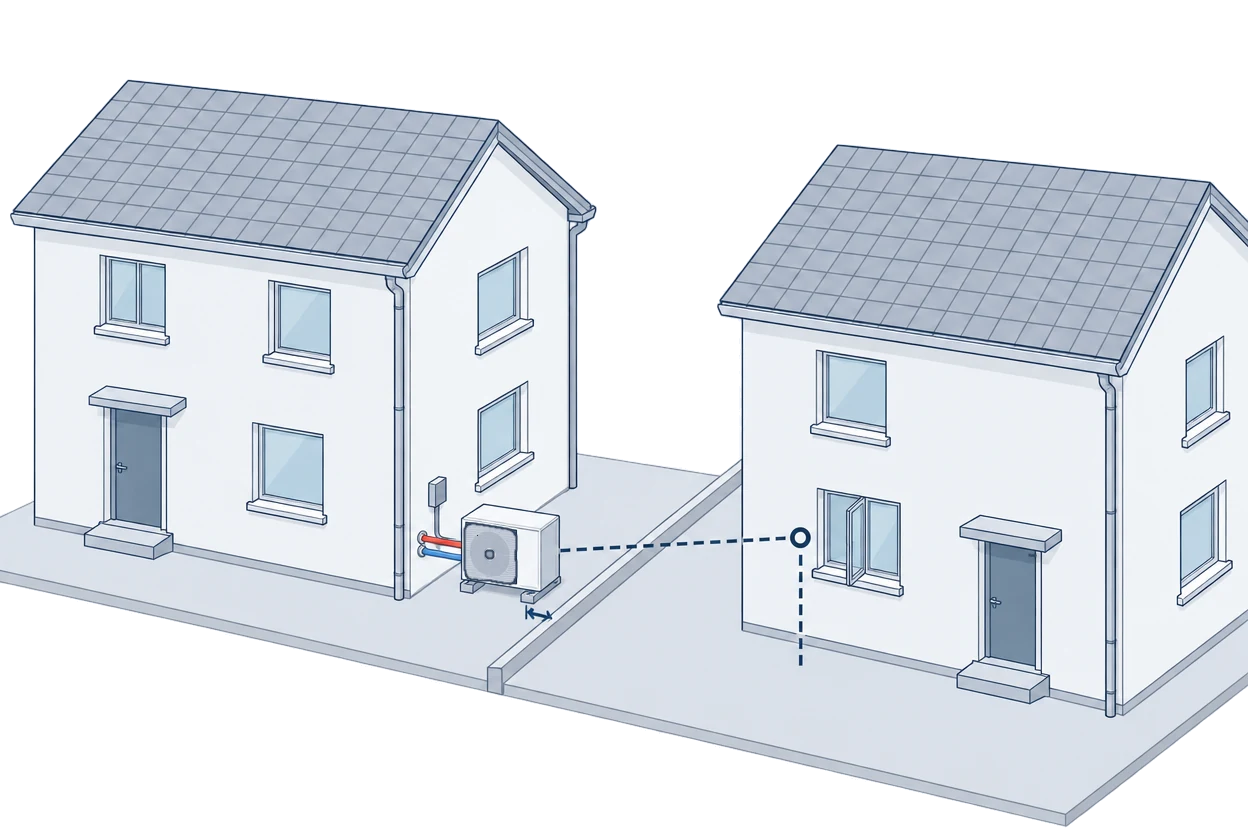
Heat pump noise comes down to two numbers: the sound power of the outdoor unit, printed on its datasheet, and the sound pressure that reaches a neighbour's window. Mitsubishi Electric's Ecodan R290 5 kW, for example, has a sound power of 56 dB(A) and measures 40 dB(A) at 1 m on its UK datasheet. In England and Wales, a unit fitted without a planning application must pass the MCS 020(a) calculation: 37 dB(A) or less 1 m outside every neighbouring habitable-room window or door. In our example semi that unit comes out at 39.0 dB(A) on the ground against the back wall, 4 m from next door's window, and passes at 6 m or behind a solid fence that hides the window.
At a glance
- Two numbers. Sound power describes the unit; sound pressure is what arrives at a window, and it falls with distance.
- The test. In England and Wales, permitted development needs 37 dB(A) or less at every neighbouring habitable-room window or door, worked out by your installer under MCS 020(a).
- Walls and distance. Each reflecting surface within 1 m of the unit adds 3 dB; twice the distance takes off about 6 dB.
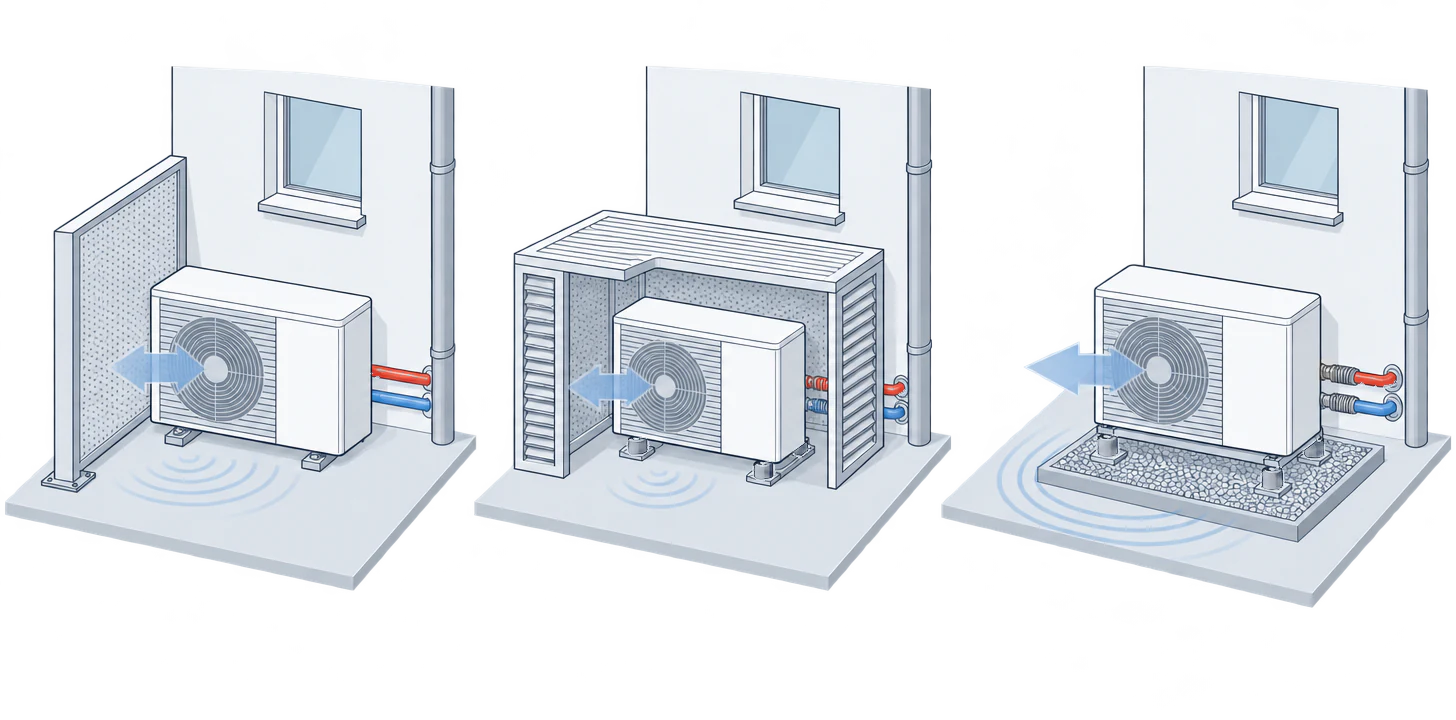
- What helps most. A quieter unit, more distance, fewer walls around it and a solid barrier that hides the window. A hedge doesn't count.
Sound power and sound pressure: two different numbers
The sound power level on a datasheet is the total sound energy the unit gives off, measured in a test; like a bulb's wattage, it doesn't change with where the unit stands. The sound pressure level is what reaches one point, and it depends on the distance and the surfaces around the unit. The "A" in dB(A) means the reading is weighted the way the ear hears.
The Ecodan R290 5 kW datasheet shows both, with 7 °C outside and 55 °C water: 56 dB(A) sound power, tested to BS EN 12102, and 40 dB(A) sound pressure at 1 m. Compare models on sound power; a sound pressure figure means little without its distance.
For planning, what counts is the sound pressure at the assessment position: 1 m outside the centre of any window or door to a habitable room of a neighbouring home. Bedrooms and living rooms count; bathrooms, toilets, utility rooms, hallways and rooms used only for cooking don't, and nor does a neighbour's garden.
How loud is a heat pump?
On Mitsubishi Electric's UK datasheets, the Ecodan R290 5 kW has a sound power of 56 dB(A) and the 8 kW model 58 dB(A); both measure 40 dB(A) 1 m from the unit. That is a test result under set conditions. In real use, MCS's guidance on mitigating noise says a heat pump is more noticeable when it works harder in winter, heats hot water, defrosts or needs maintenance. A review of heat-pump noise for the Department for Energy Security and Net Zero (DESNZ) cites ten week-long UK case studies in which units measured on site were on average 4 dB louder than their datasheets.
What you hear comes mainly from the compressor, the fan and the circulating pumps. Neighbours interviewed for the DESNZ review described a low hum or a rumble; some people in a survey it quotes compared it with a fridge. A tonal sound, a whine or drone at one pitch, can be more annoying than a sound at the same level without one, and the MCS calculation has no correction for it. Defrosting changes the sound for a while; how a heat pump works explains why.
What 37 dB(A) means. It is a level at the neighbour's window, not at the unit: 3 dB below the 40 dB(A) the Ecodan datasheets give 1 m from the unit, and below the nominal 40 dB(A) background level that the earlier MCS noise standard assumed. Night is when it matters: in the DESNZ review, complaints usually centred on disturbed sleep, because a unit stands out most when background noise is low. Complaints were relatively infrequent and mostly traced to where the unit stood or how well it was installed.
How distance, walls and fences change the level
MCS 020(a) turns sound power into sound pressure at a window with one formula:
Sound pressure = sound power + 10 × log(Q ÷ (4 × π × r²)) − barrier
r is the straight-line distance in metres from the centre of the unit to the assessment position, to 0.1 m. Q counts reflecting surfaces: any surface within 1 m of the unit, the ground included but not plants, that reaches at least 1 m beyond the unit's edge in two or more directions. A unit on the ground in the open has one (Q2); against a wall, two (Q4); in a corner, three (Q8). More than three, as in a small light well, fails the standard outright.
Three rules of thumb follow:
- Twice the distance: about 6 dB less at the window.
- One more reflecting surface: 3 dB more, so a corner is 3 dB louder than a single wall.
- Two units: decibels add as energy, so two units each giving 37.0 dB(A) at one window give 40.0 dB(A) together, which fails: the test applies to the combined level, and in England and Wales permitted development allows a second unit only on a detached house.
MCS 020(a)'s own examples count a unit on wall brackets, off the ground, against one wall as one reflecting surface (Q2); by its definition the ground still counts if it is within 1 m of the unit.
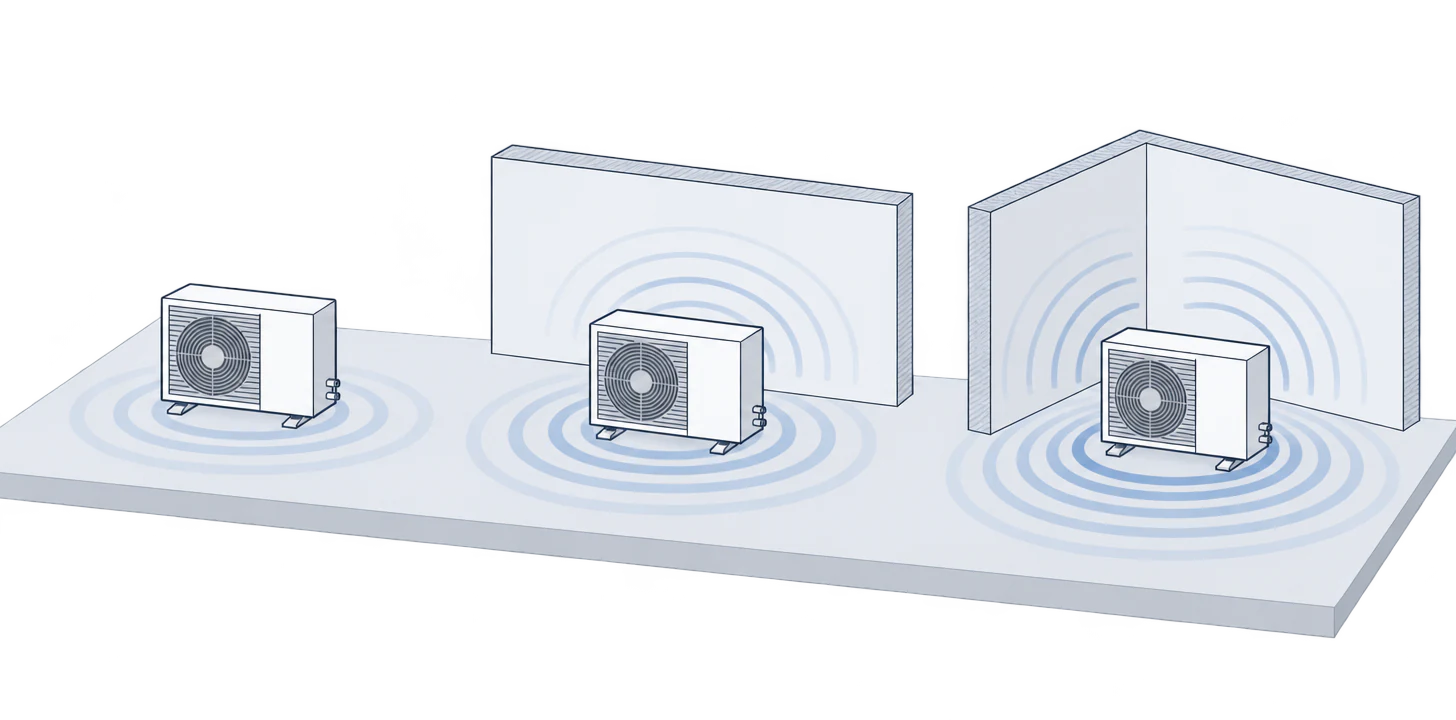
A barrier takes decibels off, depending on what it is and how much of the assessment position, the point 1 m outside the window, you can still see from the top edge of the unit:
| Barrier | No view | Partial view | Full view |
|---|---|---|---|
| Type 1A brick or masonry wall, or a solid fence at least 18 mm thick | 10 dB | 5 dB | 0 dB |
| Type 2A solid fence less than 18 mm thick | 5 dB | 2.5 dB | 0 dB |
| No barrierOpen or slatted fences, fences with gaps, walls in poor repair, hedges and other plants | 0 dB | 0 dB | 0 dB |
"Partial view" means the assessment position comes into view if you move up to 0.25 m in any direction from the top edge of the unit. A barrier only counts if it has no cracks or gaps and runs at least 1 m beyond each edge of the unit.
Sound pressure at the neighbour's window
- Permitted development limit in England and Wales, 37 dB(A)
| Distance to the assessment position (m) | On the ground, in the open (Q2) | Against a wall (Q4) | In a corner (Q8) |
|---|---|---|---|
| 2 | 42 dB(A) | 45 dB(A) | 48 dB(A) |
| 3 | 38.5 dB(A) | 41.5 dB(A) | 44.5 dB(A) |
| 4 | 36 dB(A) | 39 dB(A) | 42 dB(A) |
| 5 | 34 dB(A) | 37 dB(A) | 40.1 dB(A) |
| 6 | 32.5 dB(A) | 35.5 dB(A) | 38.5 dB(A) |
| 7 | 31.1 dB(A) | 34.1 dB(A) | 37.1 dB(A) |
| 8 | 30 dB(A) | 33 dB(A) | 36 dB(A) |
| 10 | 28 dB(A) | 31 dB(A) | 34 dB(A) |
The MCS 020(a) test: 37 dB(A) in England and Wales
In England and Wales, an air source heat pump on a house is permitted development only if it complies with MCS 020(a) and the result is 37.0 dB(A) or less at every assessment position, as a five-minute average. England dropped its old 1-metre boundary rule on 29 May 2025, and Wales its 3-metre boundary rule on 1 June 2026. Northern Ireland still keeps units 1 metre or more away from the boundary of the land around another home; its rules and Scotland's refer to the earlier standard, MCS 020, "or equivalent standards".
Your MCS installer runs the calculation before fitting, and the standard asks for:
- one calculation for every neighbouring window or door that could be affected, on all sides and upper floors; the nearest is not always the loudest, because a farther window may have a clearer view;
- the result rounded to 0.1 dB, so 37.0 passes and 37.1 fails;
- a copy of the completed table for you.
Passing the calculation isn't enough on its own: the other permitted development conditions still apply. Above 37.0 dB(A) the installation isn't permitted development at that spot: the installer can change the unit, its position or the barrier, or you may need to apply for planning permission. An installation that doesn't meet the standard can face enforcement action, so check with your local planning authority before you settle on a spot.
Worked example: a heat pump behind our example semi
Our example home is an assumption: a 1970s semi-detached house in England, 97 m², with a gas combi boiler. We take Mitsubishi Electric's Ecodan R290 5 kW (PUZ-WZ50VAA), with a sound power of 56 dB(A) on its UK datasheet, on the ground at the back. We check next door's back sitting-room window: the assessment position 1 m outside it is 4.0 m from the centre of the unit (our assumption).
Against the back wall the unit has two reflecting surfaces, the ground and the wall, so Q is 4:
56 + 10 × log(4 ÷ (4 × π × 4.0²)) = 56 + 10 × log(4 ÷ 201.1) = 56 − 17.0 = 39.0 dB(A)
That fails by 2 dB. Here is how the choices change it:
| Placement | Q | Distance | Barrier | Result | Passes? |
|---|---|---|---|---|---|
| Back wall, window in full view | Q4 | 4.0 m | 0 dB | 39.0 dB(A) | no |
| Further along the wall | Q4 | 5.0 m | 0 dB | 37.0 dB(A) | yes, just |
| Further still | Q4 | 6.0 m | 0 dB | 35.5 dB(A) | yes |
| Back wall, solid fence hides the window | Q4 | 4.0 m | 10 dB | 29.0 dB(A) | yes |
| Back wall, fence leaves a partial view | Q4 | 4.0 m | 5 dB | 34.0 dB(A) | yes |
| Corner of the wall and a back extension | Q8 | 4.0 m | 0 dB | 42.0 dB(A) | no |
What the result means: in a semi, distance runs out quickly, and a Type 1 fence that hides the window does more than 2 m of extra distance; the result then depends on that fence staying in repair. The corner is the worst spot. Each line covers one window: the installer repeats the sum for the bedroom above and the other side. Read the other way, this unit needs about 5.0 m against a wall with a clear view, 3.6 m in the open and 7.1 m in a corner. The 8 kW Ecodan R290 (PUZ-WZ80VAA) has a sound power of 58 dB(A) on its UK datasheet, so every result above rises by 2 dB.
Heat pump placement: where to put the outdoor unit for less noise
MCS's installation standard asks for the unit to follow the manufacturer's siting instructions, to avoid nuisance to neighbours, and not to sit next to sleeping areas or on floors that carry vibration. For noise, that means four habits:
- Point the fan away from neighbours' windows and your own bedrooms.
- Avoid corners, alcoves and enclosed spaces, which add reflecting surfaces.
- Give it room. A unit more than 1 m from a wall loses that wall as a reflecting surface; check the maker's clearances first.
- Keep the airflow free. Plants don't count as a barrier, and a unit boxed in by a hedge can draw its own cold air back in.
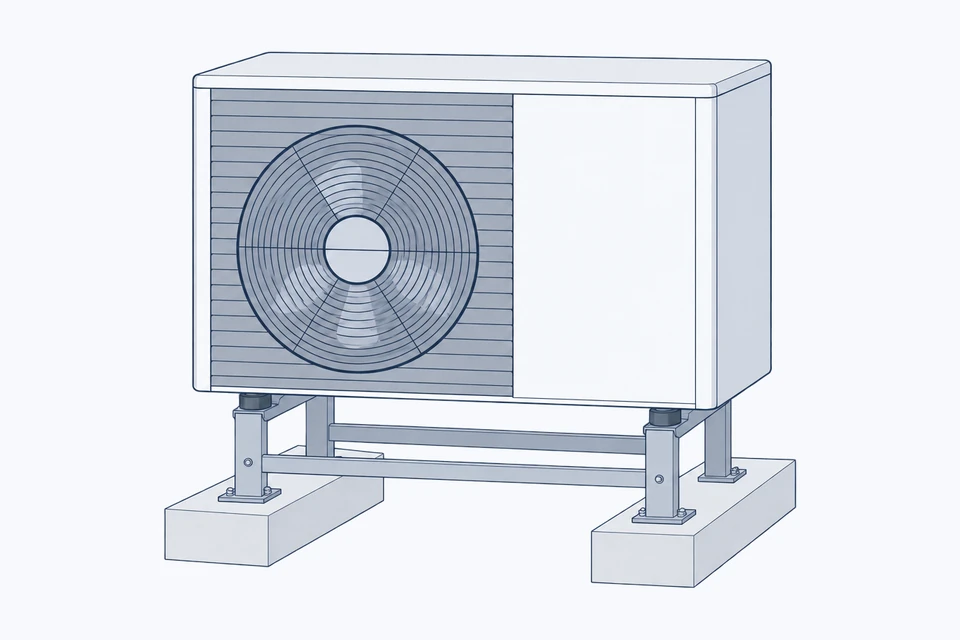
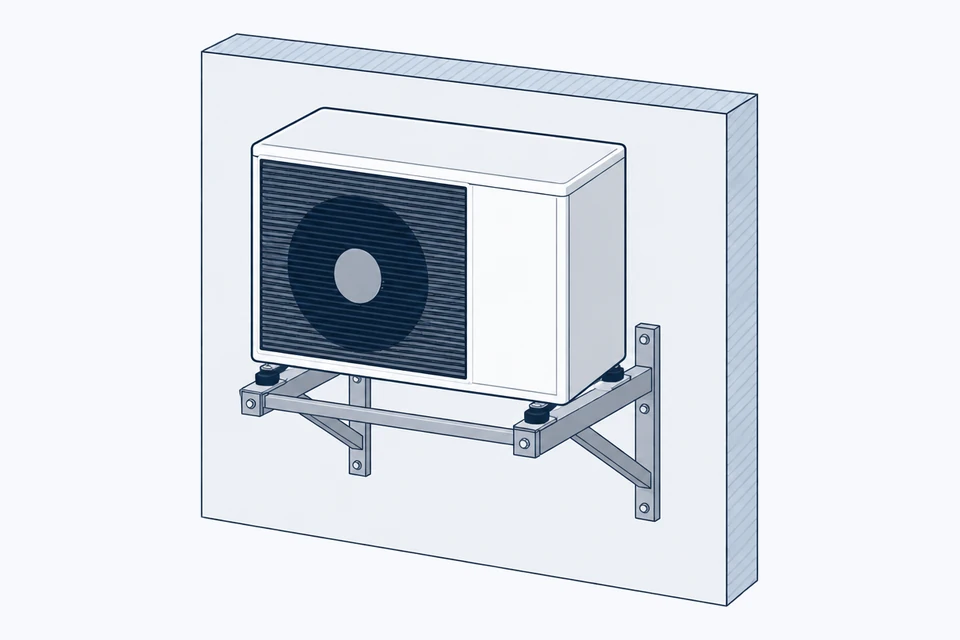
Flexible hose connections keep vibration from travelling along the pipes into the house. The base, condensate drain and the rest of the fitting are in heat pump installation.
Reducing heat pump noise: what works
MCS's guidance and its calculation give these options, before or after installation:
| Measure | Effect | Watch out for |
|---|---|---|
| Quieter unit | lower sound power, decibel for decibel at the window | compare sound power across models in our comparison of air source heat pumps |
| More distance | about 6 dB less for twice the distance | longer pipe run |
| Fewer reflecting surfaces | 3 dB less per surface removed | the maker's clearances |
| Solid barrier hiding the window | 10 dB in the calculation (Type 1) | no gaps, 1 m past each side, kept in repair |
| Anti-vibration mounts, grommets, flexible hoses | less vibration into the building | not counted in the calculation |
| Compressor jacketAn insulating jacket around the compressor, factory-fitted or supplied by the manufacturer | about 6 dB off the compressor | retrofitting may affect the warranty |
| Acoustic enclosure | helped in cases reported to the DESNZ review | must not block the airflow |
| Hedge or slatted fence | none in the calculation | – |
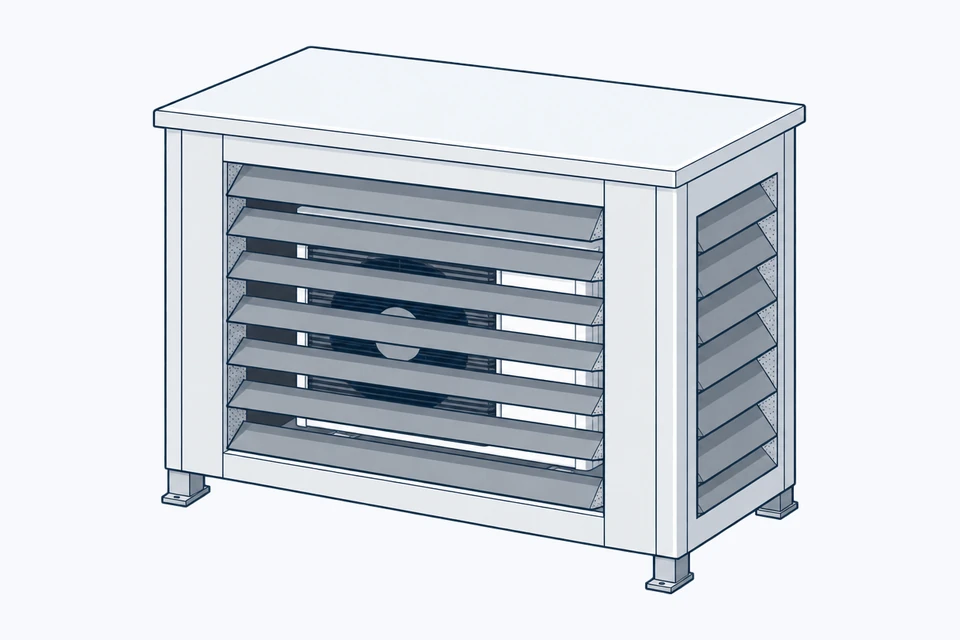
Quiet mode and timing. Quiet or eco modes slow the fan and compressor, but MCS warns they can cut the heat output, slow hot-water recovery and lower efficiency, and the 37 dB(A) test can't rely on them. Timing helps too: night-time sound stands out against a quieter background, so MCS suggests heating hot water outside common sleeping hours.
Heat pump noise and your neighbours
MCS advises talking to neighbours as early as possible: why the heat pump is going in and what they should expect to hear.
If a unit becomes noisy, MCS's guidance suggests checking for loose or failed parts and debris in the fan, whether servicing is up to date and whether anything around it has changed, such as a removed barrier, before turning to quiet modes, scheduling or extra mitigation. In the DESNZ review, installers said complaints were usually resolved by moving or replacing the unit.
If talking doesn't solve it, in England a council must look into a complaint about noise from premises and, if it finds a statutory nuisance under the Environmental Protection Act 1990, serve an abatement notice. Wales, Scotland and Northern Ireland publish their own guidance on noise nuisance.
Checklist for your quote and your neighbours
Settle these before the unit is fixed in place.
- Sound power. The figure for the exact model from the product fiche, energy label or MCS product directory, not a low-noise mode.
- The MCS 020(a) table. A copy for each assessment position, showing Q, the distance and any barrier.
- Every side. Windows and doors on all sides and upper floors checked, not only the nearest.
- The barrier. If the result relies on one, its material, thickness and length written into the quote.
- Mounting. Anti-vibration feet or pads, grommets on any brackets, flexible hoses, and not on a bedroom wall.
- Settings. Hot water scheduled outside sleeping hours; what a quiet mode would cost in output.
- Neighbours. Told before the unit goes in.
How to compare the rest of a quote is covered in choosing an MCS installer.
Figures that change
| What | Value | Applies |
|---|---|---|
| Permitted-development noise limit | 37.0 dB(A) at each assessment position | England and Wales; MCS 020(a) Issue 1.1, dated 14 April 2025 |
| Example units | Ecodan R290 PUZ-WZ50VAA (5 kW): sound power 56 dB(A); PUZ-WZ80VAA (8 kW): 58 dB(A); both 40 dB(A) at 1 m | Mitsubishi Electric UK datasheets effective January 2025 |
How we worked this out
The example runs our example home (a 1970s semi in England), an assumed garden layout and one UK datasheet's sound power through the MCS 020(a) formula. It is not an MCS noise assessment; your installer does that. More in our editorial method.
Frequently asked questions
How loud is a heat pump in decibels?
UK datasheets give the outdoor unit's sound power: 56 dB(A) for the Mitsubishi Electric Ecodan R290 5 kW, which measures 40 dB(A) at 1 m. What reaches a neighbour's window depends on the distance and the walls around the unit, and in England and Wales permitted development needs 37 dB(A) or less there under MCS 020(a).
How far from my neighbour's window does a heat pump need to be?
England and Wales set no fixed distance; the MCS 020(a) result decides. With the formula, a 56 dB(A) unit on the ground against a wall with a clear view passes from about 5.0 m to the assessment position, 1 m outside the window; in the open from 3.6 m, in a corner from 7.1 m. A solid barrier that hides the window shortens these a lot.
Are heat pumps noisy at night?
A heat pump doesn't get louder because it is night, but it is easier to hear against a quieter background, and they work harder in cold weather, when heating water and when defrosting. Scheduling hot water outside sleeping hours helps; a quiet mode may help too, at some cost in output.
What happens if a heat pump fails the noise calculation?
In England and Wales it is not permitted development in that spot. Your installer can choose a quieter model, move it, reduce the surfaces around it or add a solid barrier and run the sum again; otherwise you may need to apply for planning permission. The rules by nation are on heat pump planning permission.
What can I do if my neighbour's heat pump is too noisy?
Talk to your neighbour first and ask them to have the unit checked for loose parts, missed servicing and changes around it, such as a removed fence. If that doesn't help, in England you can complain to the council, which must look into it and, if it finds a statutory nuisance, serve an abatement notice. Wales, Scotland and Northern Ireland publish their own guidance.
Read next
Reading time: 15 min
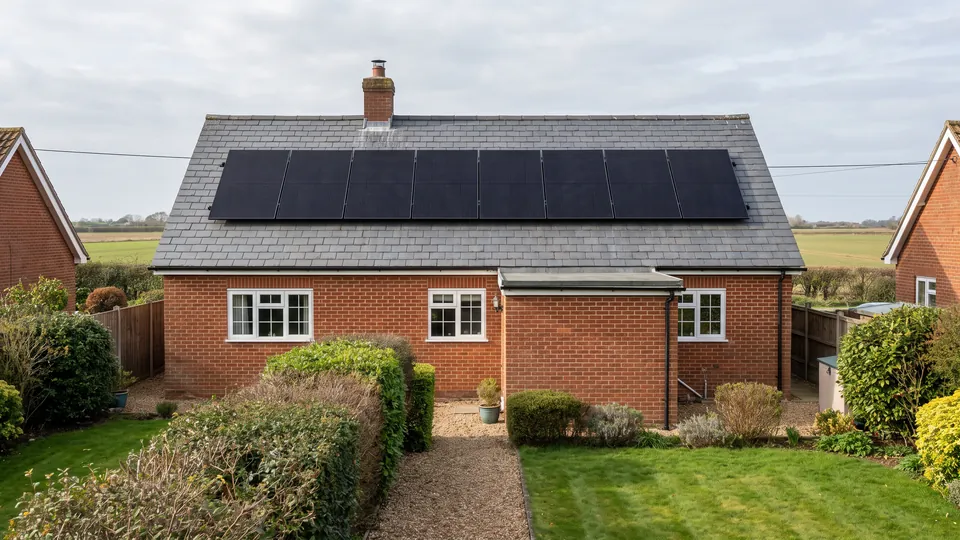
Heat pump planning permission
When an air source heat pump on a house needs planning permission in England, Wales, Scotland and Northern Ireland: a nation-by-nation table, the MCS 020(a) noise condition, one house checked against each nation's rules, listed buildings and conservation areas, Building Regulations and whether gas boilers are being banned.
Read moreHeat pump planning permission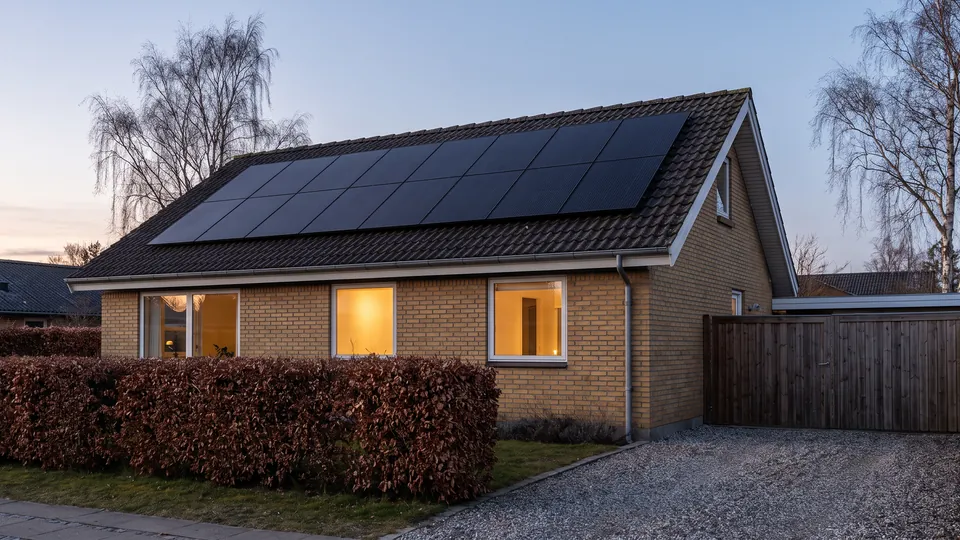
Reading time: 13 min
How a heat pump works
The refrigerant cycle in four steps, where the heat comes from in an example 1970s semi, why cold air and hot radiators cost efficiency, how heat pumps cope with UK winters, defrosting and a winter checklist.
Read moreHow a heat pump works
Reading time: 15 min
Heat pump installation
The switch from a gas boiler to an air source heat pump in order: heat-loss survey, design in writing, Boiler Upgrade Scheme voucher or Home Energy Scotland offer, hot-water cylinder, outdoor unit placement with a worked example, electrics, building-control sign-off, commissioning and handover.
Read moreHeat pump installation
Reading time: 15 min
Heat pump installers
How to choose an MCS-certified heat pump installer: checking certification and consumer-code membership, what a complete quote and design must show, warning signs, deposit protection under RECC and HIES, and cancellation rights.
Read moreHeat pump installers
Reading time: 15 min
Best air source heat pumps
Seven air source heat pumps around 8 kW ranked from MCS certificate data, UK warranty terms and makers' documents, with our weights, every model's values, a worked score, a noise example and a quote checklist.
Read moreBest air source heat pumps