Air source heat pumps: how they work, what they cost and whether one suits your home
How an air source heat pump heats your home, how the types compare, what one costs and which grants apply in England and Wales, Scotland and Northern Ireland, and the pros and cons worked through on one example home.
An air source heat pump takes warmth from the outside air and uses electricity to raise it to the temperature your radiators and hot water need, replacing a gas, oil or LPG boiler. In the government-funded Electrification of Heat trial, air source heat pumps delivered a median 2.78 units of heat for every unit of electricity over a year. Installed, one costs a median £12,826 in England and Wales (July to September 2026, before any grant); if your home qualifies, the £7,500 Boiler Upgrade Scheme grant there brings that to £5,326. In our example 1970s semi, a heat pump with a SCOP of 2.8 costs about the same to run as the existing gas boiler at the October to December 2026 price cap.
At a glance
- Price. £12,826 median installed price in England and Wales before the grant (grants paid July to September 2026), or £5,326 after the £7,500 Boiler Upgrade Scheme grant if your home qualifies.
- Grants by nation. England and Wales: £7,500, or £9,000 for off-gas-grid homes replacing oil or LPG (applications properly made 21 July 2026 to 31 March 2027). Scotland: a Home Energy Scotland grant and optional interest-free loan. Northern Ireland: no grant open to all homeowners.
- Running costs. In our example home, about the same as the existing gas boiler at SCOP 2.8 on October to December 2026 prices; more below a SCOP of 2.81, less above it.
- First step. A room-by-room heat-loss survey by an MCS-certified installer; then, in England and Wales, the installer applies for the grant before work starts, while in Scotland you apply to Home Energy Scotland and wait for its written offer.
What is an air source (air-to-water) heat pump?
An air source heat pump system is an outdoor unit with a fan, an indoor (hydraulic) unit and usually a hot-water cylinder. In the UK the term means an air-to-water heat pump: it heats water for your radiators or underfloor heating and your taps, as a boiler does. Air-to-water units account for 94,545 of the 96,611 Boiler Upgrade Scheme grants paid in England and Wales to the end of September 2026.
It works like a fridge, except that it uses the warm side. A refrigerant circulates in a sealed loop through four stages:
- Evaporator. The fan draws outside air across a coil; the colder refrigerant inside absorbs its heat and turns into vapour.
- Compressor. An electric compressor squeezes the vapour, raising its pressure and temperature.
- Condenser. The hot vapour passes its heat to the water in your heating system and turns back into liquid.
- Expansion valve. The pressure drops, the refrigerant cools, and the loop starts again.
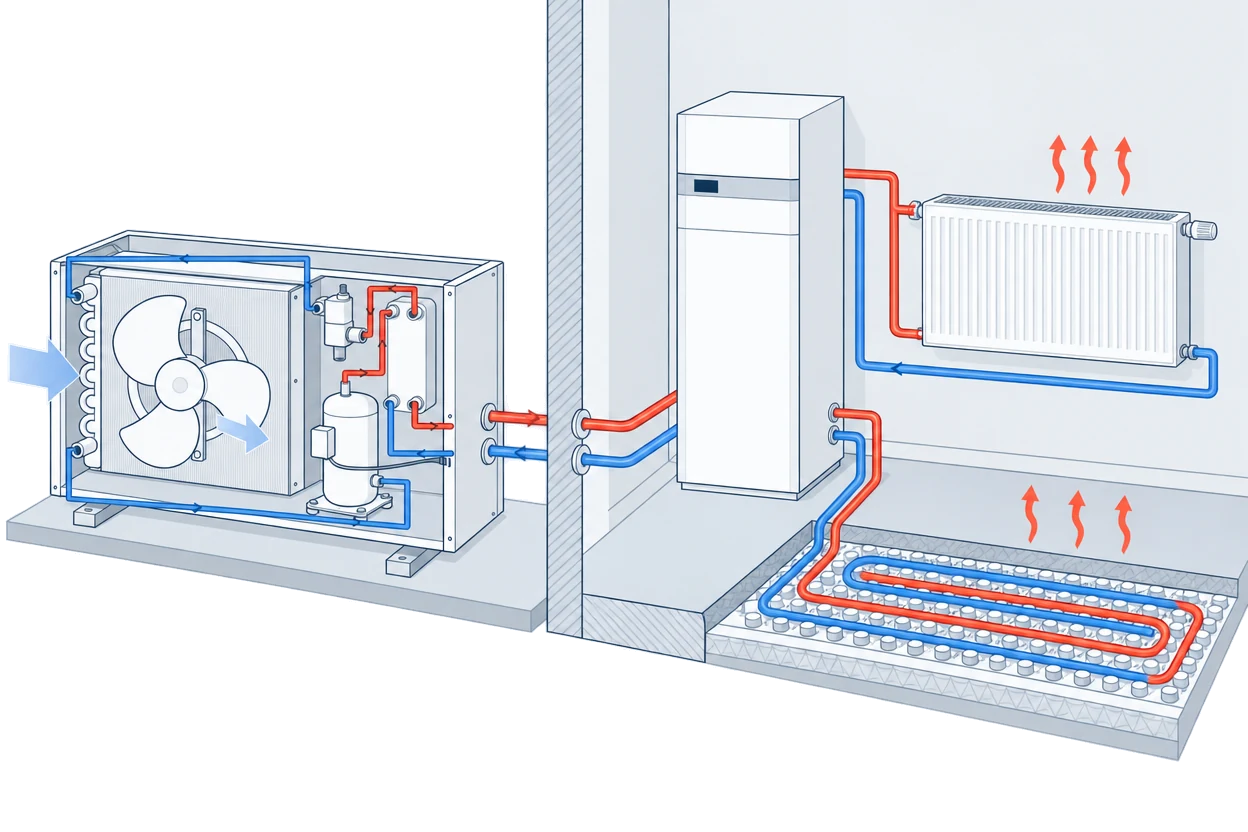
The lower the flow temperature (the temperature of the water sent to the radiators), the less electricity each unit of heat takes, so the design of the whole system matters as much as the box outside. The cycle, defrosting and cold-weather running are explained in how does a heat pump work. The diagram shows where the heat in our example home comes from.
Where 8,075 kWh of heat a year comes from
The heat pump takes electricity from the grid and heat from the outside air and gives both to the home as heat.
Per 10 kWh of heat: 4 kWh electricity + 6 kWh from the air
Heat and electricity, month by month
kWh of heat a month; the line is the electricity at SCOP 2.8
- Heat
- Electricity
- Highest
- Lowest
What the year takes
- Space heating
- 6,460 kWh
- Hot water
- 1,615 kWhabout 20%, our assumption
- Share from the air
- 64%5,191 kWh of 8,075 kWh
How much electricity the heat pump in the example house uses, how much heat it takes from the outside air and how much heat comes out for heating and hot water.
A year: 2,884 kWh of electricity and 5,191 kWh of heat from the air give 8,075 kWh of heat, 6,460 kWh for heating and 1,615 kWh for hot water; 2.8 kWh of heat per kWh of electricity.
Which type of heat pump suits your home?
Air source is the usual choice for a whole house. The alternatives differ in what they heat, what they need and what support they get:
| Type | Heats | Hot water | GrantBoiler Upgrade Scheme, England and Wales, if the home qualifies; Scotland and Northern Ireland differ | Median priceMedian installed price reported by MCS installers under the Boiler Upgrade Scheme, England and Wales, for grants paid July to September 2026, VAT included, before the grant | Needs |
|---|---|---|---|---|---|
| Air source (air-to-water) | radiators, underfloor | yes | £7,500 | £12,826 | space outside for the unit |
| Ground source | radiators, underfloor | yes | £7,500 | £34,630 | trenches or a borehole |
| Air-to-air | room air | no | £2,500 | no official median | a separate way to heat water |
| Hybrid (with a boiler) | radiators, underfloor | yes | none | no official median | a boiler kept alongside |
With only 1,603 ground-source grants paid in total, its median moves a lot between quarters; the median ground-source system behind it was 15 kW, against 8 kW for air source. A hybrid keeps a boiler for the coldest days and gets no Boiler Upgrade Scheme grant; in Scotland, Home Energy Scotland funds neither hybrids nor air-to-air.
Monobloc or split, and the refrigerant
The two designs differ in what passes through your wall:
| What differs | Monobloc | Split |
|---|---|---|
| Through the wall | heating water | refrigerant pipes |
| Refrigerant loop | sealed in the outdoor unit | connected on site |
| Refrigerant work | none on site | F-gas qualification for F-gas refrigerants |
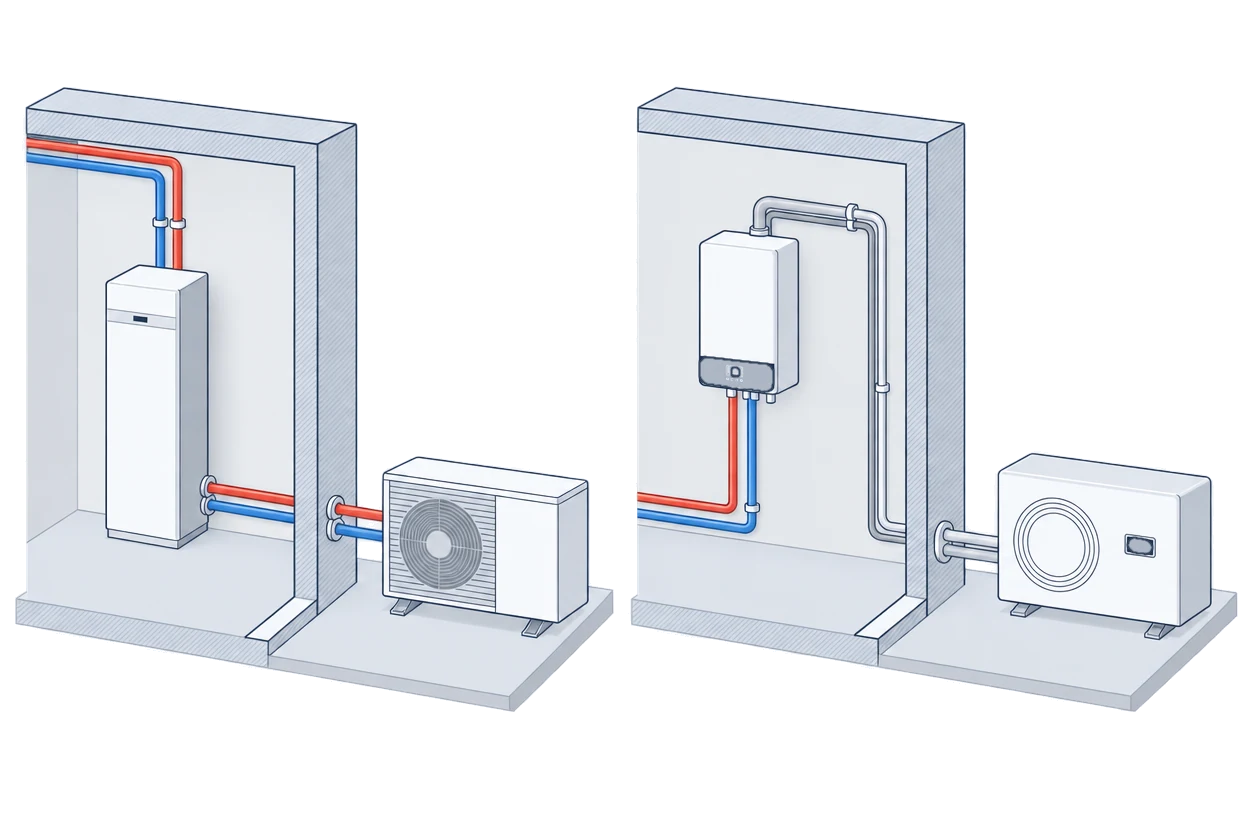
The UK is largely a monobloc market: 98,946 of the 102,258 air-to-water heat pumps sold in 2025 were monoblocs, according to the Heat Pump Association. How the main models compare is in best air source heat pumps.
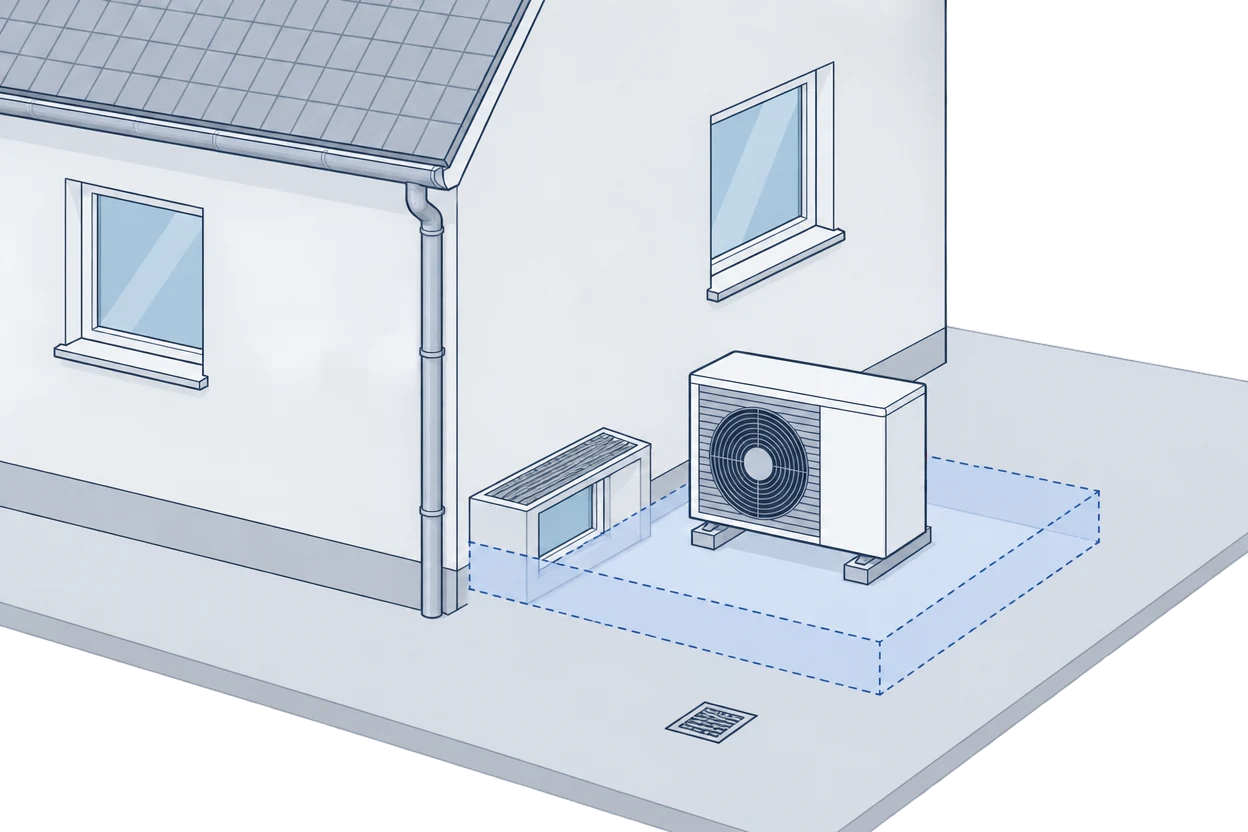
Many monoblocs use R290 (propane), a natural refrigerant; Mitsubishi Electric's 8 kW Ecodan R290 contains 1.0 kg of it, with a global warming potential of 0.02. Propane is highly flammable, so the maker sets a protective zone for an outdoor installation: for this model, 1 m around the unit and 0.3 m high. No window, door, vent, light well, drain or socket may sit inside it, and it must not extend onto a neighbour's property, a footpath or a driveway. In a small garden or a narrow side return, that can decide where the unit goes.
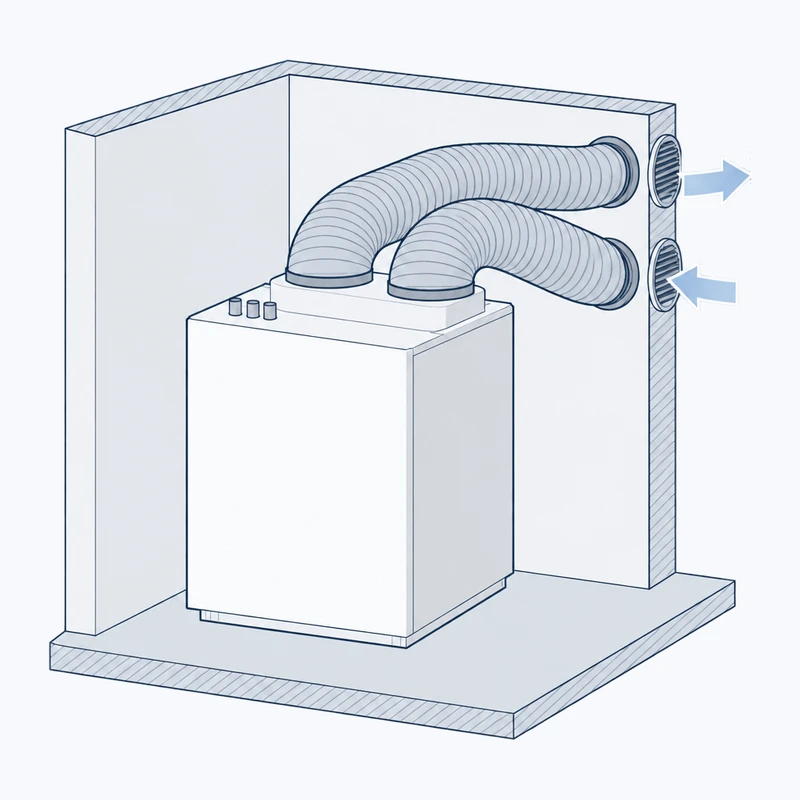
A few models are made to stand indoors, drawing outside air in and out through ducts in the wall, so there is no outdoor unit.
Price and support by UK nation
For grants paid from July to September 2026, the median air source job in England and Wales cost £12,826, as reported by MCS installers under the Boiler Upgrade Scheme, VAT included and before the grant; the median system was 8 kW. If your home qualifies, the installer takes the £7,500 grant off, which leaves £5,326. Prices by size and the extras older homes need are in heat pump cost.
What is left after the grant depends on where you live:
| Nation | Support | Before any work |
|---|---|---|
| England and Wales | Boiler Upgrade Scheme: £7,500; £9,000 for off-gas-grid homes replacing oil or LPG (applications properly made 21 July 2026 to 31 March 2027) | the installer applies; get the voucher before work starts |
| Scotland | Home Energy Scotland: grant up to £7,500, plus £1,500 for eligible rural and island homes, and an optional interest-free loan up to £7,500 | you apply and wait for the written offer |
| Northern Ireland | no grant open to all homeowners; NISEP schemes fully fund a heat pump for some lower-income owner-occupiers | depends on the scheme |
In England and Wales you never receive the grant as money: Ofgem pays the installer, who takes it off your invoice. For the Boiler Upgrade Scheme your old gas, oil or LPG heating has to be fully replaced, not kept as a backup; the rule is written about heating, so ask your installer before you plan to keep gas for cooking. Who may qualify is in heat pump grants, Scotland in Home Energy Scotland grants and loans, and the off-gas route in replacing an oil boiler with a heat pump. A heat pump supplied and installed in your home carries 0% VAT until 31 March 2027, then 5%.
What it costs to run
Our example home is a 1970s semi-detached house in England with 97 m² of floor space, radiators and a gas combi boiler. It uses 9,500 kWh of gas a year, Ofgem's typical medium use, and we assume the existing boiler turns 85% of that into heat. On unit rates alone:
- Heat needed: 9,500 kWh × 85% = 8,075 kWh a year.
- Heat pump: 8,075 kWh ÷ SCOP 2.5 / 2.8 / 3.1 = 3,230 / 2,884 / 2,605 kWh of electricity × 26.32p = £850 / £759 / £686 a year.
- Existing gas boiler: 9,500 kWh × 7.97p = £757 a year, so the break-even SCOP is 0.85 × 26.32 ÷ 7.97 = 2.81.
SCOP is the heat delivered for each unit of electricity over a year; we use 2.8, close to the trial median (see heat pump efficiency). Rates are the Ofgem price cap, GB average, direct debit, 1 October to 31 December 2026, standing charges left out. In Great Britain electricity carries no VAT until 31 March 2027 while gas carries 5%; with 5% VAT on electricity the break-even would be about 2.95 instead of 2.81. Your own result depends on the house, the installation and your tariff.
Energy cost a year, our example home
| Heating | Gas boiler | Heat pump |
|---|---|---|
| Existing gas boiler | £757 | |
| Heat pump, SCOP 2.5 | £850 | |
| Heat pump, SCOP 2.8 | £759 | |
| Heat pump, SCOP 3.1 | £686 |
The full calculation is in heat pump running costs, whether the switch pays for itself, including against a new boiler, in heat pump vs gas boiler, off-peak rates in heat pump tariffs, and pairing one with solar panels in heat pumps and solar panels.
What your home needs: heat loss, radiators and a cylinder
An older house doesn't rule one out: the Electrification of Heat trial found no statistically significant difference in performance by house type or age, although every home in it had first been judged suitable by trained designers. Three things decide it:
- Heat loss, room by room. Under the MCS design standard MIS 3005-D, the installer calculates each room's heat loss, picks a heat pump that covers all of it without the backup electric heater, and gives you the room heat losses, design flow temperature and expected SCOP in writing before installation.
- Radiators. A radiator sold as 1,500 W gives roughly 578 W when its water averages 45 °C in a 21 °C room (worked out with the manufacturer's correction factor), so some rooms may need a larger one. In England, a fully replaced wet heating system should be designed for a flow temperature of 55 °C or lower under Building Regulations guidance.
- Space for hot water. A combi home needs room for a hot-water cylinder. In England an unvented cylinder is notifiable building work unless the installer self-certifies through a competent person scheme.
How to check your own home is in is my home suitable for a heat pump.
Where it goes: noise and planning
The outdoor unit needs a firm, level base, free airflow and a drain for the water that drips from it. In England and Wales it is usually permitted development if it passes the MCS 020(a) noise test (37 dB(A) at a neighbour's window) and the size and siting conditions, but not on a listed building, and conservation areas restrict where the unit can go. Scotland and Northern Ireland have their own rules: see heat pump planning permission and check with your local planning authority.
Air source heat pump pros and cons: are they any good?
Designed and installed well, yes: it heats your home and hot water on electricity alone, and in our example home it costs less to run than the existing gas boiler above a SCOP of 2.81 (October to December 2026 cap rates). In its favour:
- One system for heating and hot water. It replaces the boiler for both, and some models can also cool (see the FAQ).
- No fuel burned at home. No flue, no gas needed for heating and no oil deliveries.
The drawbacks, and what helps:
| Drawback | In our example home | What helps |
|---|---|---|
| Upfront price | £5,326 after the grant at the median (England and Wales), against about £3,500 for a new gas boiler (government estimate) | the grant before work starts; like-for-like quotes |
| Efficiency depends on design | below SCOP 2.81 it costs more to run than the existing gas boiler | a room-by-room survey and the lowest workable flow temperature |
| Electricity prices | your bill follows the unit rate; no VAT on electricity in Great Britain only until 31 March 2027 | a heat-pump or time-of-use tariff |
| Space | an outdoor unit, and a cylinder in a combi home | settle both positions at the survey |
| Noise and siting | 37 dB(A) test at a neighbour's window (England and Wales) | distance, a solid barrier |
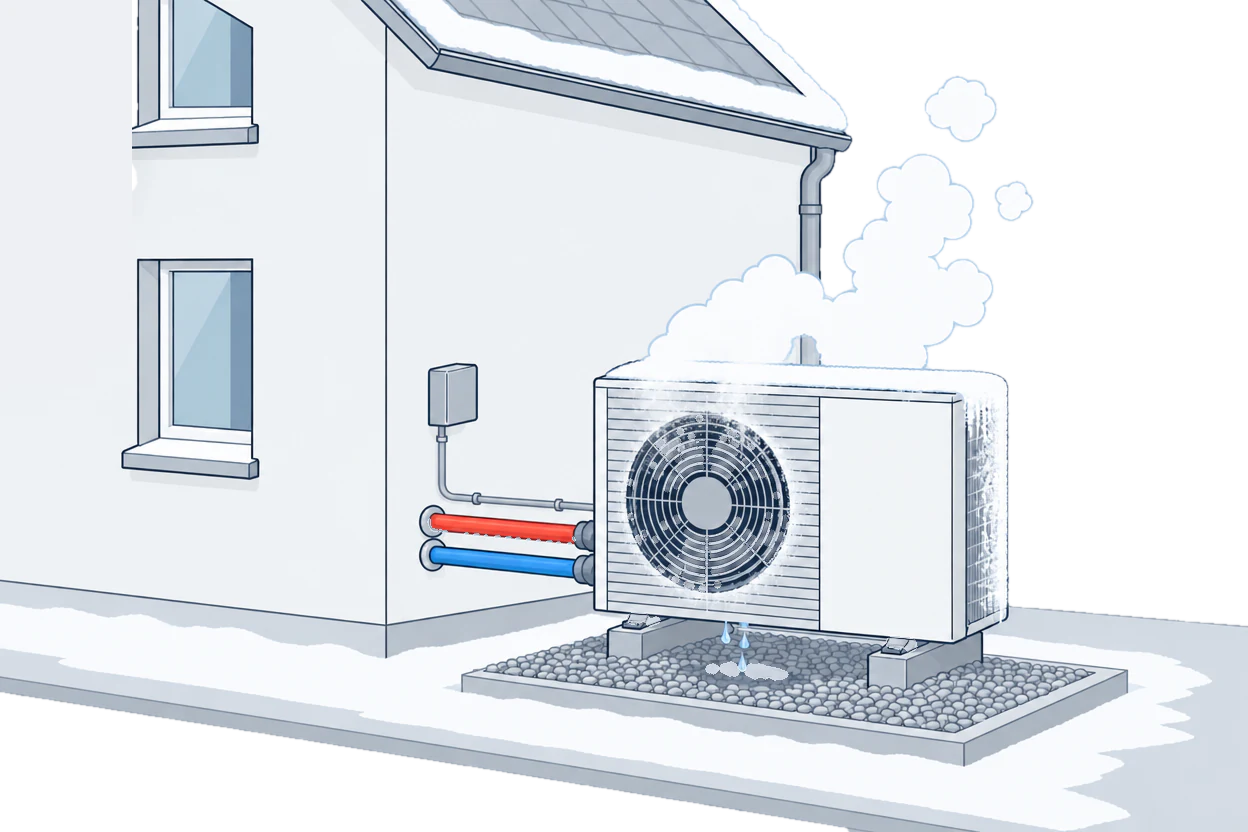
"They don't work when it's freezing"
They do, though they use more electricity as the air gets colder. An MCS design has to keep every room at its target temperature on the coldest day the standard sets for your area (−3.0 °C in London and −5.9 °C in Glasgow on its colder values) and through repeated defrosts. The 8 kW R290 model above is rated to run down to −25 °C.
"You need underfloor heating"
It helps, because it runs cool, but radiators work if each is large enough for its room at the design flow temperature; the survey shows which need replacing.
"Gas boilers are being banned"
There is no ban on keeping or repairing a gas boiler in an existing home. The Future Homes Standard applies to new homes in England from 24 March 2027.
Checklist: your route to an air source heat pump
From first look to switch-on
- Find your yearly gas or oil use on your bills.
- Note where an outdoor unit and, in a combi home, a cylinder could go.
- Book a room-by-room heat-loss survey with an MCS-certified installer.
- Get more than one quote for the same scope.
- In England and Wales, start work only once the grant voucher is issued; in Scotland, wait for Home Energy Scotland's written offer.
- Ask the installer to confirm the unit meets permitted development, or whether you need planning permission.
- After switch-on, compare tariffs that suit how your heat pump runs.
How to compare installers and their quotes is in choosing an MCS installer, and each stage from survey to switch-on in heat pump installation.
Figures that change
| What | Value | Applies |
|---|---|---|
| Air source heat pump, installed | median £12,826 | grants paid July–September 2026, England and Wales, before the grant |
| Ground source heat pump, installed | median £34,630 | grants paid July–September 2026, England and Wales, before the grant |
| Boiler Upgrade Scheme grant | £7,500 air source or ground source; £2,500 air-to-air | England and Wales; air-to-air from 28 April 2026 |
| Off-gas grant | £9,000 | England and Wales; oil or LPG homes off the gas grid, applications properly made 21 July 2026 to 31 March 2027 |
| Home Energy Scotland | grant up to £7,500 (+£1,500 eligible rural and island homes), interest-free loan up to £7,500 | Scotland, 2026/27, budget-limited |
| VAT on installed heat pumps | 0%, then 5% | 0% until 31 March 2027 |
| New gas boiler, government estimate | about £3,500, VAT included | DESNZ, Boiler Upgrade Scheme business case 2026 |
| Electricity unit rate | 26.32p/kWh | price cap, GB average, direct debit, 1 October to 31 December 2026, no VAT in Great Britain |
| Gas unit rate | 7.97p/kWh | same period, 5% VAT included |
How we worked this out
Our figures use our example home (1970s gas semi, 97 m², 9,500 kWh of gas, 85% efficiency for its existing boiler as our assumption), the median price for grants paid July–September 2026, the October–December 2026 cap rates and SCOP 2.5 / 2.8 / 3.1; standing charges, servicing and finance are left out. More in our editorial method.
Frequently asked questions
Is a heat pump electric or gas?
Electric. It uses electricity to run a compressor and fan and takes the rest of its heat from the outside air, so it needs no gas supply. If you claim the Boiler Upgrade Scheme in England and Wales, ask your installer whether you can keep gas for cooking.
Is an air source heat pump the same as air conditioning?
No. In the UK an air source heat pump heats water for your radiators, underfloor heating and taps. Units that blow warm air into rooms are air-to-air heat pumps, which work much like air-conditioning units and don't heat water; see air-to-air heat pumps.
Can an air source heat pump cool my house?
Some can, by running the refrigerant cycle in reverse: Mitsubishi Electric's service manual for its Ecodan R290 outdoor units, for example, gives operating ranges for both heating and cooling. It depends on the model and how the system is set up, so ask for cooling in the quote if you want it. In England, permitted development doesn't cover a heat pump used solely for cooling.
Do I need planning permission for an air source heat pump?
Usually not for a house in England or Wales, if the unit passes the MCS 020(a) noise calculation and meets the size and siting conditions. Permitted development doesn't cover listed buildings, conservation areas restrict where the unit goes, and Scotland and Northern Ireland have their own rules, so check with your local planning authority.
Read next
Reading time: 13 min
How a heat pump works
The refrigerant cycle in four steps, where the heat comes from in an example 1970s semi, why cold air and hot radiators cost efficiency, how heat pumps cope with UK winters, defrosting and a winter checklist.
Read moreHow a heat pump works
Reading time: 15 min
Ground source heat pump
Boreholes, trenches and open loops compared, the MCS arithmetic for how much ground you need, efficiency against air source, installed prices from the Boiler Upgrade Scheme statistics, planning rules by nation, England's water and drilling rules, and a worked example.
Read moreGround source heat pump
Reading time: 15 min
Air-to-air heat pumps
Air-to-air heat pumps explained: the difference from air-to-water, the £2,500 Boiler Upgrade Scheme grant in England and Wales, why no price statistic exists, hot water, running costs and a quote checklist.
Read moreAir-to-air heat pumps
Reading time: 15 min
Hybrid heat pumps
Hybrid heat pumps explained: the MCS definition and 55% sizing rule, how the controller switches by temperature or price, hot water, no Boiler Upgrade Scheme or Home Energy Scotland funding, costs per kWh of heat in our example semi, and a quote checklist.
Read moreHybrid heat pumps
Reading time: 16 min
Heat pump cost
Installed heat pump prices from the government's Boiler Upgrade Scheme statistics: the median and its range, prices by size and type, extras in older and combi homes, the grant by nation, 0% VAT to 31 March 2027 and a worked example.
Read moreHeat pump cost
Reading time: 16 min
Heat pump grants
The Boiler Upgrade Scheme in full: amounts in England and Wales, the £9,000 for oil or LPG homes to 31 March 2027, who qualifies, the six steps from quote to voucher, Scotland and Northern Ireland, loans and 0% VAT to 31 March 2027.
Read moreHeat pump grants
Reading time: 14 min
Heat pump running costs
Heat pump running costs in our example 1970s semi: 2,884 kWh and £759 a year at SCOP 2.8, £850 at 2.5 and £686 at 3.1 (Ofgem price cap, 1 October to 31 December 2026), against £865 for gas including a £108 standing charge that ends only if the gas supply is disconnected, as we assume.
Read moreHeat pump running costs
Reading time: 15 min
Heat pump vs gas boiler
Heat pump vs gas boiler in our example 1970s semi: running costs at the October to December 2026 price cap against the current boiler and a new one, break-even SCOPs, the extra cost after the £7,500 grant in England and Wales if your home qualifies, payback, 20-year totals and when it isn't worth it.
Read moreHeat pump vs gas boiler
Reading time: 15 min
Is my home suitable for a heat pump?
How to tell whether your home suits a heat pump: gas use per m², a cold-day radiator test and the MCS room-by-room survey, older and solid-walled homes, space and planning, insulation and grants by nation.
Read moreIs my home suitable for a heat pump?
Reading time: 15 min
Heat pump planning permission
When an air source heat pump on a house needs planning permission in England, Wales, Scotland and Northern Ireland: a nation-by-nation table, the MCS 020(a) noise condition, one house checked against each nation's rules, listed buildings and conservation areas, Building Regulations and whether gas boilers are being banned.
Read moreHeat pump planning permission
Reading time: 15 min
Heat pump installers
How to choose an MCS-certified heat pump installer: checking certification and consumer-code membership, what a complete quote and design must show, warning signs, deposit protection under RECC and HIES, and cancellation rights.
Read moreHeat pump installers
Reading time: 15 min
Best air source heat pumps
Seven air source heat pumps around 8 kW ranked from MCS certificate data, UK warranty terms and makers' documents, with our weights, every model's values, a worked score, a noise example and a quote checklist.
Read moreBest air source heat pumps