Heat pump maintenance: servicing, warranties and lifespan
What an annual heat pump service covers, what you can safely check yourself, the service conditions in each maker's UK warranty, when the law requires an F-gas leak check and what we can say about lifespan.
An air source heat pump needs one service a year by a qualified engineer, plus a few simple checks you can do yourself. MCS's best-practice guide says more than one service inspection a year is unlikely to be needed, and six of the seven brands we review make an annual service a condition of their UK warranty, so a missed visit can cost you the cover. Routine servicing is a warranty condition, not a general legal duty for a home heat pump. The exception is the F-gas leak check: in Great Britain it is a legal requirement from 5 tonnes of CO₂ equivalent (7.41 kg of R32 or 2.40 kg of R410A), and propane (R290) is not an F gas.
At a glance
- Service. Once a year by a qualified engineer, recorded in the Benchmark logbook, the record your installer fills in at installation, or in the maker's service record.
- Warranty. 12 months to 10 years, counting paid extensions, depending on maker, registration and installer; six brands' UK terms require an annual service.
- Your checks. A clear outdoor unit, the pressure gauge, the condensate drain and your meter readings.
- F-gas. In Great Britain a leak check is required from 5 tonnes of CO₂ equivalent; propane units don't count. Northern Ireland follows the EU F-gas system.
- Lifespan. No official UK figure, so we don't quote one; the warranty is the cover you can check.
What heat pump maintenance involves
The heat pump itself is a sealed unit, much like a fridge, and needs little attention; the heating system it feeds, with its water, valves, filter and controls, needs a regular look. MCS draws this line in its best-practice guide, tells installers to follow the manufacturer's recommendations and says more than one service inspection a year is unlikely to be needed.
In practice the manufacturer sets the timetable. Grant's manual for its Aerona 290 range, for example, says the heat pump should be serviced at least every twelve months, with each visit entered in the manual's service log. The work splits like this:
| Task | Who | How often |
|---|---|---|
| Outdoor unit clear of leaves, snow and plants | you | through the year, and after storms |
| Pressure gauge, condensate and readings | you | a quick look once a month (our suggestion) |
| Annual service of heat pump and heating system | qualified engineer | once a year |
| Refrigerant work, repairs, anything inside the casing | qualified engineer | when needed or legally required |
What you can check yourself
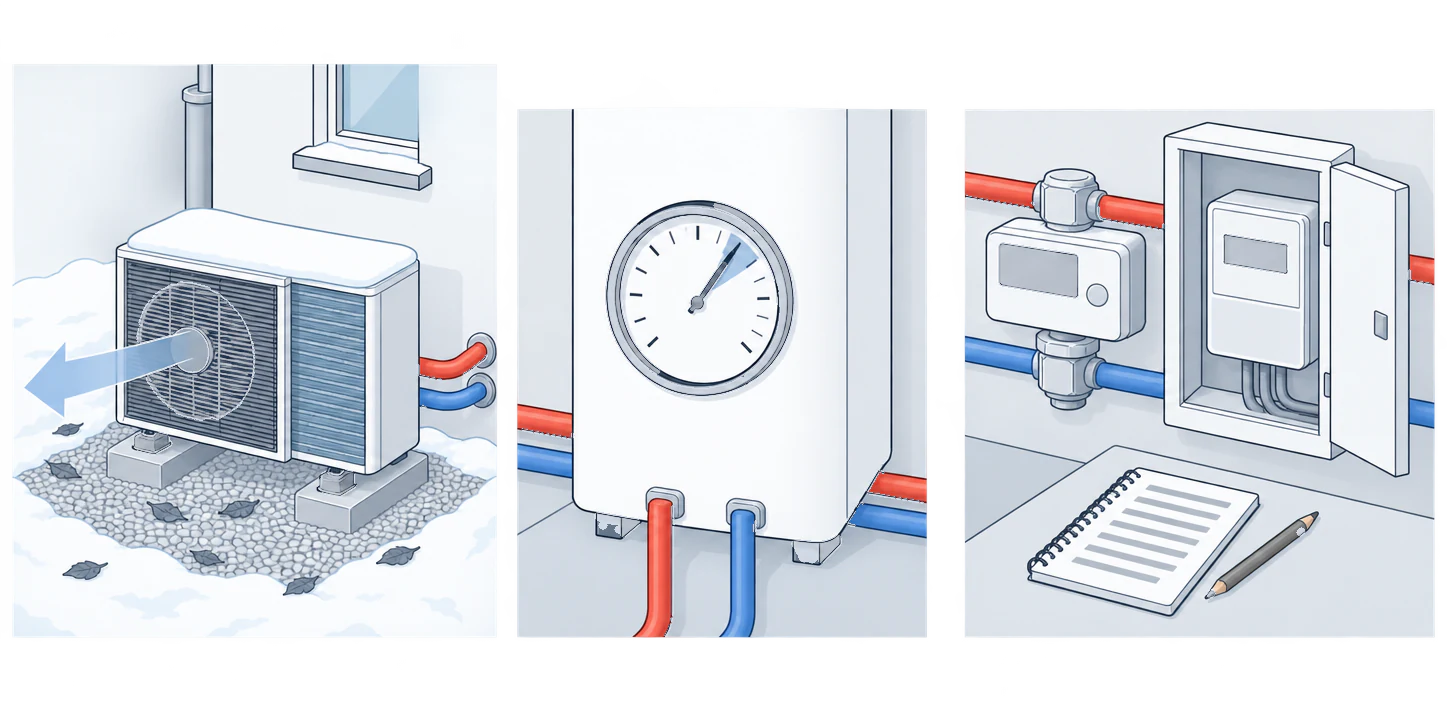
MCS says checking the outdoor unit's airflow needn't be done by a specialist. Everything inside the casing is for an engineer; Mitsubishi Electric's Ecodan guide tells users not to attempt repairs themselves.
- Outdoor unit. Clear leaves, snow and debris from the grille, keep plants from growing over it and stack nothing against it, as Grant's manual asks. Don't hose it down: Grant warns that rinsing the unit can cause an electric shock or fire.
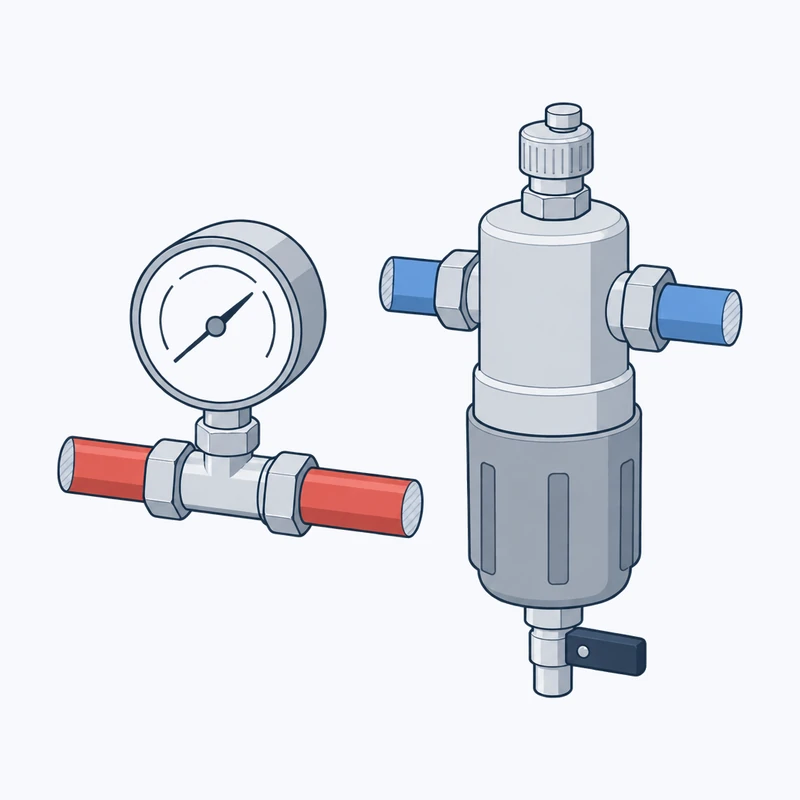
- Pressure. Ask your installer what gauge reading is normal and whether you may top up; Grant gives 1 to 3 bar for the Aerona 290's heating water and has the engineer top up below 1 bar.
- Condensate. Water drains from holes in the base of the outdoor unit. Check it runs away and doesn't pool or reach a path, where Grant warns it can freeze.
- Power. Leave the outdoor isolator on in winter: switched off there, Grant's frost protection and refrigerant leak sensor stop working.
- Readings. If your controller, app or a heat meter shows heat produced and electricity used, note both monthly; the efficiency section shows why.
What happens at an annual heat pump service
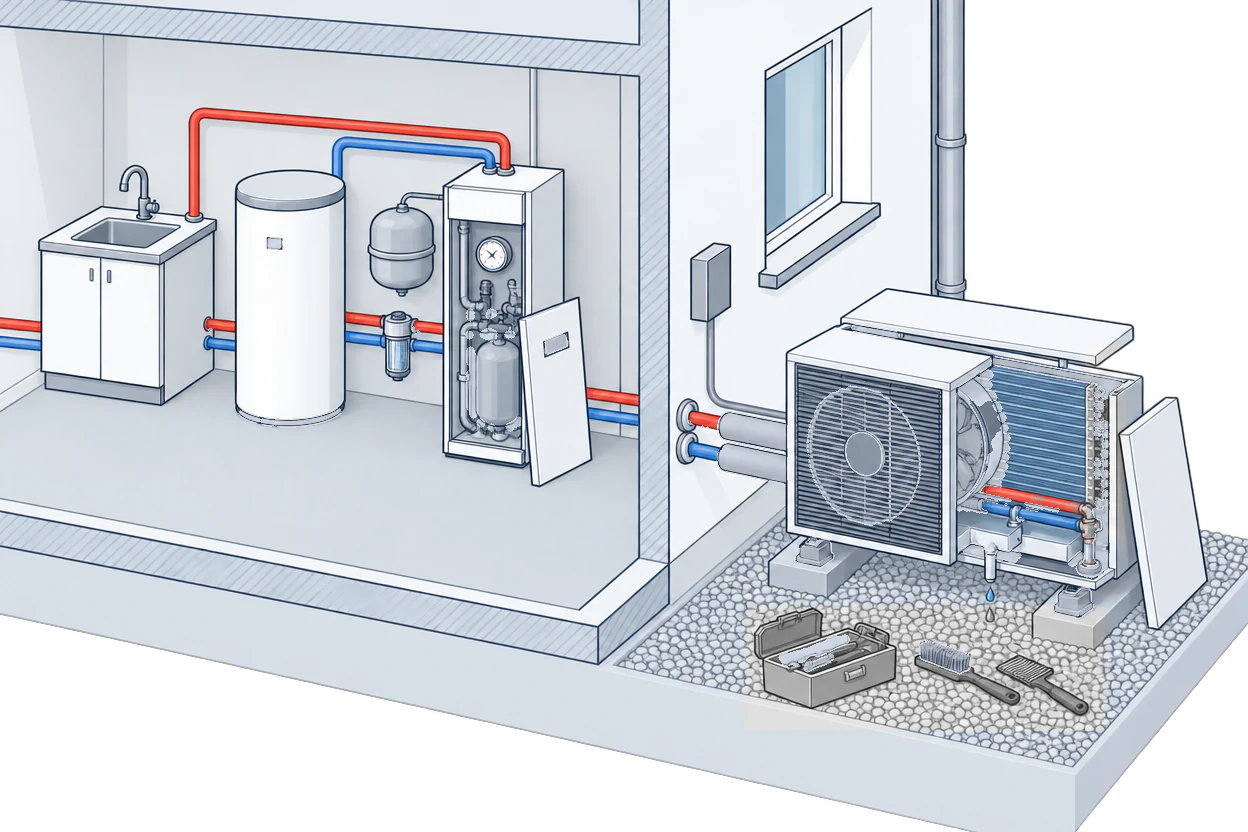
Service lists differ by model. Grant's annual procedure for the Aerona 290 shows what an engineer checks:
- refrigerant leaks and the unit's general condition,
- the inlet grille and evaporator fins, cleaned with a soft brush or gentle vacuum, and the fan outlet,
- condensate drain holes and hoses,
- pipe insulation, flexible hoses and the relief valve's discharge pipe,
- electrical connections and the control board,
- in the heating system: expansion vessel, relief valve, pressure, inhibitor, leaks and a clean magnetic filter,
- controller settings against those set at commissioning.
The type of unit adds checks. For a monobloc, where the heating water runs out to the unit, MCS says the antifreeze in that circuit should be checked, how often depending on any record of leaks. For a split system, with refrigerant pipes into the house, it recommends periodic checks of the refrigeration system. Grant's manual says any work on the refrigerant side of its propane units must be done by an F-gas registered refrigeration engineer.
Ask for every visit to be written into the Benchmark logbook or the maker's service record, and keep the invoice; Vaillant's terms require the logbook to be kept with the heat pump for each engineer's visit.
Warranties: the annual service condition by brand
UK manufacturer cover depends on registration within a deadline, who installed the heat pump and a yearly service. Each maker's published UK terms:
| Brand | Cover | Registration | Service condition |
|---|---|---|---|
| Vaillant | 2 years; up to 7 with a Vaillant cylinder and a myREWARDS installer | within 30 days, or cover drops to 12 months | serviced annually, or the guarantee becomes invalid |
| Mitsubishi Electric | 3, 5 or 7 years, matching the installer's status at commissioning | you register within 3 months of commissioning, or the guarantee is limited to 12 months | serviced every 12 months; evidence may be required |
| Daikin | 2 years; 5 once the installer registers it on Stand By Me; 7 paid, through Daikin's expert installers | installer within 90 days of commissioning; you activate within 2 years | valid only if annual maintenance is carried out |
| Grant | 12 months; 2 years if registered and serviced; 7 years with a G1 installer | within 30 days; a G1 installer registers it | serviced every 12 months |
| NIBE | 2 years; 7 years parts and labour through a NIBE Pro installer, mainland Great Britain only | within 28 days | serviced every year, Benchmark completed |
| Viessmann | 2 years; 5 on the Vitocal 200-A ie; paid extensions to 7 or 10 years depending on model | within 30 days; by a VPlus installer for the 200-A ie's 5 years, otherwise you or your installer, and the owner is responsible | serviced at the end of each 12 months from commissioning |
| Samsung | ask your installer for Samsung's warranty terms in writing | ask your installer | its UK support page says an annual service helps keep the warranty valid |
Three habits keep the cover alive: confirm registration happened before the deadline, book the service before the anniversary passes, and keep every record. Vaillant's terms add that the guarantee doesn't pay for the service, parts fitted under it are guaranteed for 12 months, and moving the heat pump to another property without consent voids it. Read the exclusions too: Viessmann excludes faults from sludge, scale or poor water quality and from frost or storms; Mitsubishi Electric excludes expendable parts such as fuses.
A maker's warranty sits on top of your legal rights, not in place of them; Vaillant's terms say so plainly. If your installer belongs to the RECC consumer code, it must also give a workmanship warranty of at least two years for problems caused by the installation. Full terms are in our brand reviews, for example Vaillant heat pumps, and our heat pump comparison shows how warranty length counts there.
Some makers and installers sell service plans. No official source publishes a market price for a heat pump service, but Mitsubishi Electric publishes its own plan prices for its Ecodan heat pumps, VAT included:
| Mitsubishi Electric plan | Price a year | What it covers |
|---|---|---|
| Heat Pump Service | £237 | yearly service of the heat pump and its controls, with the engineer's report |
| Yearly System Service | £323 | yearly service of the heat pump, hot-water cylinder and controls, a system health check, priority call-out for repairs and a discount on repair parts and labour |
| 3 Diamond Cover | £497 | the same yearly system service, repair parts and labour included, priority call-out and one free call-out a year |
These are one maker's prices for its own plans, not a market price. 3 Diamond Cover starts only after a pre-inspection you pay for in advance, which is non-refundable, and Mitsubishi Electric reviews prices once a year, with four weeks' notice before renewal. Before signing any plan, check what is covered, the response time, minimum term and notice. Finding an installer who services what they fit is part of choosing a heat pump installer.
Keep an eye on efficiency: what a drop costs
A service keeps the heat pump safe and in warranty; your own readings show whether it is still efficient. The measure is the seasonal coefficient of performance (SCOP): heat delivered over a year divided by the electricity used. Under the MCS design standard MIS 3005-D an MCS-certified installer gives you the design SCOP, the figure the system is designed to reach, in writing before work starts, so you have something to compare against; more in heat pump efficiency.
What a drop is worth in our example home, a 1970s semi-detached house in England (97 m²) that used 9,500 kWh of gas a year in a combi boiler we assume ran at 85% efficiency:
- Heat needed: 9,500 kWh × 85% = 8,075 kWh a year.
- At SCOP 2.8: 8,075 kWh ÷ 2.8 = 2,884 kWh of electricity; 2,884 kWh × 26.32p = £759 a year.
- At SCOP 2.5: 8,075 kWh ÷ 2.5 = 3,230 kWh; × 26.32p = £850 a year.
- At SCOP 3.1: 8,075 kWh ÷ 3.1 = 2,605 kWh; × 26.32p = £686 a year.
A slip from 2.8 to 2.5 adds £91 a year here. The same heat from your existing boiler costs 9,500 kWh × 7.97p = £757 in gas unit charges, so at SCOP 2.8 the two are roughly level; the break-even SCOP is 0.85 × 26.32 ÷ 7.97 = 2.81. We use 2.8 because it is close to the median measured in the government-funded Electrification of Heat trial. Rates are the Ofgem price cap, GB average, direct debit, 1 October to 31 December 2026, with no VAT on electricity in Great Britain until 31 March 2027; standing charges and servicing are left out. Results depend on the house, installation and tariff; the full arithmetic is in heat pump running costs.
A yearly figure well below the design is worth raising at the service.
F-gas leak checks: when the law requires one
The refrigerant is the fluid that carries heat round the sealed circuit inside the heat pump. Some refrigerants are F gases, fluorinated gases with a strong warming effect, and in Great Britain stationary heat pumps holding enough of them must be leak-checked. Government guidance sets the duty by the charge in tonnes of CO₂ equivalent, the mass of gas times its global warming potential (GWP):
Charge in kg × GWP ÷ 1,000 = tonnes of CO₂ equivalent
| Refrigerant | GWP | Leak check from |
|---|---|---|
| Propane (R290) | not an F gas | no F-gas leak check |
| R32 | 675 | 7.41 kg (5,000 ÷ 675) |
| R410A | 2,088 | 2.40 kg (5,000 ÷ 2,088) |
From 5 to under 50 tonnes the check is due at least every 12 months, or every 24 months with automatic leak detection. A hypothetical split unit holding 3 kg of R32 comes to 3 × 675 ÷ 1,000 = 2.0 tonnes, below the threshold. Propane units sit outside these rules; Grant's Aerona 290 range holds 0.61 to 1.65 kg of it.
The guidance puts the check on whoever uses the equipment, which for a home heat pump means you. The rating plate or datasheet gives the refrigerant and charge. These are Great Britain's rules; Northern Ireland is part of the EU F-gas system, so ask your installer there.
Faults: what to check before you call the engineer
Some signs need no engineer; others need one quickly:
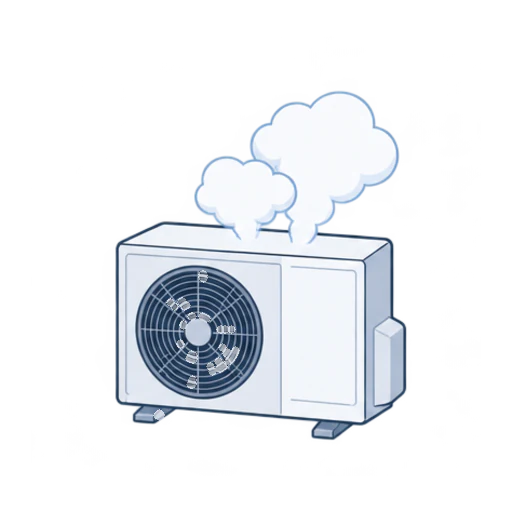 Steam from the outdoor unit in cold weather. Cause: the unit is defrosting. What to do: nothing, it is normal operation.
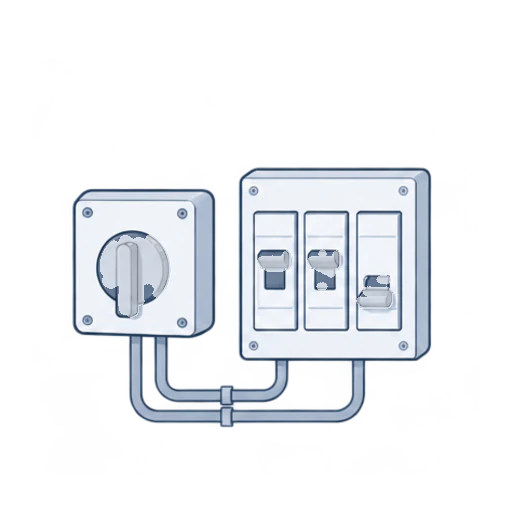 Heat pump not running. Cause: no power or no demand. What to do: check the outdoor isolator, the controller and the heating schedule.
 Error code on the controller. Cause: the unit reports a fault. What to do: note the code, look it up in the manual and call your installer.
 Pressure outside the normal range. Cause: too little or too much water pressure. What to do: ask your installer; if water pours from a relief valve, switch the heat pump and any immersion heater off, then call your installer.
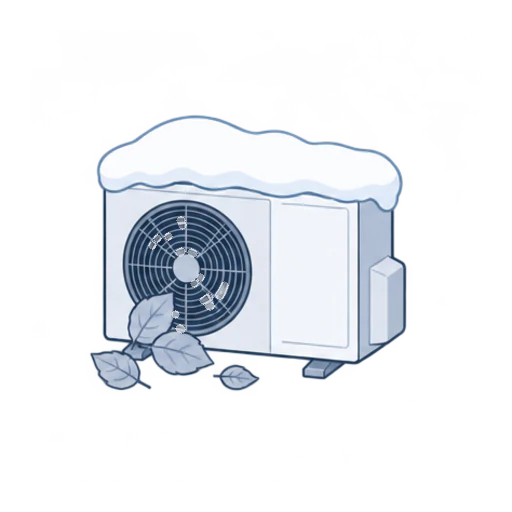 Snow or leaves on the unit. Cause: the airflow is blocked. What to do: clear the grille and the space around it.
 Switching on and off every few minutes. Cause: short cycling. What to do: ask your installer to check the settings and water flow.
Mitsubishi Electric's Ecodan guide calls the steam the defrost cycle and says no action is needed; how defrosting works is in how a heat pump works. If the simple checks don't help, call your installer or a service engineer; don't open the casing yourself.
How long does a heat pump last?
No official UK source gives a working life for an air source heat pump, so we don't quote one. A warranty is not a life expectancy: it is the period in which the maker repairs faults, 12 months to 10 years in the table above.
The makers' terms show what they won't pay for: damage from frost, sludge, scale or poor water quality, and heat pumps that missed their service. Mitsubishi Electric ties regular servicing to the best performance from an Ecodan "throughout its working life". The service, clean water with inhibitor, a clear outdoor unit and correct settings are the parts you control.
Checklist: heat pump upkeep
Set these up once, then keep them going.
- Register. Confirm the heat pump was registered in time (28 days for NIBE, 30 for Vaillant, Grant and Viessmann, 90 days for Daikin's installer and 2 years for your activation, 3 months for Mitsubishi Electric) and keep the confirmation.
- Book. Put the annual service in the diary before the anniversary of commissioning.
- Records. Keep the Benchmark logbook, service reports and invoices with the manual.
- Handover. Ask which checks are yours: normal pressure, topping up, the filter and the isolator.
- Refrigerant. Note the refrigerant and charge from the rating plate; if an F-gas charge reaches 5 tonnes of CO₂ equivalent, add the leak check to the service.
- Readings. Note heat and electricity monthly and compare the yearly figure with the design SCOP.
Figures that change
| What | Value | Applies |
|---|---|---|
| Electricity unit rate | 26.32p/kWh, no VAT in Great Britain | Ofgem price cap, GB average, direct debit, 1 October to 31 December 2026; electricity VAT removed in Great Britain until 31 March 2027 |
| Gas unit rate | 7.97p/kWh, 5% VAT included | Ofgem price cap, GB average, direct debit, 1 October to 31 December 2026 |
| Manufacturer warranties | 12 months to 10 years, paid extensions included | each maker's UK terms; makers can change them for new installations |
| F-gas leak-check threshold | 5 tonnes CO₂ equivalent | Great Britain |
| Mitsubishi Electric Ecodan service plans | £237, £323 and £497 a year, VAT included | Mitsubishi Electric's UK service-plan page, reviewed by the maker once a year; its 2025 leaflet gave £230, £314 and £483 |
How we worked this out
The efficiency example uses our example home (97 m² 1970s semi in England, 9,500 kWh of gas, 85% boiler efficiency assumed), SCOP 2.5 to 3.1 and Ofgem cap unit rates for 1 October to 31 December 2026, without standing charges or servicing. Warranty conditions and Mitsubishi Electric's plan prices come from the makers' UK documents; no official source publishes a market service price. More in our editorial method.
Frequently asked questions
Do heat pumps need servicing, and how often?
Yes, once every 12 months by a qualified engineer, unless your manual says otherwise; MCS's guide says more than one service inspection a year is unlikely to be needed. It is a warranty condition rather than a general legal duty: Viessmann wants the service at the end of each 12 months from commissioning, Grant at least every twelve months, and Vaillant, Daikin and NIBE annually, and missing one can void the extended cover.
How much does a heat pump service cost?
No official source publishes a market price for a heat pump service, so we don't quote one. Mitsubishi Electric publishes its own plan prices for its Ecodan heat pumps: £237 a year for a service of the heat pump and controls, £323 with the cylinder, priority call-out and a repair discount, and £497 with repair parts and labour included, VAT included. For any other plan or a one-off service, ask for the price in writing with what it covers (the heat pump, the heating system and cylinder, call-outs, parts and labour), and compare a plan's price, minimum term and notice period with booking a single yearly visit.
Can I service a heat pump myself?
Not the service itself: that needs a qualified engineer, and Grant requires an F-gas registered engineer for any work on the refrigerant circuit, even on its propane units. Your part is the owner's checks, never anything inside the casing.
Does a heat pump need an F-gas leak check?
Only if it holds enough F-gas refrigerant: in Great Britain the duty starts at 5 tonnes of CO₂ equivalent, and propane (R290) units are outside it. In Northern Ireland the EU F-gas system applies, so ask your installer which rules cover your unit.
How long do heat pumps last?
No official UK figure, so we don't give one. A manufacturer warranty, 12 months to 10 years depending on maker, registration, installer and any paid extension, is the period the maker repairs faults, not a life expectancy.
Read next

Reading time: 14 min
Heat pump efficiency
COP, SCOP and SPF explained with a UK datasheet, the Electrification of Heat field results (median 2.78 across 428 homes), the Boiler Upgrade Scheme's SCOP 2.8 minimum (England and Wales) and a meter-reading example.
Read moreHeat pump efficiency
Reading time: 14 min
Heat pump running costs
Heat pump running costs in our example 1970s semi: 2,884 kWh and £759 a year at SCOP 2.8, £850 at 2.5 and £686 at 3.1 (Ofgem price cap, 1 October to 31 December 2026), against £865 for gas including a £108 standing charge that ends only if the gas supply is disconnected, as we assume.
Read moreHeat pump running costs
Reading time: 13 min
How a heat pump works
The refrigerant cycle in four steps, where the heat comes from in an example 1970s semi, why cold air and hot radiators cost efficiency, how heat pumps cope with UK winters, defrosting and a winter checklist.
Read moreHow a heat pump works
Reading time: 15 min
Heat pump installers
How to choose an MCS-certified heat pump installer: checking certification and consumer-code membership, what a complete quote and design must show, warning signs, deposit protection under RECC and HIES, and cancellation rights.
Read moreHeat pump installers
Reading time: 15 min
Best air source heat pumps
Seven air source heat pumps around 8 kW ranked from MCS certificate data, UK warranty terms and makers' documents, with our weights, every model's values, a worked score, a noise example and a quote checklist.
Read moreBest air source heat pumps
Reading time: 15 min
Vaillant
Vaillant aroTHERM plus, aroTHERM pro and aroTHERM Split for UK homes: sizes, MCS SCOP at 35 and 55 °C, sound power with a 37 dB(A) example, MCS listings, the 2- to 7-year warranty routes, Cover & Care, controls and a quote checklist.
Read moreVaillant