Heat pump vs gas boiler: is a heat pump worth it?
Heat pump or a new gas boiler? The yearly running costs, the extra upfront cost after the grant and the years it takes to pay back, worked through on our example home at Ofgem price-cap rates, and what moves the answer.
A heat pump is worth it against a gas boiler mainly when your boiler needs replacing anyway and the heat pump runs efficiently; on running costs alone the two are close. In our example 1970s gas semi in England, a heat pump with a seasonal efficiency (SCOP) of 2.8 uses £759 of electricity a year, against £865 for gas in the current boiler with a standing charge we assume you stop paying once the gas is disconnected (Ofgem price cap, 1 October to 31 December 2026). Against a new £3,500 boiler at 93% efficiency, the extra £1,826 after the £7,500 grant (England and Wales, if your home qualifies) pays back in about 16 years at SCOP 3.1 and about 44 at 2.8, at flat prices with the gas disconnected.
At a glance
- Running costs. £759 a year for the heat pump at SCOP 2.8 against £865 for gas in the current boiler, standing charge included (price cap, GB average, 1 October to 31 December 2026); a new boiler at 93% would cost £800. With the gas disconnected, the heat pump is cheaper to run than the current boiler from a SCOP of 2.46 and than a new one from 2.66.
- Upfront. The £12,826 median installed price (England and Wales, grants paid July to September 2026) minus the £7,500 grant, if your home qualifies, leaves £5,326: about £1,826 more than a new gas boiler.
- Payback. Against a new boiler at 93% efficiency, about 16 years at SCOP 3.1 and about 44 at 2.8, at flat prices with the gas disconnected; no meaningful payback at 2.5 or if you keep gas for a hob.
- Biggest lever. Efficiency: the same house needs £850 of electricity a year at SCOP 2.5 and £686 at 3.1.
- Where you live. The grant figures are for England and Wales. In Scotland you apply to Home Energy Scotland and wait for its written offer; Northern Ireland has no Boiler Upgrade Scheme and is outside the Ofgem price cap.
Do heat pumps save money? Running costs against gas
Our example home is a 1970s semi-detached house in England with 97 m² of floor space (the average for a semi in the English Housing Survey), radiators and a gas combi boiler due for replacement. It uses 9,500 kWh of gas a year, Ofgem's typical medium use, and we assume the current boiler turns 85% of it into heat. It's an illustration, not a forecast for your home.
SCOP (seasonal coefficient of performance) is the heat a heat pump delivers for each unit of electricity over a whole year. We use 2.8, close to the 2.78 median measured across 428 air source heat pumps in the government-funded Electrification of Heat trial, with 2.5 and 3.1 either side; what drives it is in heat pump efficiency. Prices are the Ofgem price cap for 1 October to 31 December 2026: GB average, direct debit, with no VAT on electricity in Great Britain until 31 March 2027 and 5% VAT included on gas.
The sums in short: 9,500 kWh of gas × 85% = 8,075 kWh of heat; ÷ SCOP 2.8 = 2,884 kWh of electricity; × 26.32p = £759 a year. The gas costs 9,500 kWh × 7.97p = £757, plus a standing charge of 29.68p a day, or £108 a year: £865 in all. A new boiler at 93% would burn 8,075 ÷ 0.93 = 8,683 kWh, or £800 a year with the standing charge. The full bill is in heat pump running costs.
The last two columns compare the heat pump with the current boiler.
| Heating | Energy a year | Cost a year | Gas disconnectedDifference from the current boiler's £865 when the gas is disconnected, so there is no £108 gas standing charge (our assumption) | Gas keptYou keep a gas supply, for example for a hob, and keep paying the £108 standing charge |
|---|---|---|---|---|
| Current gas boiler (85%) | 9,500 kWh of gas | £865 | – | – |
| New gas boiler (93%) | 8,683 kWh of gas | £800 | – | – |
| Heat pump, SCOP 2.5 | 3,230 kWh | £850 | £15 less | £93 more |
| Heat pump, SCOP 2.8 | 2,884 kWh | £759 | £106 less | £2 more |
| Heat pump, SCOP 3.1 | 2,605 kWh | £686 | £180 less | £72 less |
Where the heat pump overtakes gas depends on the gas supply and on which boiler you compare with. Against the current boiler, with the standing charge paid either way, it matches gas on unit rates at a SCOP of 0.85 × 26.32 ÷ 7.97 = 2.81; with the gas disconnected the break-even falls to (8,075 kWh × 26.32p = £2,125) ÷ £865 = 2.46. Against a new boiler the bar is higher: 0.93 × 26.32 ÷ 7.97 = 3.07 with gas kept, and £2,125 ÷ £800 = 2.66 with the gas disconnected. The electricity standing charge is left out because you pay it with either system.
What a heat pump costs upfront against a new boiler
In England and Wales the median price of an air source heat pump, for grants paid in July to September 2026, was £12,826 before the grant: the middle of the prices MCS installers reported under the Boiler Upgrade Scheme, VAT included. A heat pump supplied and installed in your home carries 0% VAT until 31 March 2027, then 5%. If your home qualifies, the installer takes the £7,500 grant off the price, and the government estimates a replacement gas boiler at about £3,500 including VAT. For our example home:
- Heat pump after the grant: £12,826 − £7,500 = £5,326.
- Extra upfront against a new boiler: £5,326 − £3,500 = £1,826.
Without any grant, the gap in our example would be £12,826 − £3,500 = £9,326. Prices are explained in heat pump cost and the grant rules in heat pump grants.
These figures apply in England and Wales. In Scotland, Home Energy Scotland offers a grant of up to £7,500 and an optional interest-free loan; you apply yourself and need its written offer before any work starts, so the offer sets your net price. Northern Ireland has no Boiler Upgrade Scheme and is outside the Ofgem price cap, so neither side of this example applies there.
Payback: how long until the extra cost is paid back?
Payback is how many years the lower running cost takes to cover what you paid extra at the start:
Payback in years = extra upfront cost ÷ lower energy cost a year
Your boiler still works. Then the whole £5,326 after the grant has to be paid back from the saving against your current boiler: £5,326 ÷ £106 = about 50 years at SCOP 2.8, or about 30 at 3.1, with the gas disconnected.
Your boiler is due for replacement. Then only the £1,826 difference from a new boiler counts, and the saving is measured against that new boiler's £800 a year: £1,826 ÷ £115 = about 16 years at SCOP 3.1, and £1,826 ÷ £41 = about 44 years at 2.8, with the gas disconnected.
| Situation | Compared with | Extra upfront | Lower a year | Payback |
|---|---|---|---|---|
| Boiler still works, SCOP 2.8 | current boiler (85%) | £5,326 | £106 | about 50 years |
| Boiler still works, SCOP 3.1 | current boiler (85%) | £5,326 | £180 | about 30 years |
| Boiler due, SCOP 2.5 | new boiler (93%) | £1,826 | none (£50 more) | none |
| Boiler due, SCOP 2.8 | new boiler (93%) | £1,826 | £41 | about 44 years |
| Boiler due, SCOP 3.1 | new boiler (93%) | £1,826 | £115 | about 16 years |
| Boiler due, gas keptGas supply kept, for example for a hob, so the £108 standing charge stays, SCOP 2.8 | new boiler (93%) | £1,826 | none (£67 more) | none |
| Boiler due, gas keptGas supply kept, for example for a hob, so the £108 standing charge stays, SCOP 3.1 | new boiler (93%) | £1,826 | £6 | no meaningful payback |
All rows use the price-cap rates for 1 October to 31 December 2026, held flat, with the gas disconnected unless the row says otherwise. The current boiler is at 85%, our assumption; a new boiler is at 93%, the figure MCS's pre-sale estimate method uses for a new boiler. To try your own prices, SCOP or no grant, use the chart: it starts from our example home and marks the year the heat pump catches up.
Heat pump against a new gas boiler
Where the heat pump stands each year
Below the line: the extra cost still to earn back. Above it: the lead over the boiler.
- Still to earn back
- Ahead of the boiler
The sums
Example home, 8,075 kWh of heat a year, SCOP 2.8
- Extra cost back
- not within 20 years
- Saving a year
- £41
- Extra cost after the grant
- £1,826
- Heat pump installedafter the £7,500 grant
- £5,326
- New gas boiler installed
- £3,500
- Heat pump a year2,884 kWh of electricity
- £759
- Gas boiler a yearwith the gas standing charge
- £800
- After 20 yearsheat pump against the boiler
- -£1,006
Heat pump against a new gas boiler in the example house over 20 years: price after the grant plus energy costs, at constant prices.
Grant £7,500, extra cost £1,826. Gas costs £800 a year, electricity for the heat pump £759: £41 saved. The extra cost does not come back within 20 years. After 20 years: gas boiler £19,500, heat pump £20,506.
Total cost over 20 years
Adding the price after the grant to 20 years of energy at the same flat rates, with the gas disconnected and the new boiler at 93%:
| Option | Calculation | 20-year total |
|---|---|---|
| New gas boiler | £3,500 + 20 × £800 | £19,500 |
| Heat pump, SCOP 2.5 | £5,326 + 20 × £850 | £22,326 |
| Heat pump, SCOP 2.8 | £5,326 + 20 × £759 | £20,506 |
| Heat pump, SCOP 3.1 | £5,326 + 20 × £686 | £19,046 |
After 20 years the heat pump's total is £454 below the new boiler's at SCOP 3.1, but £1,006 above at 2.8 and £2,826 above at 2.5. Over that time efficiency matters more than the price gap at the start. The 20 years are a comparison period we chose, not a lifespan.
Left out on purpose:
- Servicing. We have no official UK price for servicing either system, so both sides leave it out.
- The gas supply. Disconnecting it may carry a charge we have no official figure for; keeping it for a hob keeps the £108 standing charge.
- Your boiler's age. MCS's method uses 0.82 to 0.92 for existing boilers depending on age, so your current boiler may burn more or less gas than our 85% suggests.
- Price changes and finance. Prices stay at the October to December 2026 cap; no inflation, no loan interest.
- Extra work. A cylinder, bigger radiators or electrical work are in the median only where the installer included them.
What moves the result
How the £106 a year at SCOP 2.8 against the current boiler, with the gas disconnected, changes when one thing moves and the rest stays as in our example home:
| What changes | By how much | Effect a year |
|---|---|---|
| SCOP | 0.1 higher or lower | heat pump £26 cheaper or £28 dearer |
| Electricity rate | 1p/kWh more | heat pump £29 dearer |
| Gas rate | 1p/kWh more | gas £95 dearer |
| Gas supply | kept, for example for a hob | £108 more on the heat pump side |
| Price-cap period | 1 July–30 September 2026 | break-even SCOP 3.03, not 2.81 |
A penny on the gas unit rate moves the gas bill about 3.3 times as much as a penny on electricity moves the heat pump's, because the house buys 9,500 kWh of gas but only 2,884 kWh of electricity.
The ratio of electricity to gas prices sets the break-even. Under the cap for 1 July to 30 September 2026 (26.11p/kWh for electricity and 7.33p for gas, both with 5% VAT), it was 0.85 × 26.11 ÷ 7.33 = 3.03 against the current boiler. In Great Britain electricity carries no VAT from 1 October 2026 to 31 March 2027; with 5% VAT on today's rate the break-even against the current boiler would be about 2.95 (0.85 × 27.64 ÷ 7.97). The cap is reset every three months, so rerun the sums with your own rates.
The lever you control is efficiency, and that depends mostly on the flow temperature: how hot the water sent to the radiators has to be. MCS's guide to performance estimates before a sale uses design figures of 2.5 for flow temperatures of 56–60 °C, 2.8 for 51–55 °C and 3.1 for 46–50 °C (MCS calls them seasonal performance factors, SPF): estimates, not measured results, and the reason this page uses those three SCOP values. In England, when a whole wet heating system is replaced, Building Regulations guidance says it should be designed to run at 55 °C or lower.
A heat-pump time-of-use tariff can lower the electricity line if much of the heat pump's use falls in cheaper hours; use your weighted average rate, not the lowest band. How these tariffs work is in heat pump tariffs.
What changes when a heat pump replaces a gas boiler
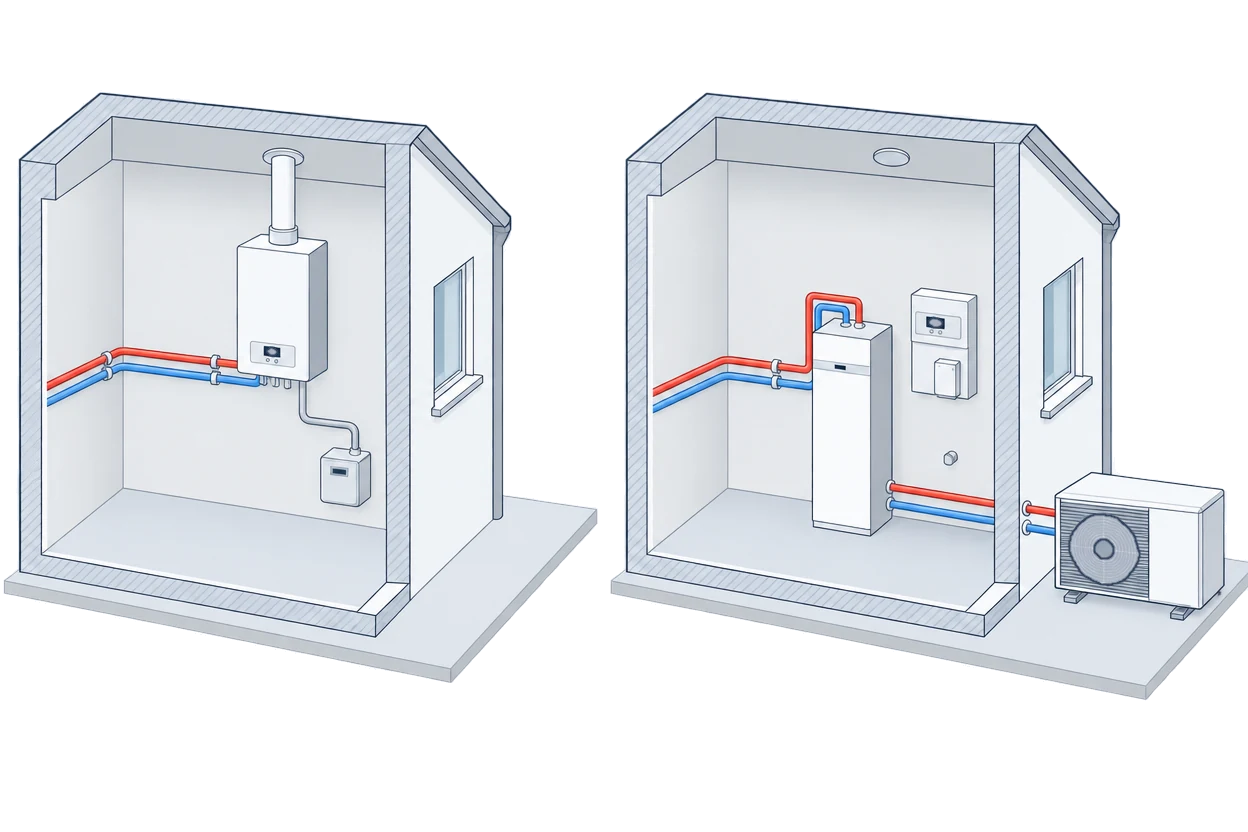
A heat pump can replace a combi boiler, but it isn't a like-for-like swap:
- Hot water. A heat pump heats your hot water and stores it in a cylinder, so a combi home needs room for one.
- Radiators. Some rooms may need bigger radiators so the system can run at a lower flow temperature; the heat-loss survey shows which.
- The boiler goes. For the Boiler Upgrade Scheme, the existing gas, oil or LPG heating has to be fully replaced, not kept as a backup. Ofgem's rule is written about heating; if you want to keep a gas hob, confirm it with your installer, and remember its standing charge stays too.
- Hybrids. A heat pump and a gas boiler working together as one system get no Boiler Upgrade Scheme grant.
When a heat pump is worth it, and when it isn't
In our example the numbers favour a heat pump when three things come together: the boiler is due for replacement anyway, the system is designed for a low flow temperature so it reaches a SCOP of about 3 or better, and the gas is disconnected. Against an efficient new boiler, SCOP 2.8 only just beats it on running costs, £41 a year, which is why the payback stretches to about 44 years. The grant does much of the work.
The sums are hard to make work when:
- The boiler is sound. The whole £5,326 has to be paid back, not £1,826.
- Efficiency stays low. Below a SCOP of 2.46 the heat pump costs more to run than the current boiler even with the gas disconnected, and below 2.66 more than a new one. Radiators that need very hot water to heat a room on cold days pull it down.
- Gas stays for cooking. The standing charge stays, and the break-even SCOP rises from 2.46 to 2.81 against the current boiler and from 2.66 to 3.07 against a new one.
- No grant applies. If your home doesn't qualify, or you live in Northern Ireland, the extra upfront cost is the full gap to a boiler.
There is no ban on keeping or repairing a gas boiler in an existing home, so you can time the switch to when your boiler needs replacing. If you heat with oil or LPG, the comparison depends mostly on the oil price period and there is a higher grant for some off-gas homes in England and Wales: see replacing an oil boiler with a heat pump.
Checklist: work out your own numbers
Your own comparison
- Gas use. Take the kWh of gas from your annual statement, with your unit rate and standing charge.
- Heat. Multiply the kWh by your boiler's efficiency; without a better figure, use 85% as we do.
- SCOP. Use the SCOP your MCS installer must give you in writing before installation, and rerun the sums with a lower figure too.
- Electricity. Divide the heat by the SCOP and multiply by your electricity unit rate, or your weighted rate on a time-of-use tariff.
- New boiler. If your boiler is due anyway, divide the heat by a new boiler's efficiency (we use 93%) and price that gas too.
- Payback. Take the heat pump quote after any grant, subtract a quote for a new boiler, and divide by the yearly difference, once with and once without the gas standing charge.
Figures that change
| What | Value | Applies |
|---|---|---|
| Electricity unit rate | 26.32p/kWh | price cap, GB average, direct debit, 1 October to 31 December 2026; no VAT on electricity in Great Britain until 31 March 2027 |
| Gas unit rate and standing charge | 7.97p/kWh and 29.68p a day | same period, 5% VAT included |
| Cap 1 July to 30 September 2026 | electricity 26.11p/kWh, gas 7.33p/kWh | 5% VAT included |
| Air source heat pump, installed | median £12,826 | grants paid July–September 2026, England and Wales, before the grant |
| Boiler Upgrade Scheme grant | £7,500 | England and Wales, if the home qualifies |
| New gas boiler, government estimate | about £3,500, VAT included | DESNZ, Boiler Upgrade Scheme business case 2026 |
| VAT on installed heat pumps | 0%, then 5% | 0% until 31 March 2027 |
How we worked this out
Our example home (1970s gas semi in England, 97 m², 9,500 kWh of gas a year, 85% efficiency for the current boiler and 93% for a new one, SCOP 2.5 / 2.8 / 3.1, all our assumptions) at price-cap rates for 1 October to 31 December 2026 held flat, with the July–September 2026 median heat pump price and the government's boiler estimate; servicing, gas disconnection and finance are left out. More in our editorial method.
Frequently asked questions
Is a heat pump cheaper to run than a gas boiler?
In our example home, only just. At SCOP 2.8 and the 1 October to 31 December 2026 price cap, the heat pump's £759 of electricity is £2 more than the £757 of gas units in the current boiler, and it comes out £106 a year ahead only once the gas standing charge goes. Against a new boiler at 93% it is £41 a year ahead with the gas disconnected. With the gas disconnected it needs a SCOP above 2.46 to beat the current boiler and above 2.66 to beat a new one.
How long does a heat pump take to pay back?
In our example home, against a new £3,500 boiler at 93% efficiency, about 16 years at SCOP 3.1 and about 44 at 2.8, with the £7,500 grant (England and Wales, if your home qualifies), the gas disconnected and prices held flat. At SCOP 2.5, or with gas kept for a hob, there is no meaningful payback. If your boiler still works, the whole £5,326 has to be paid back from the saving against it, which takes about 50 years at SCOP 2.8.
Is a heat pump worth it without the grant?
In our example home, not within 20 years. Without a grant the gap to a new boiler is £12,826 − £3,500 = £9,326; at £115 a year lower running costs (SCOP 3.1, against a new boiler at 93%, gas disconnected) that takes about 81 years, and at SCOP 2.8 over 200. The £7,500 Boiler Upgrade Scheme grant, in England and Wales if your home qualifies, is what brings it down to about 16 years at SCOP 3.1 in our example.
How much does a heat pump save a month?
Against the current boiler in our example home, the energy bill is about £9 a month lower at SCOP 2.8 (£106 ÷ 12), about £15 at 3.1 and about £1 at 2.5, with the gas disconnected and price-cap rates for 1 October to 31 December 2026. Against a new boiler at 93% it is about £3 a month at 2.8 and about £10 at 3.1. That is the bill only: the payback above also counts the extra upfront cost.
What happens if electricity prices go up?
The gap narrows. With gas at 7.97p/kWh and the gas disconnected, the heat pump in our example home at SCOP 2.8 would cost the same as the current boiler at an electricity rate of about 30p/kWh (£865 ÷ 2,884 kWh), and the same as a new boiler at 93% at about 28p. If gas prices rise, the gap widens faster: each extra penny on gas adds £95 a year to the current boiler's bill.
Can a heat pump replace a combi boiler, and is it better?
Yes, but it isn't a like-for-like swap: a combi heats water as you run the tap and needs no cylinder, while a heat pump heats a stored cylinder and needs room for it and for an outdoor unit. Neither wins in every home. On cost, the answer turns on the SCOP your system reaches and whether your boiler needs replacing anyway, as the example shows; an MCS installer's heat-loss survey tells you what your house needs.
Read next

Reading time: 14 min
Heat pump running costs
Heat pump running costs in our example 1970s semi: 2,884 kWh and £759 a year at SCOP 2.8, £850 at 2.5 and £686 at 3.1 (Ofgem price cap, 1 October to 31 December 2026), against £865 for gas including a £108 standing charge that ends only if the gas supply is disconnected, as we assume.
Read moreHeat pump running costs
Reading time: 16 min
Heat pump cost
Installed heat pump prices from the government's Boiler Upgrade Scheme statistics: the median and its range, prices by size and type, extras in older and combi homes, the grant by nation, 0% VAT to 31 March 2027 and a worked example.
Read moreHeat pump cost
Reading time: 16 min
Heat pump grants
The Boiler Upgrade Scheme in full: amounts in England and Wales, the £9,000 for oil or LPG homes to 31 March 2027, who qualifies, the six steps from quote to voucher, Scotland and Northern Ireland, loans and 0% VAT to 31 March 2027.
Read moreHeat pump grants
Reading time: 14 min
Heat pump efficiency
COP, SCOP and SPF explained with a UK datasheet, the Electrification of Heat field results (median 2.78 across 428 homes), the Boiler Upgrade Scheme's SCOP 2.8 minimum (England and Wales) and a meter-reading example.
Read moreHeat pump efficiency
Reading time: 14 min
Heat pump tariffs
Heat pump tariffs in the UK: cheap-hour, time-of-use and half-hourly types, supplier examples as facts, and a weighted-rate test against the Ofgem price cap of 26.32p/kWh (1 October to 31 December 2026).
Read moreHeat pump tariffs
Reading time: 15 min
Replacing an oil boiler with a heat pump
Replacing an oil or LPG boiler with a heat pump: the £9,000 grant for off-gas homes in England and Wales replacing oil or LPG (applications properly made 21 July 2026 to 31 March 2027), if your home qualifies, running costs against three oil prices, LPG as a formula, the oil tank and eight steps.
Read moreReplacing an oil boiler with a heat pump