Is my home suitable for a heat pump?
A heat pump can heat an older home, solid walls included, if the radiators keep every room warm with water at about 55 °C or less. Here are three checks, our 1970s example semi worked through, and what to change if rooms stay cold.
A heat pump can heat an older home, solid walls included, if the radiators keep every room warm with water at about 55 °C or less. In the government-funded Electrification of Heat trial, air source heat pumps in homes built from before 1919 to 2001 onwards showed no statistically significant difference in performance by house age, though every home had first been judged suitable. A room-by-room heat-loss survey settles it for your house; two checks of your own come first.
At a glance
- 55 °C as the target. The cooler the water your radiators need, the less electricity a heat pump uses.
- Three checks. Gas use per m², a cold-day radiator test, then an MCS installer's room-by-room survey.
- Insulation and grants. In England and Wales the £7,500 Boiler Upgrade Scheme grant needs neither insulation nor an EPC if your home qualifies; in Scotland, Home Energy Scotland needs no EPC to apply for a heat pump but pays only once a post-installation EPC recommends no loft or cavity wall insulation.
- Space. An outdoor unit about a metre wide and, if you have a combi boiler, a cupboard for a hot-water cylinder.
Will a heat pump work in an older home?
Yes, if your radiators can keep every room warm with cooler water. The Electrification of Heat trial, led by Energy Systems Catapult for the government, installed 742 heat pump systems in North-East England, South-East England (outside London) and South-East Scotland and worked out a year's efficiency for each system with enough data. Its air source heat pumps covered every age band from pre-1919 to 2001 onwards, detached to terraced, with no statistically significant variation in performance by house type or age. But designers had judged every home suitable first, so it shows what a properly designed system achieves, not that every house works unchanged.
The flow temperature is the temperature of the water sent round the radiators: the lower it can be while rooms stay warm, the less electricity each unit of heat takes. Efficiency over a year is given as SCOP, the seasonal coefficient of performance (SPF on MCS paperwork): at 2.8, 1 kWh of electricity gives 2.8 kWh of heat. MCS's pre-sale estimate shows the effect:
Estimated SPF, air source heat pump
| Flow temperature | Air source estimate |
|---|---|
| up to 35 °C | 4.0 |
| 36–40 °C | 3.8 |
| 41–45 °C | 3.4 |
| 46–50 °C | 3.1 |
| 51–55 °C | 2.8 |
| 56–60 °C | 2.5 |
Radiators sized for a boiler that runs hotter are the usual catch: at the lower flow temperatures, MCS says keeping all of them unchanged is "unlikely to be viable" unless they are significantly oversized, so the survey replaces them only in rooms that fall short. Underfloor heating isn't required. In England, a fully replaced wet heating system (heat source, radiators and pipework) should be designed for 55 °C or lower under Building Regulations guidance, or, where that isn't feasible, as low as possible; see heat pumps and radiators.
Solid walls and period properties
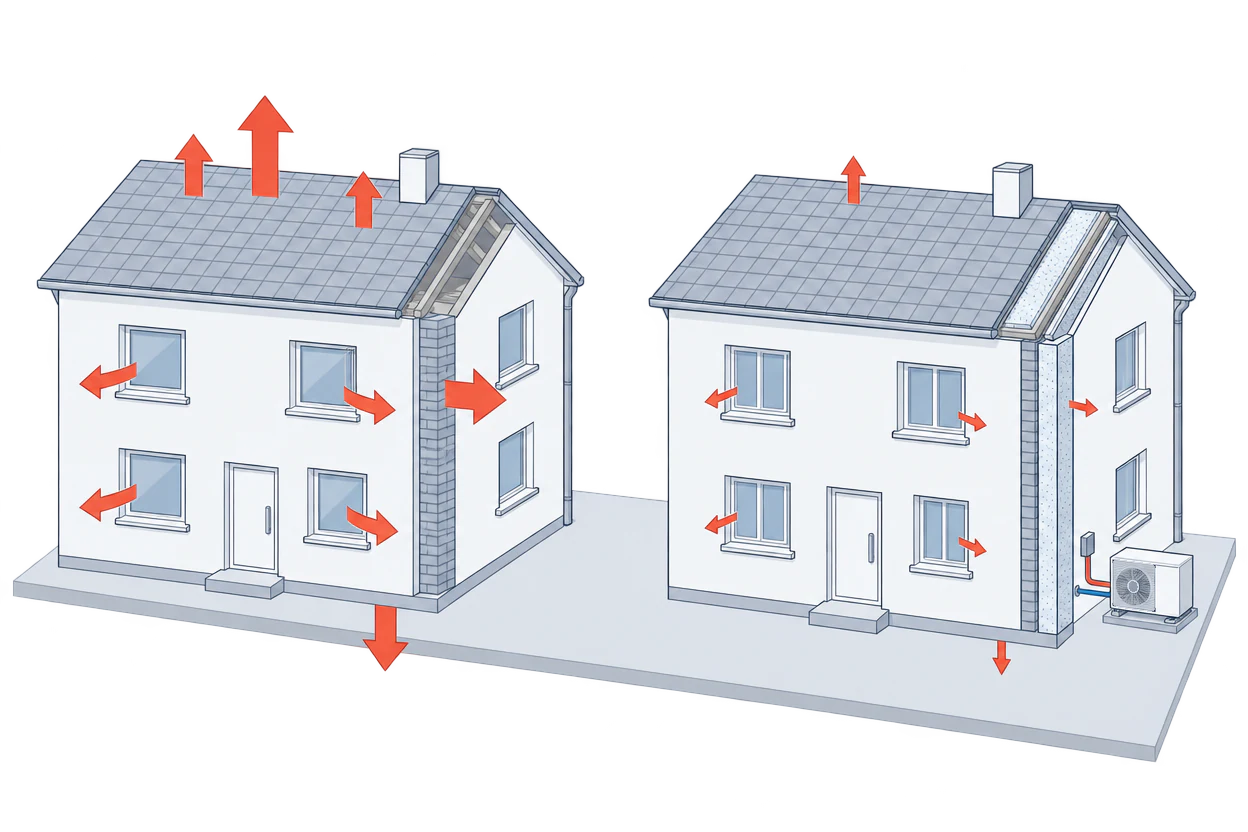
England has around 8.9 million homes built before 1945, and 64% of them have uninsulated solid walls (English Housing Survey, 2023). Such walls add to a room's heat loss, so that room needs more radiator output. But build date alone says little: pre-1919 houses use less gas per square metre than inter-war ones.
| Built | Gas per m²Median annual gas use per m² of floor area, houses in England and Wales, gas year mid-May 2024 to mid-May 2025 (NEED) |
|---|---|
| Before 1919 | 110 kWh |
| 1919–1944 | 122 kWh |
| 1945–1964 | 112 kWh |
| 1965–1982 | 106 kWh |
| 1983–1992 | 103 kWh |
| 1993–1999 | 98 kWh |
| 2000 onwards | 74 kWh |
| All houses | 105 kWh |
Listed buildings are harder: MCS's design standard names them as one reason larger radiators may not be possible.
Check if a heat pump is suitable: three checks before you get quotes
Do the first two yourself; the installer's survey decides.
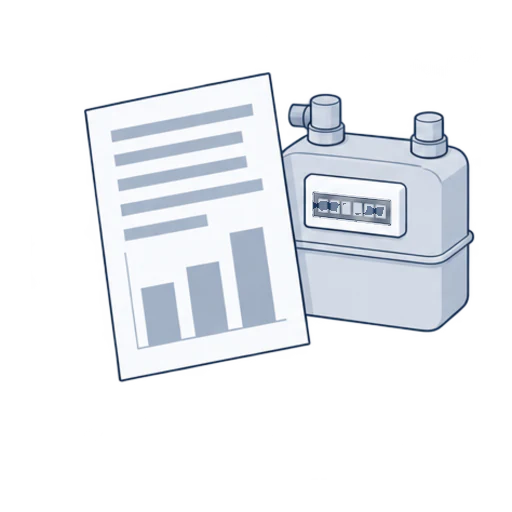 Gas use. Three years of statements, averaged, per m².
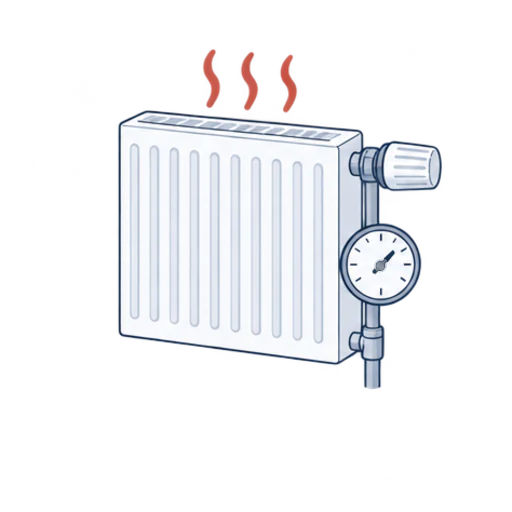 Radiator test. Boiler flow at 55 °C on a cold day.
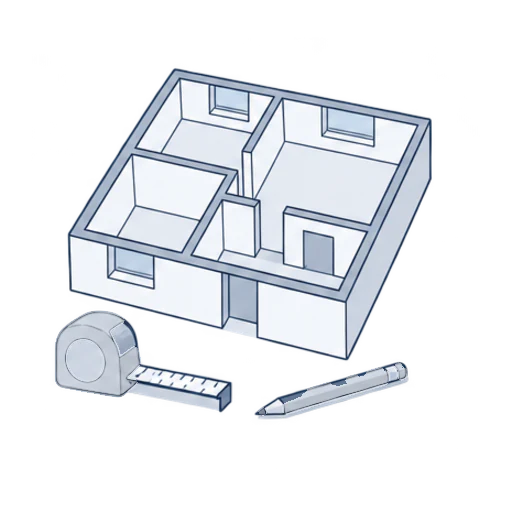 Room-by-room survey. Each room's heat loss against its radiator.
Check 1: your gas use
Average three years of gas statements (one winter skews a single year) and divide by your floor area. Our example home is a 1970s semi-detached house in England with a gas combi boiler, 97 m² of floor space (the English Housing Survey average for a semi) and 9,500 kWh of gas a year (Ofgem's typical medium use): 9,500 kWh ÷ 97 m² = 98 kWh per m², just under the 106 kWh median for houses built 1965–1982. A figure well above the median for your band points to higher heat loss and bigger radiators, not to an unsuitable house.
For our example we assume the existing boiler turns 85% of the gas into heat, 9,500 × 0.85 = 8,075 kWh; the electricity for that is worked out in the example below. Gas for cooking is in the total, so it slightly overstates the heat. With oil, ask the installer to convert litres to kWh.
The survey, not floor area, sets the size. For scale, the median air source heat pump in Boiler Upgrade Scheme grants paid in England and Wales in July to September 2026 was 8 kW, as reported by MCS installers. Building Regulations guidance in England says systems should not be significantly oversized; see heat pump sizing.
Check 2: a radiator test on a cold day
Our suggestion, not an official test: on a properly cold day, set your boiler's heating flow temperature to 55 °C, leave the radiator valves at their usual settings and give it a day.
- Every room gets warm: promising; your radiators may already be large enough.
- One or two rooms stay cool: those rooms probably need bigger radiators.
- The whole house stays cool: expect bigger radiators throughout, or insulation and draught-proofing first.
Your boiler's manual shows how to set the flow temperature; if the boiler also heats a hot-water cylinder, ask a heating engineer first.
Check 3: the room-by-room heat-loss survey
Under Issue 3.0 of the MCS design standard, MIS 3005-D, the installer works out each room's heat loss on a cold design day, puts a bigger radiator wherever the existing one falls short at the planned flow temperature, and before installation gives you in writing each room's heat loss, every radiator's type and size, the design flow temperature and the SCOP at it; heat pump sizing explains the calculation.
Without that calculation, MCS's space-heating estimate has to assume a 60 °C flow if the old radiators stay, the lowest bar in the chart.
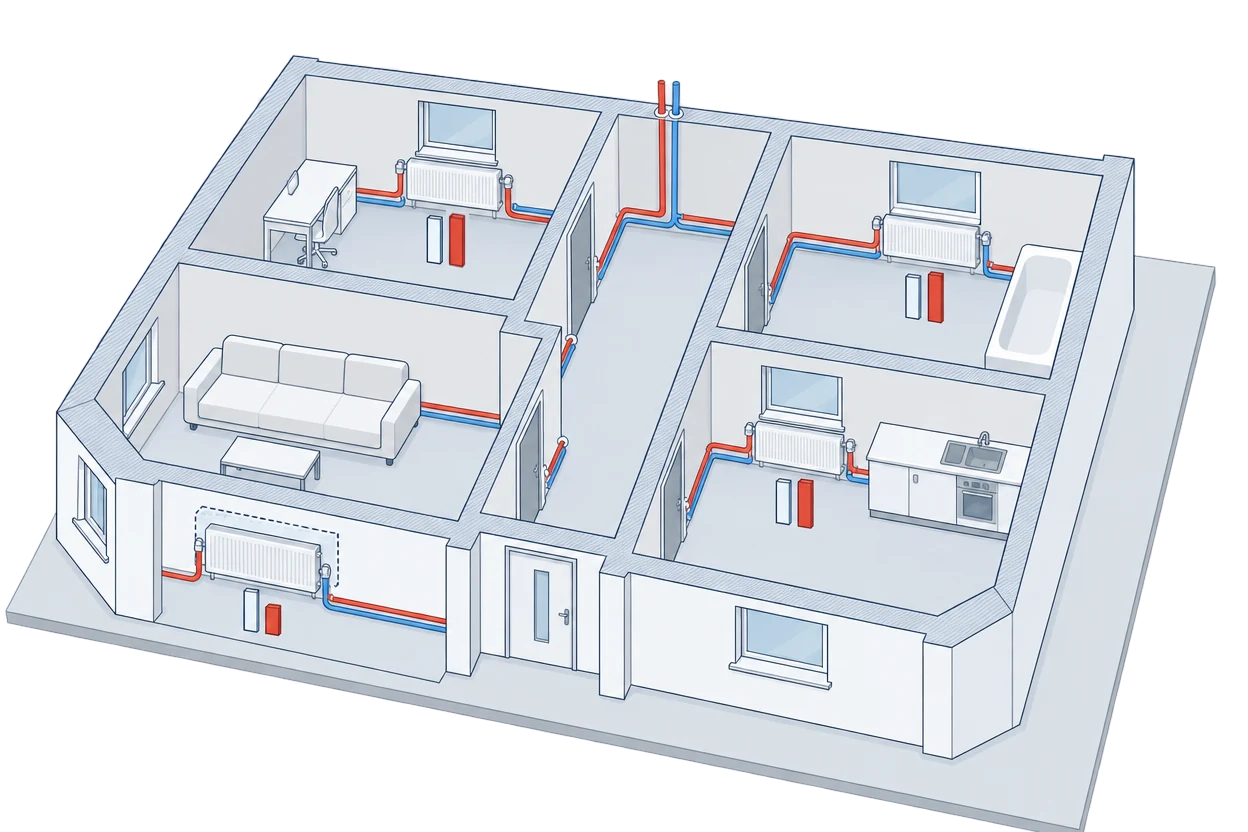
Space for the outdoor unit and a cylinder
As an example, Mitsubishi Electric's 8 kW Ecodan R290 outdoor unit measures 1,050 mm wide, 480 mm deep and 1,020 mm high and weighs 117 kg. Whether it can go where you want it depends on the planning rules, which differ by nation, and on how loud it is at your neighbour's window: planning permission for a heat pump covers both. A listed building never qualifies for permitted development in England, Wales and Scotland (in Northern Ireland only once listed building consent has been granted), so ask your local planning authority first.
A heat pump stores hot water in a cylinder instead of heating it on demand, so a home with a combi boiler needs a cupboard for one. Mitsubishi Electric's 210-litre slimline cylinder, for example, is about 2 m tall and weighs 258 kg when full. Sizes and placement are in heat pump hot water cylinders.
Worked example: our 1970s semi
In our example home, with its radiators and a working combi boiler due for replacement, we assume the boiler turns 85% of the gas into 8,075 kWh of heat. It is an illustration, not a forecast. Its electricity by flow temperature, applying MCS's space-heating estimate for each band to all its heat (MCS uses 1.9 for hot water, so the real figures would be a little higher):
| Flow temperature | MCS estimate | Electricity a year |
|---|---|---|
| 41–45 °C | 3.4 | 8,075 ÷ 3.4 = 2,375 kWh |
| 46–50 °C | 3.1 | 8,075 ÷ 3.1 = 2,605 kWh |
| 51–55 °C | 2.8 | 8,075 ÷ 2.8 = 2,884 kWh |
| 56–60 °C | 2.5 | 8,075 ÷ 2.5 = 3,230 kWh |
A design at 46–50 °C instead of old radiators at an assumed 60 °C takes 625 kWh a year off MCS's estimate (3,230 − 2,605). For money we use measured results instead: the measured median across 428 air source heat pumps in the Electrification of Heat trial was 2.78, so we take 2.8, with 2.5 and 3.1 either side.
- Heat pump: 8,075 kWh ÷ SCOP 2.5 / 2.8 / 3.1 = 3,230 / 2,884 / 2,605 kWh × 26.32p = £850 / £759 / £686 a year.
- Your current gas boiler (at our 85%): 9,500 kWh × 7.97p = £757 a year, so the break-even SCOP against it on unit rates is 0.85 × 26.32 ÷ 7.97 = 2.81.
Rates are the Ofgem price cap, GB average, direct debit, 1 October to 31 December 2026, with standing charges left out. In Great Britain electricity carries no VAT until 31 March 2027 while gas carries 5%, part of why the result is this close; it also depends on the house, the installation and the tariff. The full arithmetic is in heat pump running costs.
If rooms stay cold: radiators, insulation and pipes
If rooms stay cool at 55 °C, these changes can be combined; start with the rooms that cooled first.
| Change | What it does | Fits when |
|---|---|---|
| Larger radiators | more surface, so cooler water heats the room | one or two rooms fall short |
| Fan-assisted radiators | more heat from a compact unit; needs a power supply | wall space is tight |
| Underfloor heating | a large surface for the lowest flow temperatures | a floor is coming up anyway |
| Pipe insulation | less heat lost before the radiators | pipes cross a loft or floor void |
| Loft and cavity insulation, draught-proofing | lower heat loss, cooler water, a smaller heat pump | the whole house stays cool |
| High-temperature heat pump | flow above 55 °C, at lower efficiency | radiators can't change, as in some listed buildings |
| Hybrid with a gas boiler | the boiler covers the coldest days | more than 55 °C is still needed (no Boiler Upgrade Scheme grant) |
Radiators. Ask for radiator changes as separate quote lines. MCS's design guide lets a fan-assisted radiator be smaller than an ordinary one for the same output, which helps where a bigger panel won't fit; heat pumps and radiators compares the options.
Insulation. Ofgem's grant guidance says heat pumps perform best in a well-insulated home and that loft or cavity wall insulation can significantly reduce heat loss. The formula shows the effect: every 1,000 kWh of heat that insulation saves takes 1,000 ÷ 2.8 = 357 kWh off the electricity at SCOP 2.8, about £94 a year at 26.32p (price cap, GB average, direct debit, 1 October to 31 December 2026, no VAT on electricity in Great Britain until 31 March 2027, standing charges left out). If such work is due anyway, do it before the survey.
Pipes. In England, Building Regulations guidance says accessible pipes should be insulated when a boiler or cylinder is replaced.
Hybrid or high-temperature heat pump?
MCS tells installers to avoid high-temperature heat pumps unless a home needs more than 55 °C, and a design above 55 °C should come with an alternative at 55 °C or lower, with the difference in efficiency explained so you can choose. A hybrid pairs a heat pump with a boiler under one control, so the boiler covers the coldest days. Hybrids get no Boiler Upgrade Scheme grant in England and Wales, which requires the old heating to be fully replaced, and no Home Energy Scotland grant. Consider one only if more than 55 °C stays necessary after radiator changes; see hybrid heat pumps.
Do I need to insulate first? Grants and EPC rules by nation
In England and Wales you don't have to insulate first to get a grant; in Scotland, loft or cavity wall insulation that an EPC recommends comes first:
| Nation | Heat pump support | EPC or insulation? |
|---|---|---|
| England and Wales | Boiler Upgrade Scheme: £7,500 off the price if your home qualifies; your installer applies and Ofgem decides | neither: no insulation condition since 8 May 2024, no EPC condition for applications properly made from 28 April 2026 |
| Scotland | Home Energy Scotland grant and optional interest-free loan if you qualify; you apply and wait for a written offer before any work | no EPC needed to apply, but the claim needs a post-installation EPC, and loft or cavity wall insulation it recommends must be done first unless an assessor shows it isn't suitable |
| Northern Ireland | no Boiler Upgrade Scheme and no grant open to all homeowners; some lower-income owner-occupiers can get a heat pump through income-tested NISEP schemes | NISEP heat-pump schemes carry out an EPC before and after the installation |
For the Boiler Upgrade Scheme, if there is no EPC the installer sends Ofgem other evidence, such as a recent bill. The median price MCS installers reported for an air source heat pump in England and Wales was £12,826 for Boiler Upgrade Scheme grants paid in July to September 2026, before the grant. See heat pump grants and heat pump cost.
MCS's design standard says an EPC's annual heat demand isn't appropriate for sizing a heat pump, and its pre-sale standard warns that an EPC may have to assume a building's insulation and airtightness, which can make the figures uncertain, especially in irregular or unusual buildings. A low EPC band doesn't rule a heat pump out; the room-by-room survey decides.
Checklist: is your home ready?
Before the survey
- Gas or oil bills for the last three years, with the average per m² worked out.
- The radiator test done on a cold day, with a note of the rooms that cooled first.
- A spot for the outdoor unit, and its distance to a neighbour's window.
- With a combi boiler, a cupboard for a hot-water cylinder.
- Listed or in a conservation area? Talk to your local planning authority.
- Loft insulation, draught-proofing and pipe lagging done or planned before the survey.
Figures that change
| What | Value | Applies |
|---|---|---|
| Electricity unit rate | 26.32p/kWh | price cap, GB average, direct debit, 1 October to 31 December 2026, no VAT in Great Britain until 31 March 2027 |
| Gas unit rate | 7.97p/kWh | same period, 5% VAT included |
| Air source heat pump, installed | median £12,826, median size 8 kW | Boiler Upgrade Scheme grants paid July–September 2026, England and Wales, reported by MCS installers, before the grant |
| Boiler Upgrade Scheme grant | £7,500 for an air source heat pump | England and Wales only, if the home qualifies; no EPC or insulation condition |
| Median gas use per m² | 74–122 kWh by build date; 105 kWh all houses | houses in England and Wales, gas year mid-May 2024 to mid-May 2025 |
| Homes built before 1945 | about 8.9 million, 64% with uninsulated solid walls | England, 2023 |
How we worked this out
Our example home (1970s gas semi, 97 m², 9,500 kWh of gas, 85% efficiency for its existing boiler as our assumption) uses MCS's pre-sale estimates by flow temperature and, for money, SCOP 2.5 / 2.8 / 3.1 at price-cap rates without standing charges. The radiator test is our suggestion. More in our editorial method.
Frequently asked questions
Will a heat pump work in an old house with solid walls?
It can. The Electrification of Heat trial included homes built before 1919 and found no statistically significant difference in performance by house age, though all its homes had been judged suitable first. Uninsulated solid walls raise the heat loss of the rooms behind them, so expect the survey to call for bigger radiators there, or for wall insulation where that is practical.
Do I need to insulate my home before getting a heat pump?
Not in England and Wales: the Boiler Upgrade Scheme has no insulation or EPC condition. In Scotland, Home Energy Scotland needs no EPC to apply for a heat pump, but loft or cavity wall insulation that an EPC recommends must be done before it pays, unless an assessor shows it isn't suitable. Either way, insulation helps the design, because lower heat loss means smaller radiators, cooler water and less electricity.
Can a heat pump work with my existing radiators?
Yes, wherever a radiator is big enough for its room at the design flow temperature; the survey replaces only those that fall short. If all the old radiators stay and nobody does the room-by-room calculation, MCS's space-heating estimate has to assume a 60 °C flow, which is why the calculation matters. Heat pumps and radiators shows how to check each room.
Can I have a heat pump in a listed building or conservation area?
Yes, but check the planning position first. A listed building can't use permitted development in England, Wales or Scotland, and in Northern Ireland only once listed building consent has been granted; a conservation area adds limits. The rules by nation are in heat pump planning permission, and your local planning authority has the final word.
Are some homes not suitable for a heat pump?
A home is harder to suit when no spot for the outdoor unit meets the permitted-development noise limit, there is no space for a cylinder, or rooms can't take bigger radiators or insulation. Even then, a planning application, a design at a higher flow temperature, or a hybrid without the grant may work. The survey and its written figures are what tell you, not the age of the house.
Read next
Reading time: 15 min
Heat pump radiators
Radiator output at heat-pump temperatures with Stelrad's ΔT factors, MCS room-by-room sizing, two rooms of our example semi worked through, flow temperature and England's 55 °C design rule, weather compensation, balancing and a checklist.
Read moreHeat pump radiators
Reading time: 15 min
Heat pump sizing
Heat pump sizing explained: heat loss vs heat demand, MCS's room-by-room method (MIS 3005-D), design temperatures from Plymouth to Glasgow, a bill-based check on our example semi, backup heaters, hybrids and a checklist for the heat loss report.
Read moreHeat pump sizing
Reading time: 15 min
Heat pump planning permission
When an air source heat pump on a house needs planning permission in England, Wales, Scotland and Northern Ireland: a nation-by-nation table, the MCS 020(a) noise condition, one house checked against each nation's rules, listed buildings and conservation areas, Building Regulations and whether gas boilers are being banned.
Read moreHeat pump planning permission
Reading time: 14 min
Heat pump hot water cylinder
Hot water cylinders for heat pumps: MCS sizing (45 litres a day per person), cylinder sizes by bedrooms and heat pump size, space and weight, unvented G3 rules by nation, legionella and the immersion heater, a worked example and standalone hot water heat pumps.
Read moreHeat pump hot water cylinder
Reading time: 14 min
Heat pump running costs
Heat pump running costs in our example 1970s semi: 2,884 kWh and £759 a year at SCOP 2.8, £850 at 2.5 and £686 at 3.1 (Ofgem price cap, 1 October to 31 December 2026), against £865 for gas including a £108 standing charge that ends only if the gas supply is disconnected, as we assume.
Read moreHeat pump running costs
Reading time: 15 min
Hybrid heat pumps
Hybrid heat pumps explained: the MCS definition and 55% sizing rule, how the controller switches by temperature or price, hot water, no Boiler Upgrade Scheme or Home Energy Scotland funding, costs per kWh of heat in our example semi, and a quote checklist.
Read moreHybrid heat pumps
Reading time: 16 min
Heat pump grants
The Boiler Upgrade Scheme in full: amounts in England and Wales, the £9,000 for oil or LPG homes to 31 March 2027, who qualifies, the six steps from quote to voucher, Scotland and Northern Ireland, loans and 0% VAT to 31 March 2027.
Read moreHeat pump grants
Reading time: 16 min
Heat pump cost
Installed heat pump prices from the government's Boiler Upgrade Scheme statistics: the median and its range, prices by size and type, extras in older and combi homes, the grant by nation, 0% VAT to 31 March 2027 and a worked example.
Read moreHeat pump cost