Heat pump hot water cylinders: size, space and legionella
A heat pump stores your hot water in a cylinder, so a home with a combi boiler needs room for one. Here is how MCS sizes the cylinder, how much space it takes, what the unvented rules require and how the legionella cycle works.
A heat pump stores your hot water in a cylinder, so a home with a combi boiler needs room for one. MCS, the certification scheme for heat pump installers that grant-funded installations need, plans for 45 litres a day for each person, counting at least one more person than you have bedrooms: at least 180 litres for a three-bedroom home. For a three- to four-bedroom home with one bathroom, its reference guide suggests a 150 to 210 litre cylinder, depending on the heat pump's size.
At a glance
- Size. MCS plans 45 litres a day per person; its example cylinders run from 120 to 300 litres for two- to six-bedroom houses.
- Space. Mitsubishi Electric's standard 210-litre Ecodan cylinder, for example, needs about 550 × 650 mm of floor and 1.5 m of height; its slimline models are narrower and taller.
- Rules. In England and Wales, fitting an unvented cylinder is notifiable building work unless your installer self-certifies through a competent person scheme.
- Legionella. HSE guidance says hot water should be stored at 60 °C at least; MCS requires a way to prevent bacterial growth, often a regular pasteurisation cycle.
Do heat pumps heat water? Yes, into a cylinder
A combi boiler heats water as it runs; a heat pump delivers heat more gently, so it warms a store of water in advance. MCS's reference guide shows why: heating 60 litres from 10 °C to 60 °C, enough for one bath, with 8 kW going into the water takes 60 × 50 ÷ (14.3 × 8) = 26 minutes (14.3 is MCS's constant for turning litres, degrees and kilowatts into minutes). 8 kW is no extreme: it was the median size of air source heat pumps in Boiler Upgrade Scheme grants paid in England and Wales in July to September 2026, as reported by MCS installers.
The heat pump's water flows through a coil inside the cylinder. Because its flow is cooler than a boiler's, the coil usually needs a larger surface; MCS's design standard, MIS 3005-D, accepts cylinders labelled to the Hot Water Association's heat pump specification, HWA 002:2020. It also requires a heat pump that heats a cylinder to reach a flow temperature of at least 55 °C at design conditions. The refrigerant side is in how does a heat pump work.
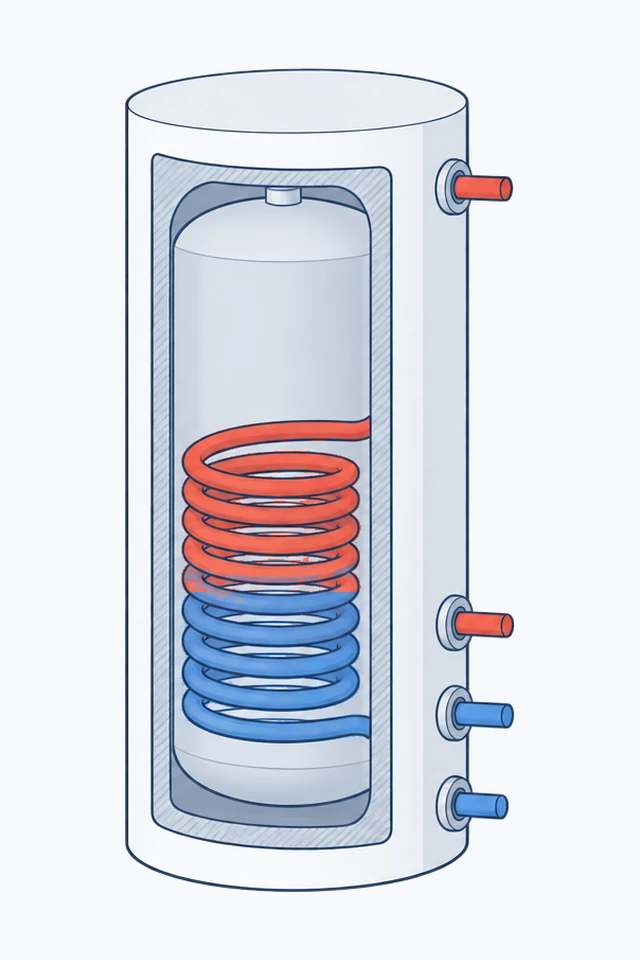
What size hot water cylinder does a heat pump need?
MIS 3005-D works out your daily hot water demand with one formula: 45 litres × N, where N is the larger of the number of bedrooms plus one, or the number of people who live there. A three-bedroom home with five people counts as five (225 litres a day). Under MIS 3005-D Issue 3.0, your installer must give you this figure in writing before work starts, with the specification of any new cylinder and its recovery rate.
MCS's reference guide, MGD 007, then sizes the cylinder from the heat pump's output, using one manufacturer's range as its example:
| Bathrooms | Bedrooms | Under 8 kWMGD 007 column for 3 to 6 kW heat pumps; MCS says systems under 8 kW should consider these larger sizes | 8 kW or moreMGD 007 column for 10 to 15 kW or more; MCS says an 8 kW system could use it |
|---|---|---|---|
| 1 bath or shower | 2–3 | 180 litres | 120 litres |
| 1 bath or shower | 3–4 | 210 litres | 150 litres |
| Bath and en-suite | 4–5 | 250 litres | 180 litres |
| 2 standard baths | 4–5 | 250 litres | 210 litres |
| 3 standard baths | 4–5 | 300 litres | 250 litres |
A smaller heat pump needs a bigger cylinder because it reheats more slowly: in the same guide, 60 litres from 10 °C to 60 °C takes 70 minutes with 3 kW and 35 minutes with 6 kW.
Bigger is not automatically better: in England, Approved Document L asks for hot water systems that are not significantly oversized, and every extra litre is kept hot around the clock. Sizing the heat pump itself is covered in heat pump sizing.
How much space does a heat pump cylinder take?
A combi home has no cylinder cupboard, so the survey has to find space. Mitsubishi Electric's 210-litre Ecodan cylinder, for example, stands 1,495 mm tall and weighs 256 kg when full. Its UK range is one maker's, but it shows what a cylinder cupboard must take:
| Cylinder type | Size | FootprintWidth × depth of the casing, from the datasheet | Height | Weight full | Heat loss a dayStanding heat loss stated by the maker, kWh in 24 hours |
|---|---|---|---|---|---|
| Slimline | 180 litres | 475 × 570 mm | 1,712 mm | 218 kg | 1.72 kWh |
| Slimline | 210 litres | 475 × 570 mm | 2,025 mm | 258 kg | 2.08 kWh |
| Standard | 210 litres | 550 × 651 mm | 1,495 mm | 256 kg | 1.79 kWh |
| Standard | 250 litres | 550 × 651 mm | 1,745 mm | 300 kg | 2.02 kWh |
| Standard | 300 litres | 550 × 651 mm | 2,058 mm | 363 kg | 2.24 kWh |
| Pre-plumbed | 210 litres | 730 × 756 mm | 1,509 mm | 274 kg | 1.53 kWh |
The floor has to carry up to 363 kg in this range. A slimline saves floor space, but the 210-litre one is over two metres tall. All three types come with a 3 kW immersion heater, an expansion vessel and the heat pump controller; the pre-plumbed one is bigger because it also houses the pumps, a plate heat exchanger and a filter.
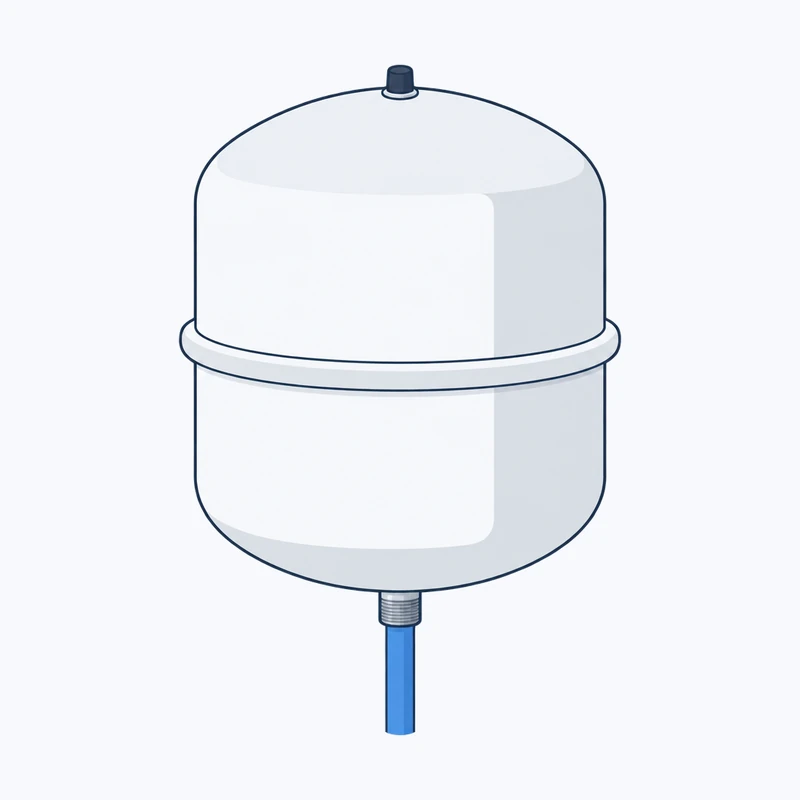
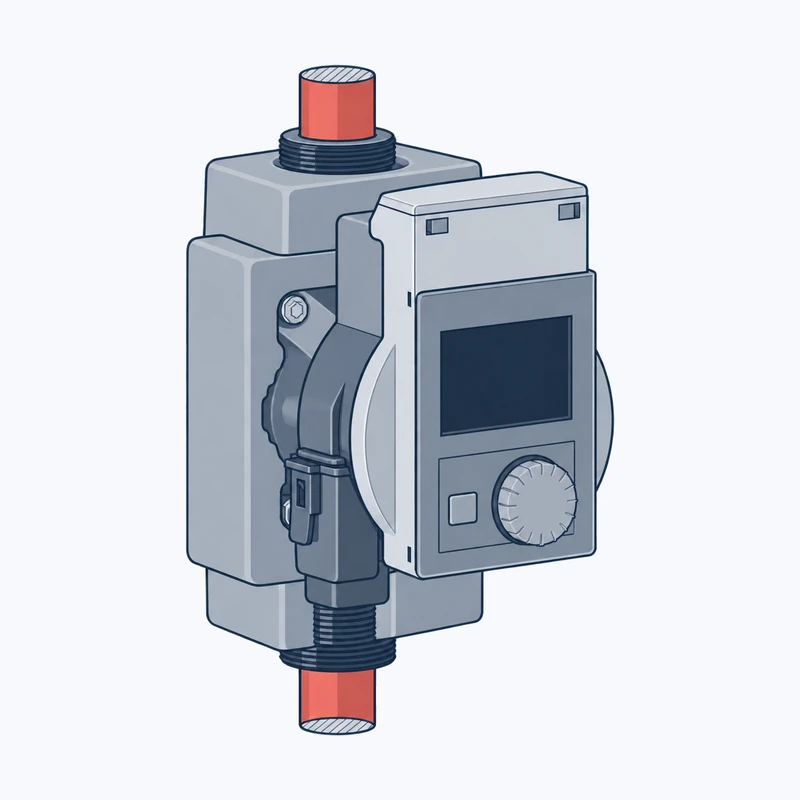
In England, Approved Document L caps a cylinder's standing loss at 2.06 kWh a day for 200 litres, about 2.10 for 210 litres (from its formula for sizes not listed), 2.22 for 250 and 2.36 for 300. Every cylinder in the table is within its cap, and you can compare the datasheet value between quotes.
Unvented or vented: the G3 rules
All the cylinders in the table are unvented: fed from the mains rather than from a cold-water tank. Building Regulations Part G3 treats the two types differently.
| Feature | Vented cylinder | Unvented cylinder |
|---|---|---|
| Fed from | a cold-water storage cistern | usually the mains supply pipe; no vent pipe |
| Expansion | up the cold feed pipe | inside the cylinder or in an expansion vessel |
| Safety | vent pipe open above the cistern, plus a device that stops the water exceeding 100 °C | at least two independent safety devices on top of the thermostat |
| Building controlApproved Document G, England and Wales | not covered by the unvented rule | notifiable unless a competent person scheme installer self-certifies |
What G3 requires. Stored water must never exceed 100 °C, and anything the safety devices discharge must be visible and led safely away. In the standard Ecodan cylinders the two devices are an over-temperature cut-out at 85 °C (±5) and a temperature and pressure relief valve that opens at 90 °C or 7 bar, discharging into a tundish, an open funnel you can see, and on outside.
Who signs it off (England and Wales). Approved Document G treats installing an unvented system as notifiable building work: building control must be told before work starts. An installer registered with a competent person scheme for unvented hot water systems self-certifies instead, and you receive a building regulations compliance certificate, usually from the scheme operator. Wales's own Approved Document G says the same. The wider installation steps are in heat pump installation.
Northern Ireland and Scotland. In Northern Ireland, regulation 88 of the Building Regulations (Northern Ireland) 2012 requires unvented cylinders over 15 litres to have devices that keep stored water from exceeding 100 °C and relieve excess pressure, discharging where it can be seen. Scotland has its own building standards: ask your installer how they apply.
Legionella: what temperature should the cylinder be?
A combi stores no hot water; a cylinder does, so legionella bacteria need managing. HSE guidance says hot water should be stored at 60 °C at least to kill legionella bacteria and reach at least 50 °C within a minute of running the tap, with cold water below 20 °C. The legal duty falls on employers, landlords and others in control of premises; in your own home it is guidance rather than a duty.
MIS 3005-D requires a way to prevent bacterial growth. Where that is periodic pasteurisation (an occasional cycle at a higher temperature), a risk assessment can help set how often. In practice there are two approaches:
- Store at 60 °C all the time. Simple, but less efficient for every litre.
- Store lower and pasteurise regularly. A lower everyday setting (MCS's estimates assume 50 °C) plus a scheduled cycle to 60 °C, run by the heat pump or the immersion heater.
A heat pump can reach these temperatures: the datasheet of the Ecodan R290 PUZ-WZ50VAA, for example, gives a maximum water outlet of 75 °C. The cost is efficiency: MCS's estimating method assumes 1.9 kWh of heat per kWh of electricity when an air source heat pump heats hot water (2.2 for ground source), below its space-heating figures (see heat pump efficiency).
The immersion heater: backup and pasteurisation
The cylinders in the table each have a 3 kW immersion heater: the backup when the heat pump is off, and a help with pasteurisation. Boiler Upgrade Scheme rules (England and Wales) let the heat pump meet the full heating and hot water demand alone or with supplementary appliances other than biomass boilers, so an immersion can stay.
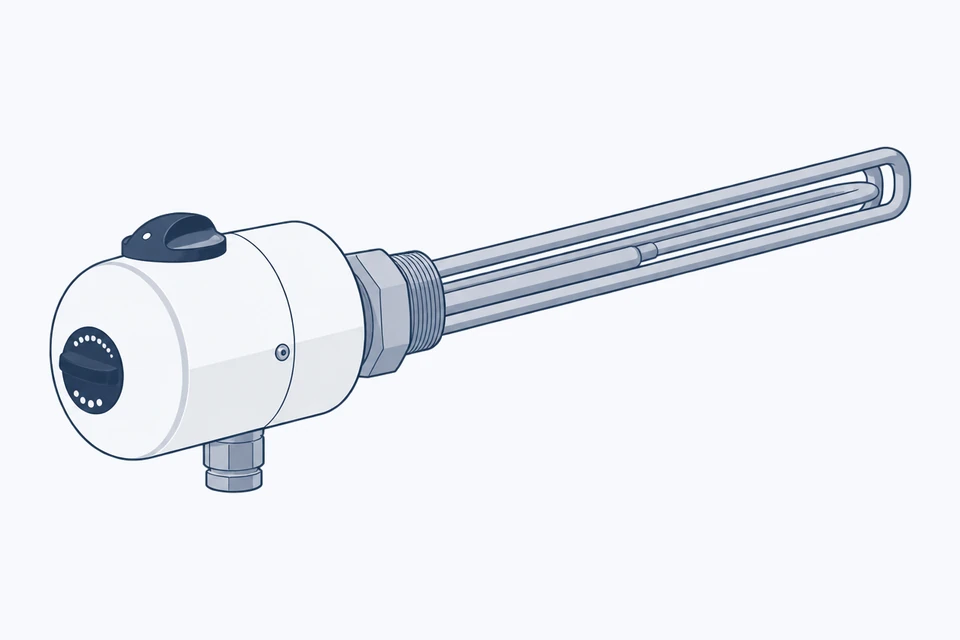
At MCS's air source factor of 1.9, the heat pump needs about half the immersion's electricity for the same heat, so the immersion's hours matter. MCS counts pasteurisation as a separate line:
Immersion electricity (kWh a year) = cycles a year × cylinder litres × 10 × 4,200 ÷ 3,600,000
The 10 is the lift from 50 °C to 60 °C that MCS assumes; 4,200 joules heat a litre of water by 1 °C, and 3,600,000 joules make a kilowatt-hour. Cycles are 52 for weekly, 365 for daily, or zero if the heat pump does the job. For a 210-litre cylinder that is 127 kWh a year weekly but 894 kWh daily.
Our example home: from combi to cylinder
Our example home is an assumption: a 1970s semi-detached house in England with radiators and a gas combi boiler, 97 m² (the English Housing Survey's mean for semi-detached homes), using 9,500 kWh of gas a year (Ofgem's typical medium use). At our assumed 85% boiler efficiency that is 8,075 kWh of heat a year. For this page we also assume three bedrooms, one bathroom and up to four people.
- Daily hot water. N = 3 bedrooms + 1 = 4, so 45 × 4 = 180 litres a day.
- Cylinder. Our heat pump sizing guide estimates the home's heat loss at about 3.6 kW, so its heat pump would most likely be under 8 kW. MCS's guide then points to the larger column: 210 litres for three to four bedrooms with one bathroom.
- Standing loss. For the standard 210-litre cylinder in the table, 1.79 kWh × 365 days = 653 kWh of heat a year; from the heat pump at MCS's air source factor of 1.9, 653 ÷ 1.9 = 344 kWh of electricity.
- Pasteurisation. Assuming a weekly cycle run by the immersion (our assumption, as in MCS's own worked example): 52 × 210 × 10 × 4,200 ÷ 3,600,000 = 127 kWh of electricity.
Together, 344 + 127 = 471 kWh of electricity a year goes on keeping water stored and safe: about £124 at 26.32p/kWh (Ofgem price cap, GB average, direct debit, 1 October to 31 December 2026, with no VAT on electricity in Great Britain until 31 March 2027), standing charges excluded.
The standing loss is about 8% of the 8,075 kWh of heat the combi delivers today, though inside the heated house some of it warms the rooms in winter. The hot water itself comes on top of this; what it adds to your bill is worked through in heat pump running costs.
Hot water heat pumps: the standalone option
A hot water heat pump is a cylinder with a small heat pump built into its top that heats only the water, using heat from the air or waste heat.
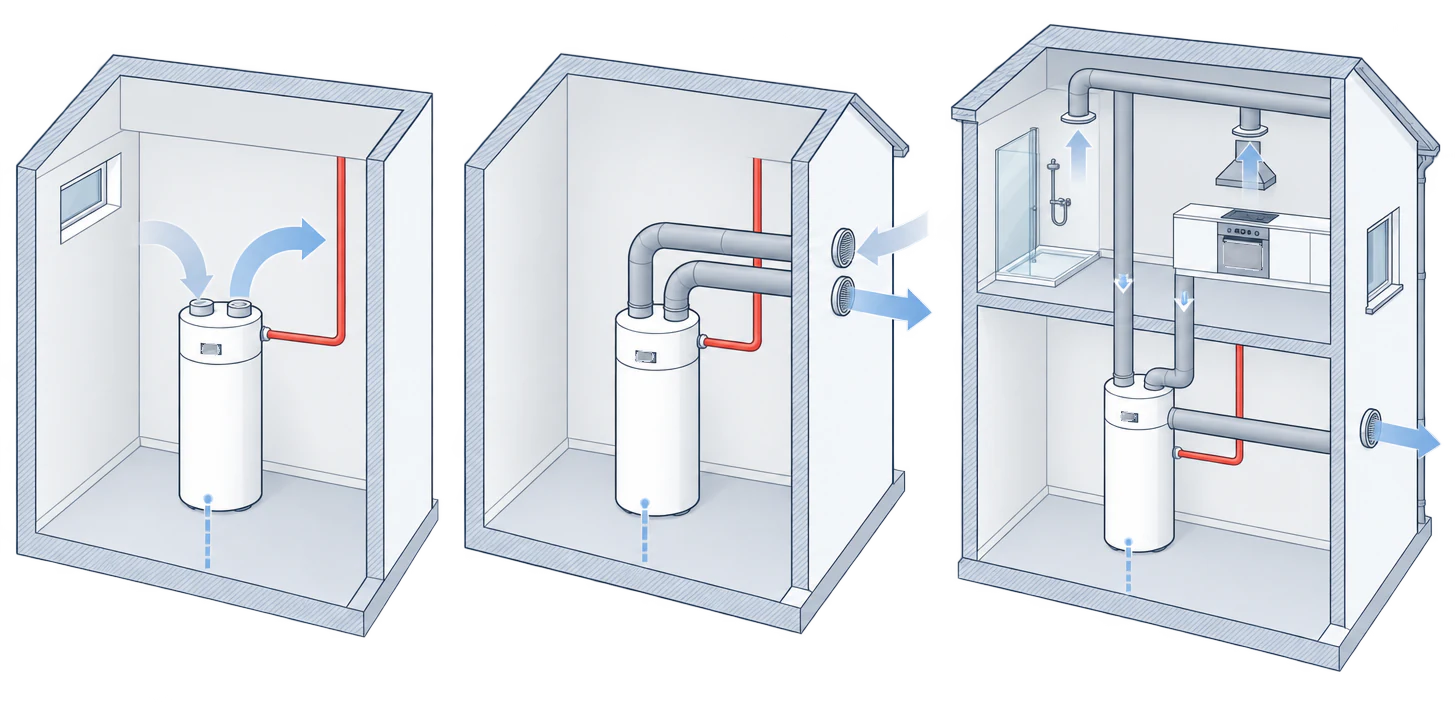
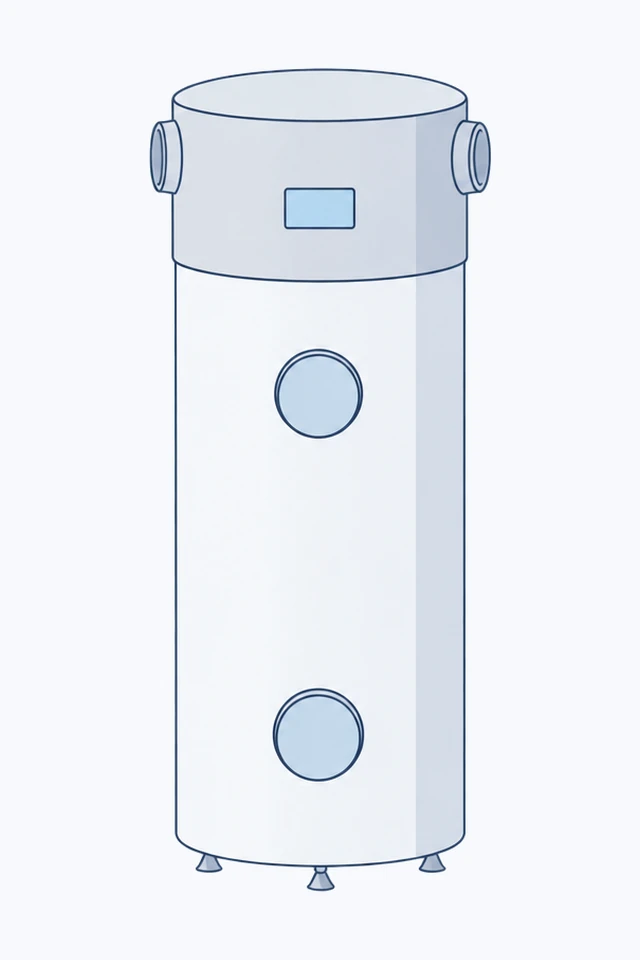
Three UK rules shape where one fits:
- MCS. Under MIS 3005-D a hot water heat pump should use only waste heat from a boiler room or server room, or outdoor air, and must not take heat from lived-in rooms in a way that adds to the space heating.
- The grant. The Boiler Upgrade Scheme in England and Wales funds heat pumps that provide space heating and can meet the home's full heating and hot water demand, so a hot-water-only unit does not qualify on its own; see heat pump grants.
- Efficiency. In England, Approved Document L expects a heat pump heating hot water to reach a coefficient of performance of at least 2.0: at most half the electricity of an immersion heater for the same heat.
So one suits a home that heats its water with an immersion heater and has no radiators or underfloor heating. If an air source heat pump does your heating, it heats the cylinder itself.
Checklist for your cylinder quote
Ask your installer
- Your daily hot water demand and the cylinder's specification and recovery rate, in writing before work starts.
- A cylinder made for heat pumps: an HWA 002:2020 label or the heat pump maker's matched model.
- The standing heat loss in kWh a day from the datasheet, to compare between quotes.
- Where it will stand, its height and full weight, and the discharge pipe route from the tundish to outside.
- How the unvented cylinder is signed off: a competent person scheme certificate or notice to building control.
- The legionella settings: storage temperature, how often the cycle runs, and whether the heat pump or the immersion runs it.
- If you keep an existing cylinder: the insulation upgrade, a condition check and the maker's size requirement.
Figures that change
| What | Value | Applies |
|---|---|---|
| Electricity unit rate | 26.32p/kWh | Ofgem price cap, GB average, direct debit, 1 October to 31 December 2026; no VAT on electricity in Great Britain until 31 March 2027 |
| Median air source heat pump size | 8 kW | grants paid under the Boiler Upgrade Scheme, England and Wales, July to September 2026 |
| Cylinder standing-loss caps | 2.06 kWh a day (200 litres) to 2.36 kWh a day (300 litres) | Approved Document L, England, 2021 edition with 2023 amendments; new Approved Document L guidance applies to building work in England from 24 March 2027 |
| Minimum efficiency of a heat pump heating hot water | COP 2.0 | Approved Document L, England, as above; changes from 24 March 2027 |
How we worked this out
The worked example uses our example home (a 1970s gas combi semi, 97 m², 9,500 kWh of gas, 85% boiler efficiency) with three bedrooms, up to four people and a weekly immersion pasteurisation cycle, all our assumptions, plus MCS's sizing rules and estimating factors, one maker's cylinder datasheet and Ofgem's October to December 2026 cap rate. Standing charges and the price of the cylinder are left out. See our editorial method.
Frequently asked questions
Do I need a hot water cylinder with a heat pump?
Yes, if the heat pump heats your hot water, as an air source heat pump replacing a boiler normally does: it stores heat in a cylinder because it delivers heat more gently than a combi boiler, which heats water as it runs. A combi home therefore needs space for one; MCS's reference guide suggests 150 to 210 litres for a three- to four-bedroom home with one bathroom.
How long does a heat pump take to heat a hot water cylinder?
MCS's reference guide works it out as litres × temperature rise ÷ (14.3 × kW): about 26 minutes for 60 litres from 10 °C to 60 °C at 8 kW, 35 minutes at 6 kW and 70 minutes at 3 kW. A full cylinder takes longer, so your installer sets the recovery rate against your daily demand and states it in writing before work starts.
Can I keep my combi boiler for hot water?
Not if you want a grant. In England and Wales, the Boiler Upgrade Scheme requires your existing fossil-fuel heating to be fully replaced, not kept alongside, and the heat pump must be able to meet your full heating and hot water demand. In Scotland, the Home Energy Scotland grant and loan only fund heat pumps that provide all of a home's heating and hot water.
Can I reuse my existing hot water cylinder?
Sometimes. MCS lets the installer reuse it only if its insulation and pipe insulation are brought up to the level for a new installation, it is in sound condition, and its size meets the heat pump maker's requirement. Heat pump cylinders usually need a larger coil than boiler cylinders, so ask whether yours suits the heat pump's lower flow temperature.
Read next
Reading time: 13 min
How a heat pump works
The refrigerant cycle in four steps, where the heat comes from in an example 1970s semi, why cold air and hot radiators cost efficiency, how heat pumps cope with UK winters, defrosting and a winter checklist.
Read moreHow a heat pump works
Reading time: 15 min
Heat pump sizing
Heat pump sizing explained: heat loss vs heat demand, MCS's room-by-room method (MIS 3005-D), design temperatures from Plymouth to Glasgow, a bill-based check on our example semi, backup heaters, hybrids and a checklist for the heat loss report.
Read moreHeat pump sizing
Reading time: 15 min
Heat pump installation
The switch from a gas boiler to an air source heat pump in order: heat-loss survey, design in writing, Boiler Upgrade Scheme voucher or Home Energy Scotland offer, hot-water cylinder, outdoor unit placement with a worked example, electrics, building-control sign-off, commissioning and handover.
Read moreHeat pump installation
Reading time: 14 min
Heat pump efficiency
COP, SCOP and SPF explained with a UK datasheet, the Electrification of Heat field results (median 2.78 across 428 homes), the Boiler Upgrade Scheme's SCOP 2.8 minimum (England and Wales) and a meter-reading example.
Read moreHeat pump efficiency
Reading time: 14 min
Heat pump running costs
Heat pump running costs in our example 1970s semi: 2,884 kWh and £759 a year at SCOP 2.8, £850 at 2.5 and £686 at 3.1 (Ofgem price cap, 1 October to 31 December 2026), against £865 for gas including a £108 standing charge that ends only if the gas supply is disconnected, as we assume.
Read moreHeat pump running costs
Reading time: 16 min
Heat pump grants
The Boiler Upgrade Scheme in full: amounts in England and Wales, the £9,000 for oil or LPG homes to 31 March 2027, who qualifies, the six steps from quote to voucher, Scotland and Northern Ireland, loans and 0% VAT to 31 March 2027.
Read moreHeat pump grants