Heat pump efficiency: what SCOP and COP mean, and what UK homes achieve
A heat pump delivers about 2.8 units of heat for each unit of electricity in a typical British home, or about 278% efficient. Here is what COP, SCOP and SPF measure, how to read a datasheet, what lowers or raises the figure and how to work out your own.
A heat pump's efficiency is the heat it delivers divided by the electricity it uses, and over a whole year that ratio is its seasonal figure (SCOP on a datasheet, SPF when measured). In the government-funded Electrification of Heat trial, the median air source heat pump in a British home delivered 2.78 units of heat for each unit of electricity (about 278% efficient, as heat pumps are sometimes described), and the middle half of the 428 systems measured fell between 2.55 and 3.05. Datasheet figures run higher because they describe the product under standard conditions, not your home.
At a glance
- Formula. Efficiency = heat out ÷ electricity in. Our example semi needs 8,075 kWh of heat a year; at 2.8 that takes 2,884 kWh of electricity.
- Field results. 428 air source heat pumps, each measured over a year with backup heaters and pumps counted: median 2.78, middle half 2.55–3.05.
- Datasheet. COP is one test point, such as −7 °C air and 35 °C water; SCOP covers a standard heating season at a set flow temperature, usually 35 °C or 55 °C.
- Grant rule. In England and Wales the Boiler Upgrade Scheme needs a SCOP of at least 2.8, calculated for your installation with MCS's calculator.
- Your own figure. With a heat meter and an electricity meter on the heat pump, divide one year's heat by the same year's electricity.
What heat pump efficiency means
Efficiency compares the heat a heat pump puts into your radiators and hot water with the electricity it uses over the same period. A figure of 3 means 3 kWh of heat for every 1 kWh of electricity; the other 2 kWh come from the outside air, as how a heat pump works explains. That is why the figure is above 1 (above 100%), which no boiler can reach.
The efficiency sets the electricity use directly: electricity = heat needed ÷ efficiency. Our example home is a 1970s gas semi in England of 97 m² that burns 9,500 kWh of gas a year. With 85% boiler efficiency, our assumption, 9,500 × 0.85 = 8,075 kWh of that becomes heat. This is the electricity a heat pump would need for the same heat:
| Efficiency | BasisWhere each figure comes from. Trial values are measured medians and quartiles; 2.8 is the grant's design minimum; 3.45 is a datasheet SCOP, not a field result. | Per 1,000 kWhElectricity in kWh for every 1,000 kWh of heat | Example home |
|---|---|---|---|
| 2.44 | median, earlier RHPP trial | 410 kWh | 3,309 kWh |
| 2.55 | lower quartile, Electrification of Heat | 392 kWh | 3,167 kWh |
| 2.78 | median, Electrification of Heat | 360 kWh | 2,905 kWh |
| 2.8 | Boiler Upgrade Scheme minimum, England and Wales (calculated) | 357 kWh | 2,884 kWh |
| 3.05 | upper quartile, Electrification of Heat | 328 kWh | 2,648 kWh |
| 3.45 | datasheet SCOP at 55 °C, 8 kW Ecodan R290 | 290 kWh | 2,341 kWh |
Moving from 2.44 to 2.78 saves the example home 404 kWh a year; moving from 2.78 to 3.45, a step twice as large and a datasheet figure rather than a result measured in a home, would save 564 kWh. Each gain counts most where efficiency is low.
In pounds, with seasonal figures as measured in real homes (not datasheet SCOPs) and Ofgem price-cap rates for 1 October to 31 December 2026 (GB average, direct debit, electricity 26.32p/kWh, standing charges left out):
- SCOP 2.5: 8,075 ÷ 2.5 = 3,230 kWh, £850 of electricity a year.
- SCOP 2.8: 2,884 kWh, £759.
- SCOP 3.1: 2,605 kWh, £686.
The same heat from your current boiler costs 9,500 kWh × 7.97p (the gas cap rate for the same period, GB average, direct debit, 5% VAT included) = £757 in unit charges, so against that boiler at 85% the heat pump matches gas at a SCOP of 0.85 × 26.32 ÷ 7.97 = 2.81. That balance depends on electricity carrying no VAT in Great Britain, which lasts until 31 March 2027; the full calculation is in heat pump running costs.
COP, SCOP and SPF: the figures compared
How to read the codes. Test points are written air/water: A7/W35 means 7 °C outside air and water leaving the heat pump at 35 °C, its flow temperature. A−7/W35 is the same water temperature on a −7 °C day.
| Figure | What it measures | Conditions | Where you see it |
|---|---|---|---|
| COP (coefficient of performance) | heat output ÷ electrical input at one moment | one test point, such as A−7/W35 | datasheet |
| SCOP (seasonal COP) | heat ÷ electricity over a standard heating season, space heating only | standard climate data, not local; set flow temperature | datasheet, MCS product directory |
| ηsSeasonal space heating energy efficiency, shown on the energy label | the same season on the energy-label scale (not SCOP × 100) | as for SCOP | datasheet, energy label |
| Design SCOP | your installation's SCOP | your design flow temperature on the coldest design day | MCS design, handover document |
| SPF (seasonal performance factor) | heat ÷ electricity measured over a year | your home, weather and settings | heat and electricity meters |
Boundaries. A measured SPF depends on what it counts. The Electrification of Heat trial uses three: H2 is the heat pump unit alone, H3 adds the backup and immersion heaters, and H4 also adds the central-heating circulation pump. H4 comes closest to the electricity you pay for.
Heat pump SCOP: reading a datasheet
Mitsubishi Electric's UK datasheet for the 8 kW Ecodan R290 (PUZ-WZ80VAA) shows the usual figures in one place:
- SCOP (MCS) 4.35 at 35 °C and 3.45 at 55 °C. Hotter water means less heat per unit of electricity: 3.45 is about 21% below 4.35.
- ηs 176% and 140%. The same two seasons on the energy-label scale (A+++ and A++), which is not the SCOP written as a percentage: 4.35 shows as 176%, not 435%.
- COP 2.28 at A−7/W35. One cold test point: a snapshot, not a seasonal figure.
SCOP (MCS)
| Model | 35 °C flow | 55 °C flow |
|---|---|---|
| Ecodan R290 5 kW | 4.42 | 3.38 |
| Ecodan R290 8 kW | 4.35 | 3.45 |
The smaller model drops further, from 4.42 to 3.38, about 24%. So compare heat pumps only at the same flow temperature, ideally the one your design uses: a 35 °C rating tells you little if your radiators need 50 °C on a cold day.
Why your home's figure will differ
A SCOP of 4.35 does not mean 4.35 in your home. MCS calls its SCOP a theoretical indication from standard European climate data, for comparing heat pumps under fixed conditions. Your SPF comes from everyday use:
| Factor | In the SCOP | In your home |
|---|---|---|
| Climate | standard climate data | your local weather, in warm and cold years |
| Flow temperature | fixed at the stated value | your design, weather compensation and settings |
| Hot water | not included; rated separately | included if the heat pump heats your cylinder |
| Installation | laboratory test data | sizing, pipework, controls, backup heater |
The trial measured the gap. In 91.9% of homes the measured SPF was below the SCOP calculated in the design (both on the H2 boundary), and the median measured figure was 17.9% below the median design SCOP. Design SCOPs also failed to predict which installations would do better than others. Use the SCOP to compare products and a measured SPF to judge your system.
Air source heat pump efficiency in UK homes: the Electrification of Heat trial
The field figures here come from the Electrification of Heat demonstration project, funded by the Department for Energy Security and Net Zero and run by Energy Systems Catapult. It installed 742 heat pump systems in North-East England, South-East England and South-East Scotland and monitored them until September 2023. Full 12-month results exist for 428 air source heat pumps, 94 hybrids and 23 ground source systems; the final report (December 2024) gives these:
| Group | Homes | Median SPF (H4) | Middle halfA quarter of homes measured below this range and a quarter above it |
|---|---|---|---|
| All air source heat pumps | 428 | 2.78 | 2.55–3.05 |
| Low-temperature models | 245 | 2.75 | 2.47–3.04 |
| High-temperature models (above 65 °C) | 183 | 2.85 | 2.63–3.06 |
| Heat pump part of gas hybrids | 94 | 2.50 | 2.10–2.84 |
| Earlier RHPP trial, air source | – | 2.44 | – |
SPF of 428 air source heat pumps
| Boundary | Lower quartile | Median | Upper quartile |
|---|---|---|---|
| Heat pump only (H2) | 2.67 | 2.93 | 3.19 |
| Plus heaters (H3) | 2.62 | 2.88 | 3.15 |
| Plus pump (H4) | 2.55 | 2.78 | 3.05 |
What the results mean for you:
- A typical figure. Around 2.8 is the middle of what these trial systems achieved; above 3.05 is the top quarter, below 2.55 the bottom quarter. Our money examples use 2.8 as a measured, real-home figure, with 2.5 and 3.1 just outside the middle half.
- Better than before. The median is about 0.3 above the earlier RHPP trial's 2.44, partly thanks to better units.
- A wide spread. The report links part of it to how consistently heat pumps were designed, installed and operated.
- House age. No statistically significant difference by house type or age, in homes that designers had judged suitable.
- High-temperature models. Their median was not lower, mainly because most of the time they ran at similar flow temperatures to the others, typically around 35–45 °C; the report warns its sample may not represent every model.
What lowers or raises efficiency
The rule: the smaller the lift from outside air temperature to water temperature, the more heat each kWh buys.
Flow temperature. The lever your design controls most directly. In the trial, the median COP of the heat pump unit alone (H2) across all heat pumps was 3.50 while producing 35 °C water, 2.38 at 55 °C and 2.02 above 65 °C; the average operating flow temperature was 39.7 °C. Weather compensation lowers the flow temperature on milder days. How low yours can go depends on the radiators: see heat pumps and radiators.
Outdoor temperature. The colder it is outside, the bigger the lift and the lower the COP; the trial's figures from 10 °C down to −5 °C are in how a heat pump works.
Hot water. A cylinder needs hotter water than most radiators. MCS's pre-sale estimate uses a performance factor of 1.9 for an air source heat pump heating hot water, against 2.8 to 4.0 for space heating at 55 °C or below.
Backup and immersion heaters. They turn 1 kWh of electricity into 1 kWh of heat, so every kWh they use pulls the yearly figure down; what MCS allows is in heat pump sizing.
Sizing. MCS counts how closely output matches the home's heat loss as a factor in efficiency.
Your settings. Turning the flow temperature up lowers efficiency.
The unit. In the trial, the median SPF (H4) was 2.90 for low-temperature models on R32 and 2.86 for high-temperature models on R290, against 2.66 for low-temperature models on R410A.
Before you buy: your design SCOP and the 2.8 rule
Under MIS 3005-D Issue 3.0, an MCS installer certified to it must give you in writing, before installation starts, the design flow temperature and the installation's SCOP at that temperature, taken from the MCS website. The same SCOP goes on the handover document: the figure to compare your system with, though in the trial most systems measured below theirs.
The Boiler Upgrade Scheme minimum (England and Wales). The scheme's regulations require an air-to-water or ground source heat pump to have a SCOP of at least 2.8. Ofgem's installer guidance says it is calculated with MCS's SCOP calculator (MCS 026) and checked against the MCS installation certificate. It is worked out for your installation, not measured afterwards: Ofgem does not require heat or electricity meters for the grant. Eligibility in full is in heat pump grants.
MCS's quick estimate. Before the full design, an installer may use MCS's pre-sale estimate, which gives an air source heat pump an estimated space-heating SPF of 3.1 at a 46–50 °C flow temperature, 2.8 at 51–55 °C and 2.5 at 56–60 °C. From 51 °C, MCS warns that efficiency is low and running costs may be high without design changes. MCS calls the estimate guidance, not a guarantee.
What to check. A design at 35 °C in a home whose radiators need 55 °C on a cold day overstates the SCOP. Comparing two quotes line by line is covered in choosing an MCS installer.
Check your heat pump's efficiency after a year
A full year shows how your system compares with its design SCOP. In the trial, 91.9% of systems measured below theirs, so a small shortfall is common and a large one is worth checking. You need a heat meter on the heat pump's output and an electricity meter on its supply; the grant doesn't require them, so ask for both in the quote.
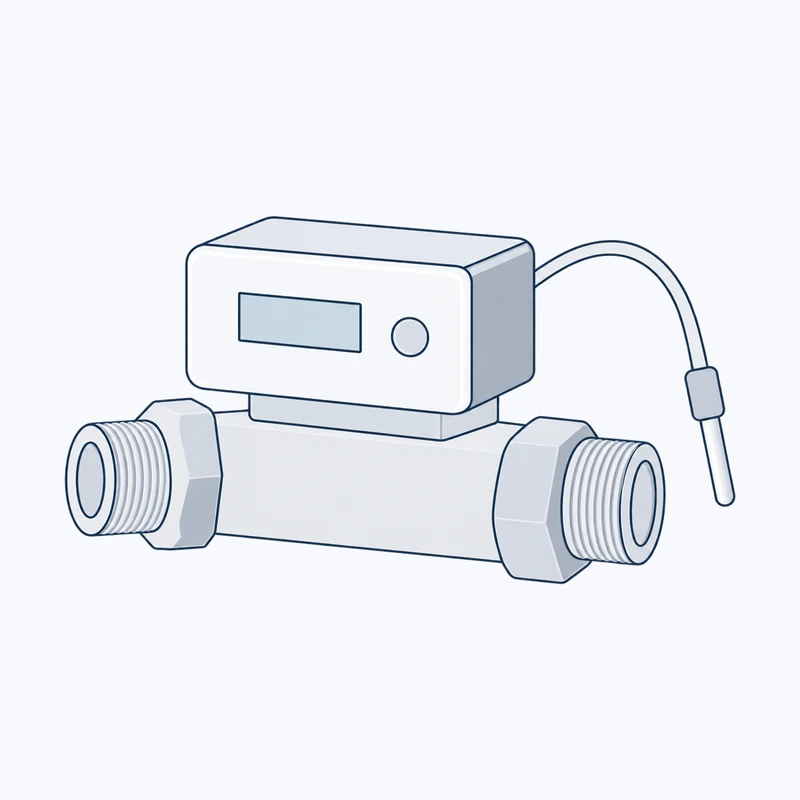
Our example home's readings might look like this (invented figures):
| Meter | At commissioning | 12 months on | Difference |
|---|---|---|---|
| Heat meter | 1,240 kWh | 9,315 kWh | 8,075 kWh |
| Heat pump electricity meter | 620 kWh | 3,504 kWh | 2,884 kWh |
SPF = 8,075 kWh ÷ 2,884 kWh = 2.80. That matches our central assumption and sits just above the trial's median.
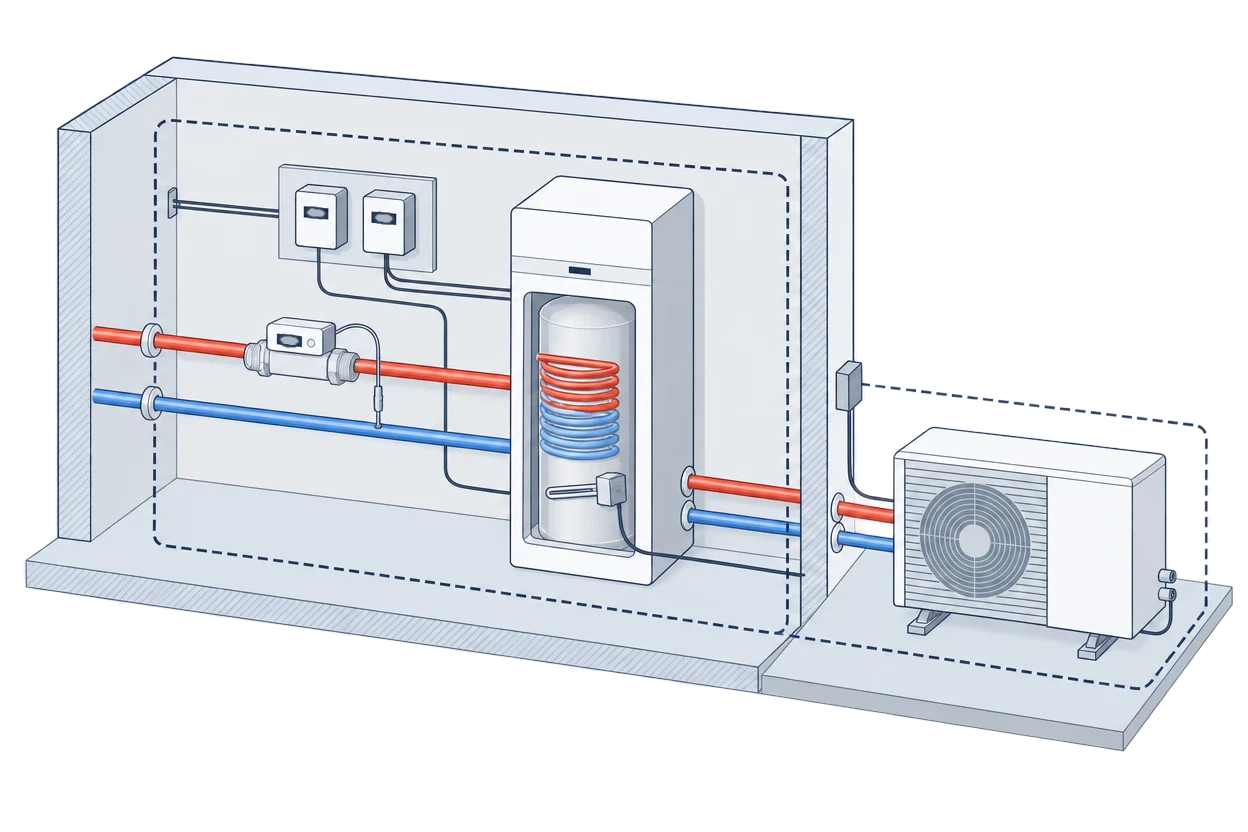
What the meters cover. Ask which loads the electricity meter you read actually covers. If the immersion heater runs on its own circuit and used, say, 150 kWh, its heat and electricity both join the sum, as in the trial's H3 boundary: (8,075 + 150) ÷ (2,884 + 150) = 8,225 ÷ 3,034 = 2.71 instead of 2.80.
A whole year. Single weeks mislead, because the COP moves with the weather. If the yearly figure is well below the design SCOP, ask your installer to check the flow temperature, weather compensation and backup heater settings.
Checklist: efficiency in the quote and after a year
From the design to the first year
- The design flow temperature and the installation's SCOP at it, in writing before work starts.
- A design flow temperature that matches what your radiators need on a cold day.
- For the Boiler Upgrade Scheme in England and Wales, a calculated SCOP of at least 2.8.
- Datasheet SCOPs compared at the same flow temperature, never a 35 °C figure against a 55 °C one.
- A heat meter and an electricity meter on the heat pump, and which loads each one covers.
- Meter readings noted at commissioning and again on the same date twelve months on.
Figures that change
| What | Value | Applies |
|---|---|---|
| Boiler Upgrade Scheme minimum SCOP | 2.8, calculated with MCS 026 | England and Wales; air-to-water and ground source |
| Electricity unit rate | 26.32p/kWh | price cap, GB average, direct debit, 1 October to 31 December 2026, no VAT in Great Britain until 31 March 2027 |
| Gas unit rate | 7.97p/kWh | price cap, GB average, direct debit, 1 October to 31 December 2026, 5% VAT included |
How we worked this out
Our example home (1970s gas semi in England, 97 m², 9,500 kWh of gas, 85% boiler efficiency as our assumption) uses the Electrification of Heat final report for field results and Mitsubishi Electric's UK Ecodan R290 datasheets as an example, not a recommendation; the meter readings are invented. More in our editorial method.
Frequently asked questions
What is a good SCOP for a heat pump?
On a datasheet, compare SCOPs at the flow temperature your design uses, not only the higher 35 °C rating. For the Boiler Upgrade Scheme in England and Wales, a calculated SCOP of at least 2.8 is required. Measured over a year in a home, the figure usually comes out lower than the design SCOP.
What is the difference between COP and SCOP?
COP is a snapshot: heat output divided by electricity input at one fixed outdoor and water temperature, such as A−7/W35. SCOP averages a standard heating season at a set flow temperature. Neither is measured in your home; that figure is the SPF from a year of meter readings.
Are heat pumps 300% efficient?
A datasheet COP of 3 is sometimes written as 300%, and that holds at the test point. Over a year in British homes the measured median was 2.78 (278%), counting backup heaters and pumps. Either way a heat pump delivers more heat than the electricity it uses, which no boiler can; what it costs to run depends on your electricity price too, as heat pump running costs shows.
Does a higher SCOP mean lower bills?
Not by itself. A higher SCOP shows a more efficient product under standard conditions, which helps when you compare models. In the government trial, design SCOPs were higher than the measured result in nearly every home, so the design, installation and settings matter as much as the rating, and your bill also depends on how much heat your home needs and your tariff.
How can I check my heat pump's efficiency?
Read the heat meter and the heat pump's electricity meter on the same date a year apart, then divide the heat difference by the electricity difference. Make sure both meters cover the same parts, including any immersion heater, and compare the result with the SCOP in your installer's design, expecting it to come out somewhat lower: most trial systems did.
Read next
Reading time: 13 min
How a heat pump works
The refrigerant cycle in four steps, where the heat comes from in an example 1970s semi, why cold air and hot radiators cost efficiency, how heat pumps cope with UK winters, defrosting and a winter checklist.
Read moreHow a heat pump works
Reading time: 14 min
Heat pump running costs
Heat pump running costs in our example 1970s semi: 2,884 kWh and £759 a year at SCOP 2.8, £850 at 2.5 and £686 at 3.1 (Ofgem price cap, 1 October to 31 December 2026), against £865 for gas including a £108 standing charge that ends only if the gas supply is disconnected, as we assume.
Read moreHeat pump running costs
Reading time: 15 min
Heat pump radiators
Radiator output at heat-pump temperatures with Stelrad's ΔT factors, MCS room-by-room sizing, two rooms of our example semi worked through, flow temperature and England's 55 °C design rule, weather compensation, balancing and a checklist.
Read moreHeat pump radiators
Reading time: 15 min
Heat pump sizing
Heat pump sizing explained: heat loss vs heat demand, MCS's room-by-room method (MIS 3005-D), design temperatures from Plymouth to Glasgow, a bill-based check on our example semi, backup heaters, hybrids and a checklist for the heat loss report.
Read moreHeat pump sizing
Reading time: 16 min
Heat pump grants
The Boiler Upgrade Scheme in full: amounts in England and Wales, the £9,000 for oil or LPG homes to 31 March 2027, who qualifies, the six steps from quote to voucher, Scotland and Northern Ireland, loans and 0% VAT to 31 March 2027.
Read moreHeat pump grants
Reading time: 15 min
Heat pump installers
How to choose an MCS-certified heat pump installer: checking certification and consumer-code membership, what a complete quote and design must show, warning signs, deposit protection under RECC and HIES, and cancellation rights.
Read moreHeat pump installers