How to choose an MCS heat pump installer and compare quotes
What to check before you sign with a heat pump installer: MCS certification and consumer code, the design figures you should get in writing, the grant line on the quote, deposits and your right to cancel, with two example quotes compared.
Choose a heat pump installer certified by MCS (the Microgeneration Certification Scheme) who surveys your home room by room and puts the design in writing: each room's heat loss, the design flow temperature and the system's SCOP, its seasonal heat output per unit of electricity. In England and Wales, if your home qualifies for the Boiler Upgrade Scheme, the installer applies for the grant and must show it as a deduction on an itemised quote. Compare quotes only once they cover the same work, and check what protects your money: RECC members may take at most 25% as a deposit, and a supply-and-install contract signed at home can be cancelled until 14 days after the equipment arrives.
At a glance
- Certification. The Boiler Upgrade Scheme (England and Wales) and Home Energy Scotland both require an MCS-certified installer; for the Boiler Upgrade Scheme it must also belong to an approved consumer code such as RECC or HIES.
- In writing. Under the MCS standard MIS 3005-D you get a performance estimate before you sign, and each room's heat loss, the design flow temperature and the SCOP before work starts.
- Grant first. In England and Wales your installer applies and the voucher should be issued before work starts; in Scotland you apply to Home Energy Scotland and wait for its written offer.
- Deposit. RECC members may take at most 25%; HIES protection covers up to 25%, capped at £5,000, for 120 days.
- Cancelling. Signed at home or online, a supply-and-install contract can be cancelled until 14 days after the equipment arrives.
What an MCS installer is and how to check one
MCS, the Microgeneration Certification Scheme, certifies and audits installation companies and certifies products. Its heat pump design standard, MIS 3005-D, has been mandatory at Issue 3.0 since 5 December 2025. The Boiler Upgrade Scheme in England and Wales and the Home Energy Scotland grant and loan both require an MCS-certified installer and product. For the Boiler Upgrade Scheme, Ofgem's guidance adds that installers working with consumers must belong to a consumer code approved by the Secretary of State, and names three: RECC (the Renewable Energy Consumer Code), HIES (the Home Insulation & Energy Systems Contractors Scheme) and MCS.
Check both certification and code membership before you ask for a quote. MCS's installer search finds a business by name or certification number, shows the technologies it is certified for and filters by Boiler Upgrade Scheme registration; RECC and HIES each run a member search. Outside the Boiler Upgrade Scheme, consumer-code membership isn't guaranteed, so ask which code applies and check it. Certification is a requirement, not proof that your job will be done well, so ask each installer:
- Similar homes. Can it put you in touch with a customer whose house is like yours?
- Who does the work. Under MIS 3005-D you must be told in writing, before you sign, of any subcontractor who will install the system. Ask who designs, fits and wires it.
- The survey. Ofgem's guidance expects a heat-loss assessment at your home before the quote.
- Notifications. The installer must say who notifies Building Regulations work, and must notify the electricity network operator.
Give every installer the same information: age and floor area, a year of gas or oil use, your radiators, photos of the boiler, cylinder space and the outside wall, and your Energy Performance Certificate, which MIS 3005-D uses for the performance estimate.
What a complete heat pump quote includes
For the Boiler Upgrade Scheme, Ofgem says the installer must give you a clear, itemised quote showing the total before the grant, the grant and what you pay after it. To compare quotes, you also need each part of the job described:
| Line | What it should say |
|---|---|
| Heat pump | make, model and output in kW, listed on the MCS website |
| Hot-water cylinder | size in litres, type and the datasheet |
| Radiators and pipes | which rooms get new or larger radiators; pipes to replace |
| Electrics | the heat pump's circuit, isolator and any consumer unit work |
| Base and drain | base or brackets for the outdoor unit, condensate drain |
| Controls | the controller, room thermostats and weather compensation |
| Old system | removing the boiler and, in an oil home, the tank |
| Handover and servicing | commissioning, the MCS certificate, your documents, warranty terms and any service plan |
| Grant and VAT | total before the grant, the grant and the balance; VAT at 0% on supply and installation until 31 March 2027 |
If a quote gives one lump sum, ask for it broken down into these lines. Watch for "excluded", "by others" and "client to supply": the price doesn't cover that item. Wiring "to the existing consumer unit, upgrades by others" leaves any upgrade to you, so ask who does each excluded item and at what cost. For the Boiler Upgrade Scheme, the old gas, oil or LPG heating must be fully replaced, not kept alongside the heat pump.
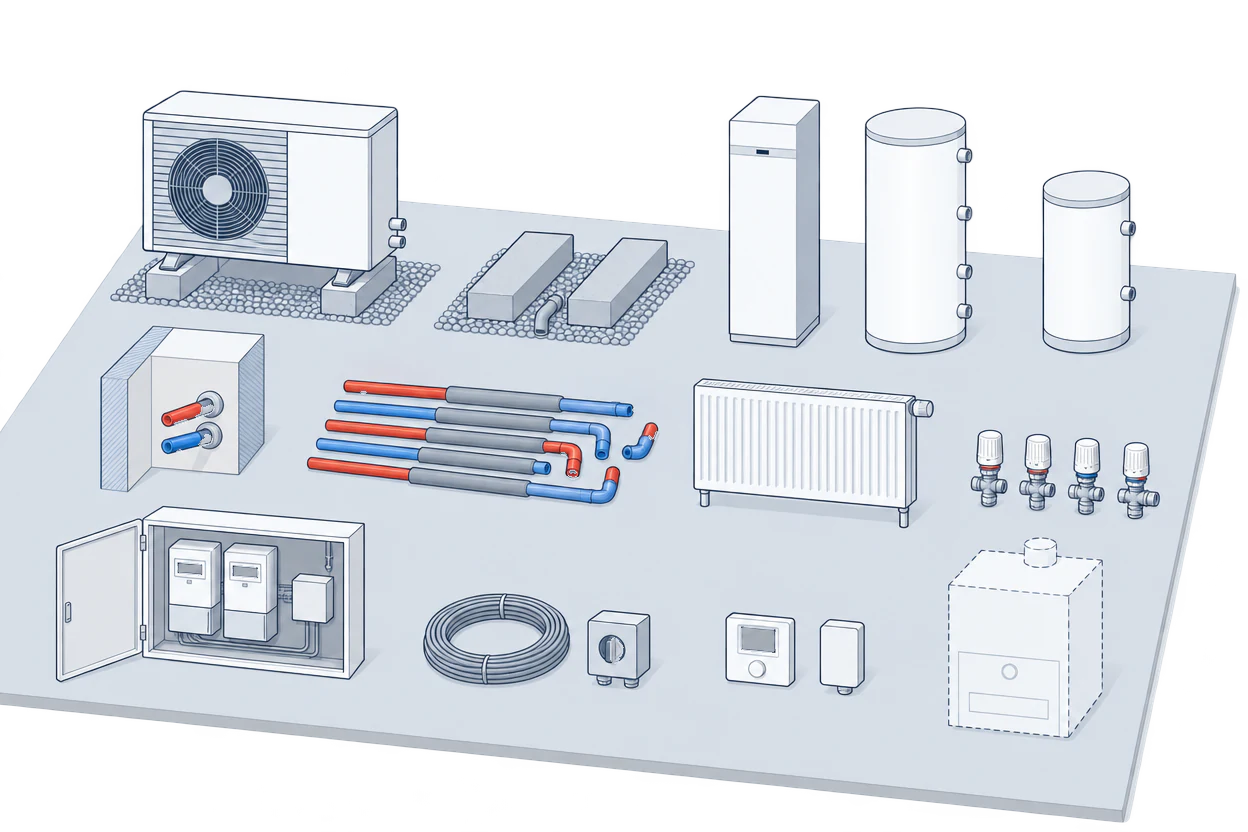
The Boiler Upgrade Scheme statistics give only a whole-job price: a median of £12,826, self-reported by MCS installers, for an air source heat pump installed in England and Wales in July to September 2026, before the grant (see heat pump cost). The job itself is in heat pump installation.
The design figures to get in writing
MIS 3005-D splits what an MCS installer gives you into two stages:
| When | You receive | Check |
|---|---|---|
| Before you sign | performance estimate on the MCS template, with MCS's Key Facts | the heat and electricity it assumes |
| Before you sign | datasheets for the heat pump and any new cylinder; any subcontractor | they match the quote |
| Before work starts | heat loss of each room in W/m²; radiators or underfloor heating to be used | every room is listed |
| Before work starts | daily hot-water demand, cylinder specification and recovery rate | the cylinder suits your household |
| Before work starts | design flow temperature, and the SCOP at it from the MCS website | at least 2.8 for the Boiler Upgrade Scheme (England and Wales) |
Heat loss and size. The heat loss is calculated room by room to BS EN 12831-1, and the heat pump must cover all of it at the design flow temperature without its back-up electric heater. A size worked out from floor area or the old boiler isn't that calculation; see heat pump sizing.
Flow temperature and SCOP. The design flow temperature is how hot the water leaving the heat pump must be on the coldest design day. The lower it is, the more efficiently the heat pump runs, so a SCOP means little without it: MCS's emitter guide estimates 2.8 for an air source heat pump designed for 51–55 °C and 3.1 for 46–50 °C. A design above 55 °C should come with an alternative at 55 °C or lower, and the difference explained.
The estimate is a guide. MCS's Key Facts call it guidance, not a guarantee. If the design or estimate changes after you sign, MIS 3005-D gives you an updated estimate, a contract variation and the chance to cancel without further cost. Where the outdoor unit relies on permitted development in England or Wales, ask for the MCS 020(a) noise calculation; the rules by nation are in heat pump planning permission.
Comparing two quotes: a worked example
Totals mean something only when two quotes deliver the same thing:
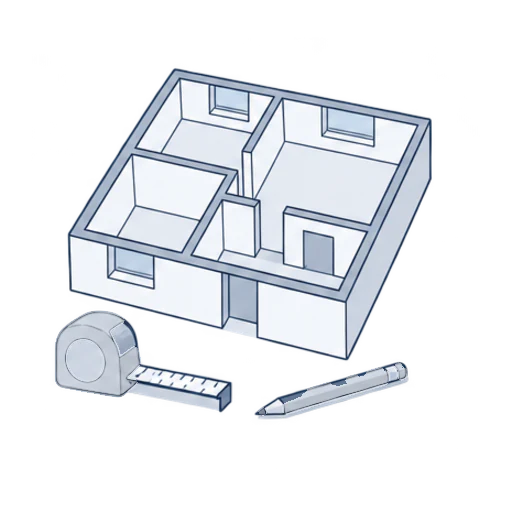 Same heat loss. Both quotes rest on a room-by-room calculation; if the sizes differ a lot, ask why.
 Same scope. Set the quote lines side by side, with the unit type (monobloc or split), refrigerant and sound power. Ask for a price for anything missing or marked "by others".
 Same terms. Consumer code, deposit and payment stages, workmanship guarantee and timetable.
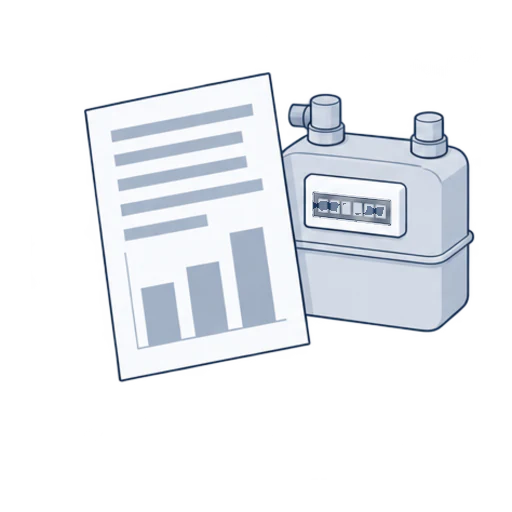 Electricity use. A higher SCOP lowers your electricity use every year; compare SCOPs only for the same heat loss, with their flow temperatures.
Our example home is a 1970s semi in England, 97 m², with radiators and a gas combi boiler using 9,500 kWh a year; we assume 85% boiler efficiency, so 9,500 × 0.85 = 8,075 kWh of heat for the heat pump to supply. Both quotes are made up to show the method; they are not market prices.
| Line | Quote A | Quote B |
|---|---|---|
| Total before the grant | £11,900 | £13,400 |
| Heat pump | 12 kW, sized from floor area | 8 kW, from a room-by-room survey |
| Hot-water cylinder | "by others" | included |
| Radiators | not mentioned | two larger radiators included |
| Design flow temperature | 55 °C | 50 °C |
| SCOP in the estimate | 2.8 | 3.1 |
| Grant line | not shown | £7,500 deducted |
| Deposit | 40% on signing | 15% on signing |
| Consumer code | not stated | RECC |
Step 2, the scope. Asked to include the cylinder and the same two radiators, installer A re-quotes at £13,950 (also made up). Quote A looked £1,500 cheaper and now costs £550 more: £13,950 − £13,400 = £550. If your home qualifies for the Boiler Upgrade Scheme in England and Wales, both drop by the same £7,500, so the gap stays. A must still show the grant line, explain 12 kW against 8 kW and name the code behind its 40% deposit; RECC's limit is 25%.
Step 4, electricity use. With the same 8,075 kWh of heat:
- Quote A: 8,075 kWh ÷ 2.8 = 2,884 kWh of electricity a year
- Quote B: 8,075 kWh ÷ 3.1 = 2,605 kWh of electricity a year
B's design uses 279 kWh less electricity a year (2,884 − 2,605), about 10% less, if both rest on the same heat loss; we treat hot water at the same SCOP for simplicity. Its value depends on your tariff, but a SCOP difference counts every year and a price difference once.
Warning signs in a heat pump quote
Each is a reason to ask before you sign, not proof of a bad quote:
| Warning sign | Why it matters | What to do |
|---|---|---|
| "Sign today for the discount" | RECC lists big discounts and pressure to sign on the spot as warning signs | take your time |
| Work before the voucher | Ofgem warns that applying after installation carries extra risk and no guarantee of payment; Scotland funds no work done before its written offer | start once the voucher or offer is issued |
| No grant line (England and Wales) | if your home qualifies for the Boiler Upgrade Scheme, the installer must deduct the grant upfront and not ask you for it | ask for it as a separate line |
| A low flow temperature with your existing radiators | MCS's estimate assumes 60 °C with existing radiators unless a room-by-room calculation justifies lower | ask to see the calculation |
| Deposit above 25% | RECC members can't take more, and HIES protects at most 25% | ask which code covers it |
| No cancellation information | for contracts signed at home or at a distance it is required; without it the period runs up to 12 months longer | ask for the form |
| "Your boiler must go by law" | there is no ban on keeping or repairing a gas boiler in an existing home | compare at your own pace |
Deposits, payments and protection
What happens to your money if the installer stops trading depends on its consumer code. Under the Boiler Upgrade Scheme the installer may not ask you for the grant amount; if Ofgem rejects the application or revokes the voucher, whether it can then charge you depends on your contract.
| RECC members | HIES members | |
|---|---|---|
| Deposit | for example 15%, never more than 25% of the estimated total | protected up to 25% of the contract value, capped at £5,000 |
| Advance payments | deposit plus advance at most 60%, the advance no earlier than 3 weeks before delivery | payments above the protected 25% aren't covered before completion |
| If the installer stops trading | another RECC member completes the contract at no extra cost | another installer finishes the job, or a refund may be possible under the policy |
| How long | until the contract is completed | 120 days from signing |
| Check | who insures your deposit | HIES's written confirmation; registration is expected within 7 days |
RECC members also give a written workmanship guarantee of at least two years, insurance-backed and transferable if you move. These rules bind members only. Prefer staged payments tied to delivery and commissioning, and keep the contract and every receipt.
Cancelling a heat pump contract
The Consumer Contracts Regulations 2013 let you cancel a contract signed at home or entirely at a distance without giving a reason. For goods plus work, such as supplying and installing a heat pump, the period ends 14 days after the equipment arrives (the last item, if it comes on different days); for a service-only contract, such as a survey on its own, 14 days after the contract is made.
Work may start within that period only at your express request, on paper or by email for a contract signed at home; if you then cancel, you pay a proportionate amount for the work done. Without the cancellation information, the period runs up to 12 months longer. A contract signed at the installer's premises usually falls outside these rules, but if a RECC member gives you the contract to sign and return in your own time, you get at least 14 days from signing.
In England and Wales, giving Ofgem your consent to the grant application isn't signing the installer's contract: deposit and cancellation terms stay between you and the installer.
Who may qualify and how the application works is in heat pump grants; for Scotland, see heat pump grants and loans in Scotland.
Checklist before you sign
Go through it for each quote; settle anything open in writing.
- Certification. The installer's MCS number checks out for heat pumps, the consumer code confirms membership, and the model is in MCS's product directory.
- Survey and size. Every room was measured, and the kW follows from the heat loss.
- Flow temperature and SCOP. Stated together; above 55 °C, with an alternative at 55 °C or lower.
- Scope. Every excluded item has a price and a name; cylinder, radiators and boiler removal are listed.
- Grant. In England and Wales a separate deduction, with work after the voucher; in Scotland, after Home Energy Scotland's written offer.
- Payments. Deposit and stages are dated, and you know who protects them.
- Cancellation. You have the information and the form.
Figures that change
| What | Value | Applies |
|---|---|---|
| MCS design standard | MIS 3005-D Issue 3.0 | mandatory from 5 December 2025 |
| Boiler Upgrade Scheme grant | £7,500 air source or ground source | England and Wales, if your home qualifies |
| Boiler Upgrade Scheme, off-gas homes | £9,000 where an air source or ground source heat pump replaces oil or LPG heating | England and Wales, if your home qualifies; applications until 31 March 2027 |
| Minimum SCOP for the grant | 2.8 | England and Wales, air source and ground source |
| Air source heat pump, installed | median £12,826 before the grant | Boiler Upgrade Scheme, July–September 2026, England and Wales |
| VAT on installed heat pumps | 0% on supply and installation | until 31 March 2027, then 5% |
| RECC deposit | at most 25%; deposit and advance at most 60% | RECC members |
| HIES deposit protection | up to 25% of the contract value, capped at £5,000, for 120 days | HIES members' registered contracts |
How we worked this out
Our example home (1970s gas semi in England, 97 m², 9,500 kWh of gas a year, 85% boiler efficiency as our assumption) is used to compare two made-up quotes, with SCOPs from MCS's emitter guide. Electricity is in kWh because its cost depends on your tariff; nothing here is legal advice. More in our editorial method.
Frequently asked questions
What is an MCS-certified installer?
An installation company certified by MCS, the Microgeneration Certification Scheme, to design and fit heat pumps to its standards, and audited by a certification body. In England and Wales the Boiler Upgrade Scheme only pays through MCS-certified installers, and Home Energy Scotland funding needs an MCS installer and product too. You can check a company by name or certification number in MCS's installer search.
How many quotes should I get for a heat pump?
Home Energy Scotland and RECC both suggest asking at least three installers. Each quote is only useful if it comes from a survey of your home and describes the same work, so give every installer the same information. Comparing two complete quotes tells you more than comparing several that leave different items out.
Can I use a heat pump installer who isn't MCS certified?
You can, but you would give up the Boiler Upgrade Scheme in England and Wales and Home Energy Scotland funding, which both require MCS certification. MCS certification also means the installer has to follow MIS 3005-D, including the written heat-loss and SCOP figures before work starts.
How much deposit should I pay for a heat pump installer?
If the installer belongs to RECC, no more than 25% of the estimated total, and RECC gives 15% as an example of a reasonable share. With an HIES member, the deposit protection covers up to 25% of the contract value, capped at £5,000, for 120 days from signing. Ask which code covers your money before you pay.
Is a very cheap heat pump quote a bad sign?
Not by itself. A total well below the others can mean something is left out or assumed: a cylinder or radiators "by others", or a heat pump sized from floor area rather than a room-by-room survey. Ask for each gap to be priced and for the heat-loss figures, then compare the totals again, as in our worked example.
How do I find a heat pump installer near me?
MCS's installer search lets you pick heat pumps, search near your address and filter by Boiler Upgrade Scheme registration; RECC and HIES run member searches too. Ask local installers for a survey, and choose on how clearly each one answers your questions about heat loss, flow temperature and the grant, not on the total alone.
Read next

Reading time: 16 min
Heat pump cost
Installed heat pump prices from the government's Boiler Upgrade Scheme statistics: the median and its range, prices by size and type, extras in older and combi homes, the grant by nation, 0% VAT to 31 March 2027 and a worked example.
Read moreHeat pump cost
Reading time: 16 min
Heat pump grants
The Boiler Upgrade Scheme in full: amounts in England and Wales, the £9,000 for oil or LPG homes to 31 March 2027, who qualifies, the six steps from quote to voucher, Scotland and Northern Ireland, loans and 0% VAT to 31 March 2027.
Read moreHeat pump grants
Reading time: 13 min
Heat pump grants in Scotland
The Home Energy Scotland Grant and Loan for heat pumps: the grant, the £1,500 rural and island uplift, the interest-free loan and its terms, who can apply, the six steps from advice to payment, a dated example and how it differs from the Boiler Upgrade Scheme.
Read moreHeat pump grants in Scotland
Reading time: 15 min
Heat pump sizing
Heat pump sizing explained: heat loss vs heat demand, MCS's room-by-room method (MIS 3005-D), design temperatures from Plymouth to Glasgow, a bill-based check on our example semi, backup heaters, hybrids and a checklist for the heat loss report.
Read moreHeat pump sizing
Reading time: 15 min
Heat pump planning permission
When an air source heat pump on a house needs planning permission in England, Wales, Scotland and Northern Ireland: a nation-by-nation table, the MCS 020(a) noise condition, one house checked against each nation's rules, listed buildings and conservation areas, Building Regulations and whether gas boilers are being banned.
Read moreHeat pump planning permission
Reading time: 15 min
Heat pump installation
The switch from a gas boiler to an air source heat pump in order: heat-loss survey, design in writing, Boiler Upgrade Scheme voucher or Home Energy Scotland offer, hot-water cylinder, outdoor unit placement with a worked example, electrics, building-control sign-off, commissioning and handover.
Read moreHeat pump installation