Do you need planning permission for a heat pump?
Usually not for a house: an air source heat pump is normally permitted development if it meets your nation's size, siting and noise conditions. Here are the rules for England, Wales, Scotland and Northern Ireland, the noise condition, listed buildings and whether gas boilers are being banned.
You usually don't need planning permission for a heat pump on a house: an air source heat pump is normally permitted development, which means planning permission granted by law, as long as it meets your nation's conditions. In England and Wales the main ones are one outdoor unit (two on a detached house) of up to 1.5 m³, none on a pitched roof, and an MCS 020(a) noise calculation showing 37 dB(A) or less outside every neighbouring window or door to a living room or bedroom that could be affected. Scotland and Northern Ireland allow one unit and set their own conditions. A listed building in England, Wales or Scotland always needs an application.
At a glance
- England. Since 29 May 2025: up to two units on a detached house and one on other houses, each up to 1.5 m³, with no minimum distance to the boundary; MCS 020(a) noise test.
- Wales. The same main limits since 1 June 2026.
- Scotland. One unit; a unit fixed to the house may stick out at most 1 m from the wall or roof and, in a conservation area, must be at ground floor on the rear wall; a free-standing unit may be up to 3 m high and not in front of a wall facing a road.
- Northern Ireland. One unit, not on a roof and at least 1 m from a neighbouring home's garden boundary.
- Gas boilers. No ban in England on keeping or repairing one in an existing home; England's new standards for new homes apply from 24 March 2027.
Do you need planning permission for an air source heat pump?
Each nation's General Permitted Development Order has its own class for air source heat pumps on houses: Class G in England, Wales and Northern Ireland, Class 6H in Scotland. Meet every limit and you don't need to apply for anything. Miss one and you need planning permission from your local planning authority before the unit goes in.
Two things can remove the right even where the unit fits every limit: an Article 4 direction, which lets a council withdraw permitted development rights in a defined area, and a condition on the planning permission for your house. Neither bans a heat pump; the work then needs a planning application. In England you can apply for a lawful development certificate, a legally binding decision on whether the work is lawful.
- Your nation. Find your column in the table below.
- Listed building. If the house is listed, permitted development doesn't apply in England, Wales or Scotland: ask your council about planning permission and listed building consent.
- Protected area. In a conservation area the siting rules are tighter; in England and Northern Ireland the same applies in a World Heritage Site, and in Scotland a World Heritage Site rules out permitted development. Ask whether an Article 4 direction or a planning condition covers your house.
- Size and position. Count the units, check the unit's size, and check the roof and road-facing limits for your nation in the table.
- Noise. Your MCS installer runs the noise calculation for each neighbouring window or door that could be affected.
- Decision. All passed: permitted development. One missed: a different spot, a quieter unit or a planning application. If in doubt, check with your local planning authority.
Heat pump planning rules by nation
The permitted development rules for an air source heat pump on a house, side by side (ground source: see the FAQ).
| Rule | England | Wales | Scotland | Northern Ireland |
|---|---|---|---|---|
| Rules in force since | 29 May 2025 | 1 June 2026 | 24 May 2024 (as amended) | 4 July 2023 |
| Number of units | 2 on a detached house, 1 otherwise | 2 on a detached house, 1 otherwise | 1 | 1 |
| Unit sizeEngland and Wales limit the volume of the outdoor compressor unit, housing included; Scotland limits how far a unit fixed to the house protrudes and how tall a free-standing unit is; Northern Ireland limits its height | up to 1.5 m³ | up to 1.5 m³ | fixed to the house: up to 1 m out from the wall or roof; free-standing: up to 3 m high | up to 3 m high |
| Distance to boundary | no rule | no rule | no rule | at least 1 m from a neighbouring home's garden boundary |
| Roof | not on a pitched roof; on a flat roof at least 1 m from the edge | as England | within the 1 m protrusion limit | never on a roof |
| Road-facing walls | not above ground floor on a wall facing a road | as England | free-standing: not in front of a wall facing a road | not in front of a wall facing a road |
| Conservation area | not on a wall or roof facing a road, nor nearer the road than the house | as England | fixed to the house: only at ground floor on the rear wall | not facing onto and visible from a road |
| Listed building | no permitted development | no permitted development | no permitted development | only once listed building consent has been granted |
| Noise standard | MCS 020(a), Issue 1.1 | MCS 020(a), Issue 1.1 | MCS 020, Issue 1.3, or equivalent | MCS 020, Issue 1.3, or equivalent |
No nation covers a unit used only for cooling, and every nation requires the unit to be removed once it's no longer needed.
England changed its rules on 29 May 2025. The amending order removed the rule that no part of the heat pump could be within 1 metre of the boundary, raised the size limit for a house's outdoor unit from 0.6 m³ to 1.5 m³, and allowed two units on a detached house, meaning one that shares no party wall. It also dropped "or equivalent standards", so only MCS 020(a) counts. Semi-detached and terraced houses still get one unit.
Wales followed on 1 June 2026. Its order dropped the old rule keeping the unit at least 3 metres from the boundary, raised the size limit for a house from 1 m³ to 1.5 m³, allowed two units on a detached house, allowed a unit at ground floor on a road-facing wall outside a conservation area, and named MCS 020(a), Issue 1.1, without "or equivalent standards".
Scotland and Northern Ireland have their own orders, which these changes don't touch: one unit each, both citing the older MCS 020, Issue 1.3, and Northern Ireland keeping its 1 metre rule for the boundary with another house's garden. Where your case doesn't fit the table neatly, check with your local planning authority.
The noise condition: MCS 020(a) and 37 dB(A)
In England and Wales the unit must comply with MCS 020(a), Issue 1.1, the MCS sound calculation for permitted development installations. Your MCS installer works out the level at each neighbouring window or door of a habitable room, a room used for living or sleeping, and must give you a copy of the completed table for each position. If every position comes out at 37.0 dB(A) or less, the noise condition is met; if any is above, the unit isn't permitted development at that spot.
Scotland's order refers to MCS 020, Issue 1.3, and Northern Ireland's to MCS 020 with the same issue, each "or equivalent standards". Passing the noise calculation doesn't make a unit permitted development on its own: every other condition in the table has to be met as well. How the sum works, with a worked example and ways to bring the level down, is in how loud is a heat pump. If a result is close to the limit, check with your local planning authority before the unit goes in.
Worked example: our example home in each nation
Our example home is a 1970s semi-detached house, 97 m², with a gas combi boiler, neither listed nor in a conservation area; the garden layout is our illustration. The installer plans a Mitsubishi Electric Ecodan R290; the 5 kW and 8 kW models share one casing, 1,050 mm wide, 480 mm deep and 1,020 mm high on their UK datasheets. It stands on the ground against the side wall, which doesn't face a road, in a narrower side passage than many homes have: the unit's nearest edge is 0.6 m from the fence with next door's garden. The same house and spot, checked against each nation's rules:
| Check | England and Wales | Scotland | Northern Ireland |
|---|---|---|---|
| Number of units | 1 on a semi (limit 1): passes | 1 (limit 1): passes | 1 (limit 1): passes |
| Unit size | 1.05 × 0.48 × 1.02 = 0.51 m³ (limit 1.5 m³): passes | 0.48 m deep, 1.02 m high (limits 1 m out, 3 m high): passes | 1.02 m high (limit 3 m): passes |
| Position | ground floor, wall not facing a road: passes | not in front of a wall facing a road: passes | not on a roof, not in front of a road-facing wall: passes |
| Boundary | no rule | no rule | 0.6 m (needs at least 1 m): fails |
| Noise | MCS 020(a), 37.0 dB(A) at each neighbouring window or door | MCS 020 or equivalent | MCS 020 or equivalent |
What the result means: in England, Wales and Scotland this unit is permitted development if the installer's noise calculation passes. In Northern Ireland it isn't at this spot: the unit has to move at least 1.0 − 0.6 = 0.4 m further from the fence, or you apply for planning permission. Moving it changes its distance to the neighbours' windows, so the noise calculation is run again for the new spot. Planning isn't the only test, either: the Ecodan R290 runs on propane, and its service manual sets a protective zone 1 m around the unit that must not reach a property boundary, so in any nation this model needs at least 1 m to the fence here. More placement checks are in heat pump installation. With a borderline case, check with your local planning authority before work starts.
Listed buildings and conservation areas
Listed buildings. In England, Wales and Scotland an air source heat pump on a listed house or within its grounds is never permitted development, so you apply for planning permission. In England you also need listed building consent for works that would affect the building's character as a building of special architectural or historic interest; elsewhere, ask your council which consent applies. Listing restricts, it doesn't forbid: a unit out of sight at the back is a different case from one on the front. In Northern Ireland the heat pump becomes permitted development once listed building consent has been granted.
Conservation areas. Permitted development still applies, with the tighter siting shown in the table. England and Northern Ireland apply the same rules in World Heritage Sites, and Scotland excludes them; Wales's rules don't mention them.
Flats and leasehold homes bring their own permissions and are outside this guide. Whatever your home, check with your local planning authority before you agree where the unit goes.
Building Regulations: a separate sign-off
Planning decides where the unit may stand; Building Regulations cover how the work is done. In England, installing or replacing a heating system may need building regulations approval, which you don't arrange yourself if your installer is registered with a competent person scheme. MCS's installation standard says the installer must complete any notification they are responsible for before handover. An unvented hot-water cylinder is notifiable building work in England in its own right. Wales, Scotland and Northern Ireland have their own building regulations or standards; ask your installer what applies. The order of work is in heat pump installation.
Is there a ban on gas boilers? The Future Homes Standard explained
No. In England there is no ban on keeping or repairing a gas boiler in an existing home, and Scotland's rule covers new buildings only. The government's Heat and Buildings Strategy (2021) put it plainly: "No-one will be forced to remove their existing boilers." It set an ambition to phase out new gas boiler installations from 2035; an ambition is not a law. In England, Approved Document L, the current Building Regulations guidance, sets a 92% minimum efficiency for a gas boiler on a wet heating system in an existing home; updated guidance takes effect on 24 March 2027.
The main rule changes concern new buildings:
- England. The Building Regulations etc. (Amendment) (England) Regulations 2026 and updated Approved Documents L and F, published as the Future Homes and Buildings Standards (often called the Future Homes Standard), come into force on 24 March 2027. They set the energy and heating requirements for new homes in England. Work notified before 24 March 2027 that starts before 24 March 2028 stays under the old rules.
- Scotland. Since 1 April 2024 a new building's heating, cooling and hot water may not come from a direct emission heating system, one that burns fuel on site with more than negligible greenhouse gas emissions, such as a gas or oil boiler. Alterations and extensions to older buildings are exempt.
Neither rule asks you to change the heating in the house you live in.
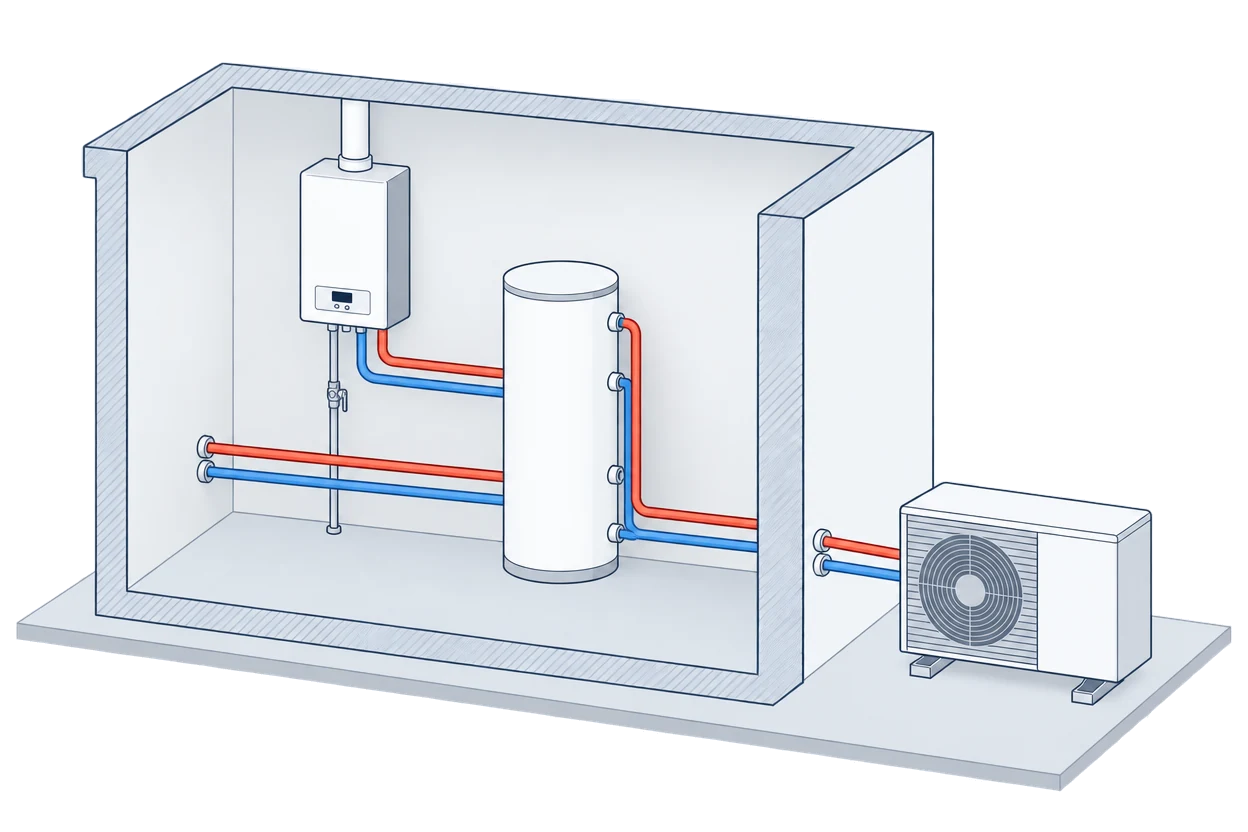
How that works, and what it means for grants, is in hybrid heat pumps.
Checklist: before the outdoor unit goes in
- Status. Check whether your house is listed or in a conservation area or World Heritage Site.
- Your rights. Ask the council whether an Article 4 direction or a planning condition on your house removes permitted development rights.
- Noise table. Ask for the completed MCS 020(a) table for every assessment position, with the unit's sound power and its source.
- Spot on the plan. Get the unit's position and model in the quote, so a change on the day doesn't undo the calculation.
- Northern Ireland. Measure the gap to next door's garden boundary: it must be at least 1 m.
- Certainty. In England, consider a lawful development certificate if the case is borderline.
- Paperwork. Keep the noise table and any building regulations certificate for when you sell.
What else to ask a firm before you sign is in how to choose a heat pump installer.
Figures that change
| What | Value | Applies |
|---|---|---|
| England permitted development (Class G) | 2 units on a detached house, 1 otherwise; 1.5 m³; MCS 020(a) Issue 1.1 | since 29 May 2025 |
| Wales permitted development (Class G) | 2 units on a detached house, 1 otherwise; 1.5 m³; MCS 020(a) Issue 1.1 | since 1 June 2026 |
| Scotland permitted development (Class 6H) | 1 unit; 1 m protrusion; MCS 020 Issue 1.3 or equivalent | as amended from 24 May 2024 |
| Northern Ireland permitted development (Class G) | 1 unit; at least 1 m from a neighbouring garden boundary; 3 m high; MCS 020 Issue 1.3 or equivalent | since 4 July 2023 |
| MCS 020(a) noise limit | 37.0 dB(A) at each assessment position | Issue 1.1, England and Wales |
| Future Homes and Buildings Standards | Building Regulations changes and updated Approved Documents L and F, England | from 24 March 2027 (notified earlier and started before 24 March 2028: old rules) |
How we worked this out
The nation rules come from each nation's permitted development order, MCS 020(a) and the Building Regulations texts. The example uses our example home (1970s semi, 97 m²) with a garden layout we made up and Mitsubishi Electric's UK datasheets for the unit's size; it is not a planning decision for your home. More in our editorial method.
Frequently asked questions
What changed in the heat pump planning rules?
In England, from 29 May 2025, the 1 metre boundary rule went, detached houses can have two units, the size limit rose to 1.5 m³ per unit, and only the MCS 020(a) noise calculation counts. Wales made similar changes from 1 June 2026: its old 3 metre boundary rule went, the limit rose from 1 m³ to 1.5 m³, and detached houses can have two units. Scotland and Northern Ireland have their own orders, which these changes don't touch.
How close to my boundary can a heat pump be?
In England and Wales there is no minimum distance to the boundary: England removed its 1 metre rule on 29 May 2025 and Wales its 3 metre rule on 1 June 2026, and the MCS 020(a) result at the neighbours' windows and doors is what limits you. Scotland has no boundary rule either. In Northern Ireland no part of the unit may be within 1 metre of the boundary of another home's garden. A propane unit also needs its own clear zone: see heat pump installation.
Do I need planning permission for a heat pump in Scotland?
Not usually, for one air source heat pump on a house that meets Class 6H: a unit fixed to the house no more than 1 m out from the wall or roof, a free-standing unit no taller than 3 m and not in front of a wall facing a road, and the MCS noise standard met. A second unit, a listed building or a World Heritage Site needs an application. In a conservation area a unit fixed to the house must be at ground floor on the rear wall.
Can I put a heat pump at the front of my house?
Sometimes. In England and Wales a ground-floor unit on a road-facing wall can be permitted development outside a conservation area (in England, also outside a World Heritage Site), but not above ground floor, and not on a wall facing a road in a conservation area or, in England, a World Heritage Site. Scotland and Northern Ireland don't allow a free-standing unit in front of a wall facing a road. Check with your local planning authority before you settle on the front.
Do I have to replace my gas boiler with a heat pump?
Not in England: you can keep, repair and replace a gas boiler in an existing home, and Approved Document L sets a 92% minimum efficiency for a new gas boiler on a wet heating system. In Scotland the 2024 rule against direct emission heating covers new buildings only. A heat pump is your choice; the rules that are changing are for new homes.
Is a ground source heat pump permitted development?
Yes, each nation has a permitted development class for it, and Northern Ireland adds limits near the boundary: no part within 3 m of it and over 4 m high. The classes, boreholes and trenches are in ground source heat pumps.
Read next
Reading time: 15 min
Heat pump noise
Heat pump noise explained: sound power and sound pressure, how distance, walls and fences change the level, the MCS 020(a) test for permitted development in England and Wales with a worked example on a UK datasheet, placement, what reduces noise and how to handle complaints.
Read moreHeat pump noise
Reading time: 15 min
Heat pump installation
The switch from a gas boiler to an air source heat pump in order: heat-loss survey, design in writing, Boiler Upgrade Scheme voucher or Home Energy Scotland offer, hot-water cylinder, outdoor unit placement with a worked example, electrics, building-control sign-off, commissioning and handover.
Read moreHeat pump installation
Reading time: 15 min
Heat pump installers
How to choose an MCS-certified heat pump installer: checking certification and consumer-code membership, what a complete quote and design must show, warning signs, deposit protection under RECC and HIES, and cancellation rights.
Read moreHeat pump installers
Reading time: 15 min
Hybrid heat pumps
Hybrid heat pumps explained: the MCS definition and 55% sizing rule, how the controller switches by temperature or price, hot water, no Boiler Upgrade Scheme or Home Energy Scotland funding, costs per kWh of heat in our example semi, and a quote checklist.
Read moreHybrid heat pumps
Reading time: 15 min
Ground source heat pump
Boreholes, trenches and open loops compared, the MCS arithmetic for how much ground you need, efficiency against air source, installed prices from the Boiler Upgrade Scheme statistics, planning rules by nation, England's water and drilling rules, and a worked example.
Read moreGround source heat pump